
A Marvel of Engineering – The 1973 F3A Model "Salamandre"
Bruno Giezendanner, the reigning RC1 world champion, had traveled to Gorizia, Italy, for the World Championships. What he unveiled sent his competitors and officials into a frenzy. The Salamandre could swing its wings in flight. A sensation. But is that even allowed under the rules?
This previously unknown, purely mechanical feature of the swivel wing thus caused quite a stir. After some back-and-forth and a meticulous review of the rules, Bruno was ultimately allowed to compete. The model, however, was extremely tricky to fly; transmitters at the time had no mixers, which would have been desperately needed. Due to the extreme change in wing geometry, a center-of-gravity shift of no less than 18 centimeters had to be compensated for with trim. An impossible task. When the wing was in the center position, everything was fine because the center of gravity was correct there. If the sweep was completely removed—that is, if the wing was moved all the way forward—
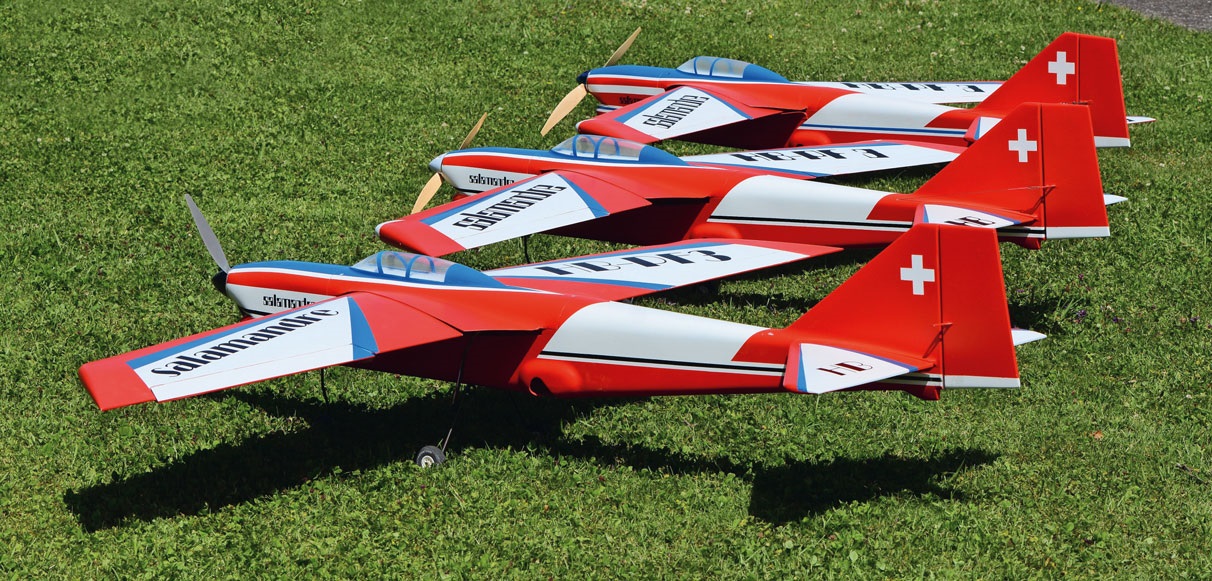
The RC1 racer was hopelessly tail-heavy; conversely, it was significantly nose-heavy. The Giezendanner brothers, striving to compensate for this, had mounted the two aileron servos (a first in 1973) in the wing tips to counteract these conditions. To truly compensate for this, a ballast weight would have been an effective solution—but they didn’t have one in 1973. Bruno was therefore more preoccupied with finding the right trim setting than with executing the individual maneuvers cleanly. And so it came to pass that he returned home with a thoroughly unsatisfactory 28th-place finish. Nevertheless, this model was—and remains—a technical sensation.
Why would anyone even think of building a swivel wing? Starting in 1973, new roll maneuvers were introduced; scored roll maneuvers are easier to fly cleanly at higher speeds. This is less necessary for circular flight maneuvers, which is why brothers Bruno and Emil Giezendanner came up with the swivel-wing concept—which remains unique in model aerobatics to this day.
Mario Waldmeier, who at the time was Bruno’s mechanic and announcer, has some incredible stories to tell. For example, the two of them developed an extensive catalog of commands during countless setup and test flights. The announcer
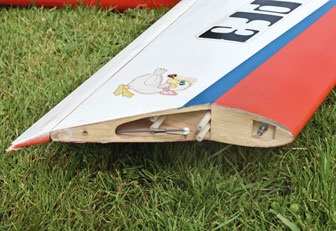
That was more than half the battle. Several markings were affixed to the transmitter’s elevator trim. Depending on which command (for example, trim three) came from the announcer—who actually had to constantly give the poor pilot instructions—the pilot would move the trim lever to the corresponding marking. Mario says that eight weeks before the World Championships, they no longer had time to work—training had been too time-consuming. After all, they had to defend their title.
There's no doubt about it—it's a one-of-a-kind undertaking. Because aside from the rather complex
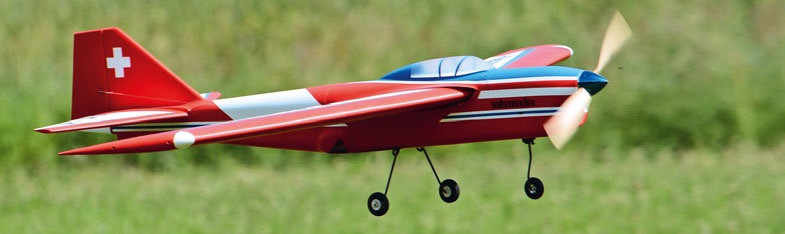
The swivel mechanism required that the aircraft be designed as a high-wing design (which is definitely due to the swivel wing) after all three landing gear units were installed in the fuselage. The landing gear retracts rearward. However, in 1973, wooden fuselages were common, and space would have run out quickly, which is why the Giezendanner brothers built a master model, made a mold of it, and laminated two fiberglass-reinforced polyester fuselages. Yes, there were only these two prototypes because the concept didn’t work out at the time. The Salamandre gave rise to the much more successful Scorpion, with a one-piece, fixed wing.
Now, of course, one might rightly ask: Where did these three airworthy models of this type suddenly come from? Emil took the trouble to create a new prototype of the fuselage—but slightly wider than the original design so he could install the in-house-built electric retractable landing gear. The prototypes were equipped with mechanical landing gear, actuated by servos. That, too, is another innovation!
The new fuselages are also constructed using sandwich construction and feature CFRP reinforcements. All of this was already familiar in the
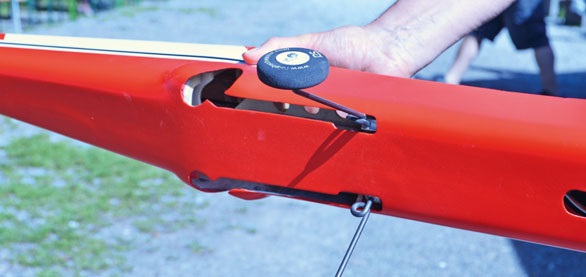
not in the 1970s. For that reason, the adjustment mechanism was made entirely of aluminum; the modern replica is partly made of carbon fiber and CNC-machined. The wings and tail surfaces are manufactured conventionally, but the models are fully painted.
Mathias Bosshard, a world-class F3A pilot, had the dubious pleasure of once again test-flying the prototype that Emil had completely restored and repainted (albeit with a new fuselage—the old polyester one had deteriorated over the years)—
An entire team was involved in the project:
Swivel Mechanism Design: Wolfgang Schütz
Swivel Mechanism Construction: Wolfgang Schütz, Fritz Oberli
Swivel Electronics: Walter Prantl
Retractable Landing Gear: Mario Waldmeier
Wings: Bruno Giezendanner
Wooden Fuselage (Prototype and Master Model): Emil Giezendanner
Plastic fuselage: Schaub Brothers
In 1973, the MG Pfäffikon did not have an airfield at its disposal. Thanks to friendly relations, Bruno was allowed to train at the MG Diessenhofen in Truttikon (I remember this with great gratitude). The highway construction site in the Linth Plain also served as an occasional training area.
GZ
fen. He said: “must” is more accurate. And Mathias continued: “I’ve never been as scared before a maiden flight as I was with this one.” That pretty much says it all. On the other hand, however, the expected erratic flight behavior was well known. With that in mind, the launch and the first flybys were performed with the sweep set to the middle position. This went smoothly, especially since the provided electric power—a 5s setup—is vastly superior to the original two-stroke engine of the past, a Webra Speed with a pot damper. The
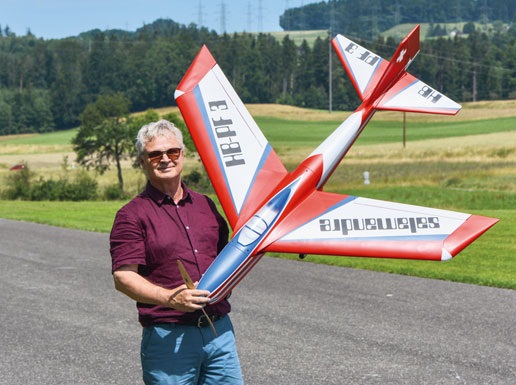
Pivoting the wings backward results in the expected nose-heavy condition, along with the equally expected higher speed. Removing the dihedral—that is, pivoting the wing all the way forward—makes the Salamandre virtually unflyable. It immediately rears up. However, the modern transmitter now in use provides the necessary mixing capabilities. Thus, when the wing is swept backward, an elevator mixer is engaged, which counteracts the nose-heavy condition. Conversely,
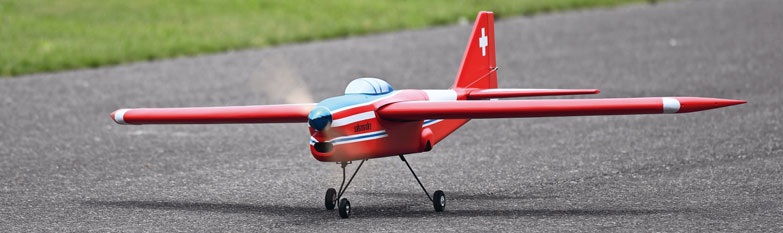
In this case, the pendulum rudder drops significantly. While this makes the swing-wing aircraft airworthy again, it doesn’t make it fly particularly well. Which brings us back to the operating weight mentioned at the beginning. Of course, something like that isn’t necessary in the age of electric power. Instead of the five-cell battery, Mathias will use one with three cells and one with two. Connected in series. The heavier three-cell battery will be mounted at the front on a sled that moves in sync with the wing adjustment, hopefully ensuring the correct center of gravity at all times. So things are still exciting for the Salamandre, which has been so quiet for 48 years.


News from HEBU

TEAM MANAGER "THIS" BOSSHARD
 Rodito Nussbaumer

SUMMER FUN 2026 AT MG USTER
Martin Wunderli
SMALL, MODEL-LIKE SAILBOATS
Res Dauwalder
TRY-OUT DAY AT MFV WETTINGEN
Urs Keller
What's New at Leomotion.com

52. 2026 ALPS CUP
 Emil Giezendanner

BY YOUTH, FOR YOUTH
Lorena Betschen
ATOM, THE NEW DOUBLE-DECKER FROM CPLR
 Matthias Bosshard

INSIGHTS INTO THE HISTORY OF SEAPLANES

YOU KNOW WHAT I MEAN? 125 YEARS OF THE SWISS AERO CLUB
Emil Giezendanner
34th HAHNENMOOS ALPINE MODEL AIRPLANE CAMP
Res Dauwalder
CORSAIR F4U – A WARBIRD WITH A MEMORABLE LOOK
Jürgen Rosenberger, Jürgen Prinz
F3A EUROPEAN CHAMPIONSHIPS IN ST-MACAIRE, FRANCE
Matthias Bosshard
HORIZON HOBBY/LEMACO NEWS: MICRO OV-10 BRONCO 645 MM BY E-FLITE

PRIDE AND GOOD IDEAS
 Markus Nussbaumer

EURO CONTEST GLIDER ACRO TOUR AUSTRIA 2026

FREE FLIGHT IN THE MIDDLE OF SUMMER
Urs Muntwyler
THE PC-21 STORY
Emil Giezendanner
TWIN TOWN PARTNERSHIP
Wolfgang Voeller
WELCOME, NEW MEMBER!
Andrea Bolliger
COUPE DES ALPES – OBSERVE AND LEARN
Rodito Nussbaumer
NEWS FROM HEBU
 Julia Bucher

FROM 0 TO 100
Markus Nussbaumer
MEMORIES
Wolfgang Völler
NOS REGION – A HUB FOR ELECTRIC AVIATION
Emil Giezendanner
Have you almost forgotten about aircraft that take off and land vertically?
Emil Giezendanner
70 YEARS OF THE NIDWALDEN MODEL AIRPLANE CLUB
Martin Barmettler