
1973 World Free Flight Championships
The World Championship, which this year featured 34 nations from all corners of the globe, is held every two years. In almost all of these countries, qualifying rounds are held beforehand. In Hungary, for example, 43 competitors entered the F1C category (internal combustion engine models). Switzerland fielded three competitors, so a minimum performance standard of 150" per flight was set. Switzerland was well prepared in terms of organization. The Austrian Aeroclub also took the organization seriously. It’s no coincidence that this World Championship was held in Vienna-Neustadt for the third time. Incidentally, the site for this sport was enough to make anyone green with envy—4 km² of perfectly flat terrain. The weather over the three days: warm—warmer—hottest.
In addition to its 9 competitors, Switzerland also provided 12 timekeepers.
On Tuesday, the model inspection was conducted in the hangar at the airfield. Three models were permitted.
Beautiful weather, 30°C, wind speed 0–2 meters per second.
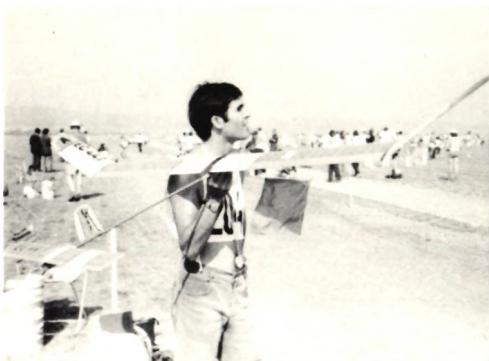
The competition was held at 24 launch sites. Each team had 1 hour per round to complete their flights. Individual competitors were grouped into teams of three to ensure fairness. Various types of thermal indicators were set up. The simplest ones consisted of a 4-meter-long bamboo tube. Attached to the top was a loop of tin foil 2 cm wide and approximately 5–6 meters long. The various movements of this loop allowed for the precise determination of wind speed and direction.
The “soap bubble machines” in various designs. A container with a capacity of approximately 2 dl for the soapy water was mounted on a three-meter-long pole. A ring was dipped into the solution via a rod, and the soap bubbles were then produced using an air pump. It could be operated manually or with an automatic interval timer.
Electronic thermal sensors. A box was equipped with an antenna approximately 2 m long; at the top was a copper wire serving as the sensor. This wire was encased in approximately 1 dm³ of Styrofoam, with holes of Ø5 mm all around it. This is necessary so that the sensor detects only temperature differences and not frictional heat. The temperature was transmitted to a potentiometer and read on a scale. These devices are not available for purchase; they are all homemade.
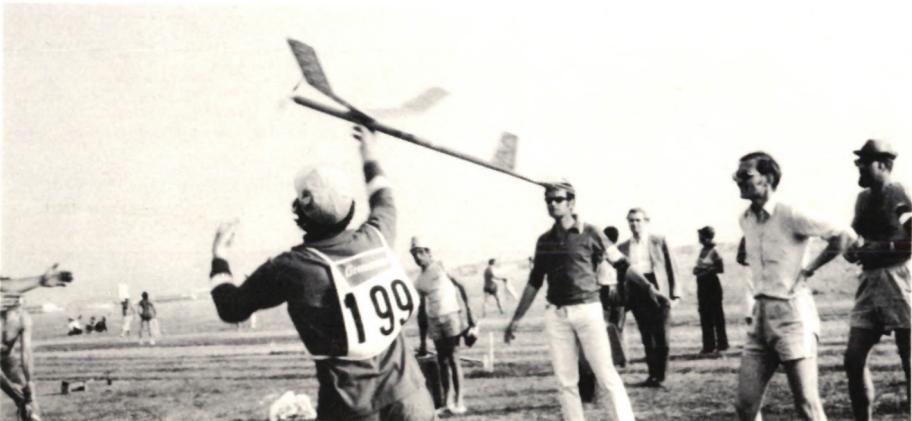
Test flights during the competition were prohibited. For each flight, the fuel (standard mixture) was dispensed by the timekeeper. All models were equipped with differential control. The Rossi 15 was the most commonly used engine.
Also worth mentioning is the folding wing by Koster from Denmark: During the climb, the underside of the wing is straight; subsequently, it changes by 3° from the main spar toward the rear.
Koster finished in 6th place with this design. There were also models made entirely of polyester. They were very wear-resistant and did not exceed the prescribed weight of 750 grams. This design would be a good choice for a beginner’s model. Engine run times were not set to the absolute maximum. They were mostly between 8.5–9.5", with average altitudes around 100 m.
World Champion Horcicka of Austria achieved 137" in the third run-off with the prescribed engine runtime of 4 seconds, without thermals. This illustrates the high performance levels. The average age was highest here.
On Peter Maurer’s model, the engine did not shut off after entering the turn—a total failure. The same happened with the second model. A bitter disappointment after the victory in Munich. Hans Schoder’s hand got caught in the propeller during his fourth launch and he had to receive outpatient treatment at the hospital. Urs Schaller recorded the most consistent flights and, with a time of 1,117" (1,260 maximum), placed 52nd out of 65 competitors.
Weather conditions: sunny to partly cloudy, temperature 32°, wind speed 0–2 m/sec. A wide variety of models were on display in this category (rubber-powered models). Wingspan 110–160 cm. An aluminum tube with a diameter of 30 x 0.3 was used for the fuselage. The Finns flew models with fiberglass fuselages—total length 1 mm, wall thickness 43–46 grams. Propeller material: glued balsa, balsa reinforced with plywood at the root; or cut from wood with very thin growth rings, Ø 50–60 cm. A surprisingly large number of competitors were still flying without a timer or differential control. 14–16 strands of rubber. Launch speed: 320–350 revolutions. Models were usually launched without the propeller attached to prevent the rubber band from causing damage. Regarding tactical use, the following can be said: With the model launched and ready to fly, wait—and wait some more. The rubber’s power lasts 20 minutes (determined by measurements). If a model found itself in a thermal tube, a murmur would ripple through the entire launch line, and suddenly 25 models would soar toward a safe maximum altitude. Reaching 400 m in 3 minutes was not uncommon. Even competitors who reached only 50 m in altitude with 30" of motor runtime flew to their maximum using this method. So it was no surprise that none of the 12 finalists flew a so-called “super model.” None reached the final round maximum of 4 minutes.
Joachim Löffler of the GDR (1963 Vienna-Neustadt) became world champion for the second time.
Dieter Siebenmann lost 19" in the third round due to a pump glide with his latest model. He finished 15th out of 86 competitors. Dieter would certainly have had a good chance at first place in the tiebreaker. Urs Schaller lost 11" in the first flight.
At that moment, the competitive spirit waned a bit, as everyone knew that at least 10 people would advance to the tiebreaker in this category as well. With a time of 1172", he finished in 34th place, tied with the former world champion Klima from Czechoslovakia. Walter Eggimann achieved the maximum score in the first five rounds. In the final round, he had to start with just one minute remaining; unfortunately, there was no more air left in the tube.
All Swiss competitors finished in the top half; the team placed 7th out of 31 countries.
Bravo, “Gümmeler”!
Weather conditions: sunny, no wind, temperature 35°. It wasn’t as straightforward as it might seem to achieve a 7-maximum. During the 7th round, for example, I didn’t see a single model flying for 15 minutes. Many countries used the circle-towing method (à la Rhis). Instead of high-launch hooks, the Argentines used a steel-wire clamp; the high-launch ring only slipped out of it when the tension reached 2–2.5 kg. At the same time, this clamp was connected to the rudder in a pendulum-like manner.
A very simple design.
The Austrians, who won the team competition, flew the following models: shell wings with a straight trailing edge, double-V shape, short wooden fuselage nose, and a fiberglass fishing rod as the fuselage. Elevator with about 4% camber. The GDR team covered the upper and lower sections of their wing centers with 0.4 mm plywood, using aluminum tabs. These caused the models to pitch up so that they flew 5–7 m higher after disengagement. Israel had models with double-trapezoidal wings, a wingspan of 2.30 m, and turbulator tips. The Italians had models built using a geodesic design, with a fuselage made of wound balsa tubing. Participants from arid countries had only paper-covered models. There were also high-launch hooks positioned about 3 cm to the side, without a curve-release mechanism.
Never before in the history of model aviation had 41 competitors been in a tiebreaker. Among them were the two Swiss pilots, Bucher and Rhis. Nearly 2 hours passed before this massive tiebreaker could be held. A 4-minute launch window proved too short. That’s what happened to Armin Rhis, who had to repeat his first flight due to a line touch and managed only 90" on the second attempt. Toni Bucher waited three minutes before launching; afterward, the entire Swiss team ran beneath the model, using windbreakers, scarves, and other items.
6th place out of 93 participants. Walter Haller’s model played a nasty trick in the third round. From an altitude of about 200 m, it suddenly went into a dive lasting 120".
Five countries achieved all maximum flight times. Switzerland placed 9th in the team standings with 3,720" (maximum 3,780). Best-ever team performances by the Swiss at World Championships. Even though there was no world champion, we thank our national team for their strong performances and the great dedication each member demonstrated.
W. Heise
| Class F1A | Class F1B | Class F1C | ||||||
|---|---|---|---|---|---|---|---|---|
| 1. Ekhtenkov V. | USSR | 1,260 (+182 +162) | 1. Löffler J. | GDR | 1,260 (+225) | 1. Horcicka V. | A | 1,260 (+180 +180 +137) |
| 2. Krejcirik V. | CSSR | 1,260 (+182 +148) | 2. KIM DONG SIK | PRK | 1,260 (+200) | 2. Landeau A. | F | 1,260 (+180 +180 +126) |
| 3. Spann R. | A | 1,260 (+172) | 3. Kobori M. | J | 1,260 (+192) | 3. Agner St. | DK | 1,260 (+180 +180 +124) |
| 4. Sodini M. | I | 1,260 (+167) | 4. Wetterberg K. | DK | 1,260 (+181) | 4. Engelhardt K. | GDR | 1,260 (+180 +177) |
| 5. KANG JUNG SIK | PRK | 1,260 (+162) | 5. White R. | USA | 1,260 (+154) | 5. Weijters J. | NL | 1,260 (+180 +170) |
| 6. Verbree G. | NL | 1,260 (+158) | 6. Benedini H. | RA | 1,260 (+149) | 6. Koster T. | DK | 1,260 (+180 +157) |
| 6. Bucher A. | CH | 1,260 (+158) | 7. Szynaka A. | PL | 1,260 (+127) | 7. Meczner A. | H | 1,260 (+180 +154) |
| 6. Leskosek B. | YU | 1,260 (+158) | 8. Dobelmann J. | BRD | 1,260 (+121) | 8. Stoilov P. | BG | 1,260 (+180 +136) |
| 9. Bjerre F. | DK | 1,260 (+157) | 9. Kroon B. | NL | 1,260 (+108) | 9. SIN SANG GEL | PRK | 1,260 (+178) |
| 10. Nikolov M. | BG | 1,260 (+156) | 10. Dr. Ing. Oschatz A. | GDR | 1,260 (+106) | 10. Dusan V. | YU | 1,260 (+171) |
| 10. Deubel A. | BRD | 1,260 (+156) | 11. Voinescu D. | R | 1,260 (+104) | 11. Sharin S. | USSR | 1,260 (+123) |
| 12. Kornhöfer P. | CSSR | 1,260 (+155) | 12. McDonald A. | NZ | 1,260 (+102) | 11. Ochman J. | P | 1,260 (+123) |
| 13. Langevin H. | USA | 1,260 (+151) | 13. Siehyla W. | P | 1,257 | 13. Laughlin Mc T. | USA | 1,259 |
| 13. Van Eldik A. | NL | 1,260 (+151) | 14. Zachhalmel H. | A | 1,248 | 14. Talour Ch. | F | 1,255 |
| 15. Chmelik H. | A | 1,260 (+150) | 15. Siebenmann D. | CH | 1,241 | 15. Reus E. | NL | 1,253 |
| 15. LI SUNG CHAN | PRK | 1,260 (+150) | 16. Punter J. | GB | 1,235 | 16. Verbitsky E. | USSR | 1,247 |
| 15. Schmelter W. | BRD | 1,260 (+150) | 17. Charles M. | F | 1,231 | 17. Brodarac J. | BRD | 1,247 |
| 15. Vörös E. | H | 1,260 (+150) | 18. Zetterdahl J. | S | 1,228 | 18. Denkin A. | BG | 1,242 |
| 19. Lepp A. | UDSSR | 1,260 (+149) | 19. Polland R. | GB | 1,223 | 19. Barbabella G | I | 1,237 |
| 20. Kongstad K. | DK | 1,260 (+148) | 20. Delcroix J. | F | 1,220 | 20. Krycer B. | CSSR | 1,236 |
| ferner | ferner | 20. Patek C. | CSSR | 1,236 | ||||
| 40. Rihs A. | CH | 1,260 (+90) | 34. Schaller U. | CH | 1,172 | Ferner | ||
| 53. Haller W. | CH | 1,200 | 45. Eggmann W. | CH | 1,149 | 52. Schaller U. | CH | 1,117 |
| Total: 93 classified | Total 86 classified | 64. Schoder H. | CH | 538 | ||||
| Total 65 classified | ||||||||
| Team Standings | Team standings | Team Standings | ||||||
| 1. Austria | 3,780 + 467 | 1. German Democratic Republic | 3,708 | 1. France | 3,733 | |||
| 2. USSR | 3,780 + 440 | 2. Poland | 3,666 | 2. Bulgaria | 3,723 | |||
| 3. Netherlands | 3,780 + 421 | 3. Austria | 3,619 | 3. Yugoslavia | 3,710 | |||
| 4. German Democratic Republic | 3,780 + 364 | 4. United Kingdom | 3,604 | 4. Netherlands | 3,709 | |||
| 5. Canada | 3,780 + 338 | 5. PRK | 3,583 | 5. USSR | 3,670 | |||
| 6. DPRK | 3,751 | 6. France | 3,578 | 6. Czechoslovakia | 3,662 | |||
| 7. West Germany | 3,740 | 7. Switzerland | 3,562 | 7. United States | 3,644 | |||
| 8. Czechoslovakia | 3,727 | 8. West Germany | 3,531 | 8. Italy | 3,626 | |||
| 9. Switzerland | 3,720 | 9. Finland | 3,522 | 9. Poland | 3,599 | |||
| 10. Spain | 3,692 | 10. Sweden | 3,511 | 9. P. R. K. | 3,599 | |||
| Total: 32 teams | Total 31 teams | 11. East Germany | 3,552 | |||||
| farther | ||||||||
| 21. Switzerland | 1,655 | |||||||
| Total: 23 teams |


News from HEBU

TEAM MANAGER "THIS" BOSSHARD
 Rodito Nussbaumer

SUMMER FUN 2026 AT MG USTER
Martin Wunderli
BY YOUTH, FOR YOUTH
Lorena Betschen
SMALL, MODEL-LIKE SAILBOATS
Res Dauwalder
TRY-OUT DAY AT MFV WETTINGEN
Urs Keller
What's New at Leomotion.com

52. 2026 ALPS CUP
 Emil Giezendanner

ATOM, THE NEW DOUBLE-DECKER FROM CPLR
 Matthias Bosshard

INSIGHTS INTO THE HISTORY OF SEAPLANES

YOU KNOW WHAT I MEAN? 125 YEARS OF THE SWISS AERO CLUB
Emil Giezendanner
34th HAHNENMOOS ALPINE MODEL AIRPLANE CAMP
Res Dauwalder
CORSAIR F4U – A WARBIRD WITH A MEMORABLE LOOK
Jürgen Rosenberger, Jürgen Prinz
F3A EUROPEAN CHAMPIONSHIPS IN ST-MACAIRE, FRANCE
Matthias Bosshard
HORIZON HOBBY/LEMACO NEWS: MICRO OV-10 BRONCO 645 MM BY E-FLITE

PRIDE AND GOOD IDEAS
 Markus Nussbaumer

EURO CONTEST GLIDER ACRO TOUR AUSTRIA 2026

FREE FLIGHT IN THE MIDDLE OF SUMMER
Urs Muntwyler
THE PC-21 STORY
Emil Giezendanner
TWIN TOWN PARTNERSHIP
Wolfgang Voeller
WELCOME, NEW MEMBER!
Andrea Bolliger
COUPE DES ALPES – OBSERVE AND LEARN
Rodito Nussbaumer
NEWS FROM HEBU
 Julia Bucher

FROM 0 TO 100
Markus Nussbaumer
MEMORIES
Wolfgang Völler
NOS REGION – A HUB FOR ELECTRIC AVIATION
Emil Giezendanner
Have you almost forgotten about aircraft that take off and land vertically?
Emil Giezendanner
70 YEARS OF THE NIDWALDEN MODEL AIRPLANE CLUB
Martin Barmettler