
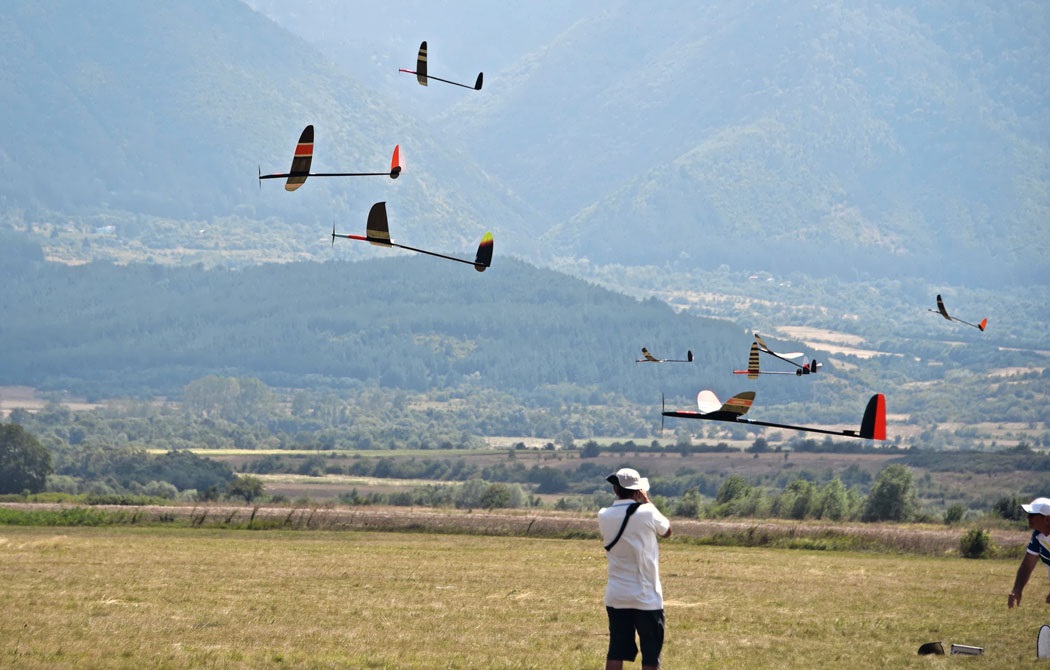
Strong Winds Pose a Challenge for Model Aviation – 2023 FAI F5J World Championships in Dupnitsa, Bulgaria
Strong winds—starting at least at noon, but possibly even earlier—blowed throughout all 14 races for juniors and seniors. The conditions were quite similar to those at the 2018 European Championships held at the World Championship venue in Dupnitsa. So there was certainly no “surprise” here.
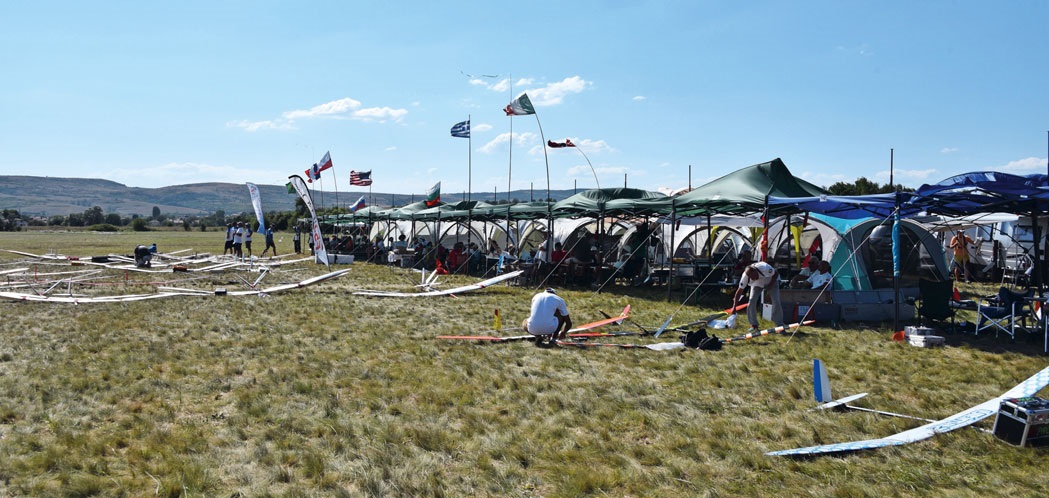
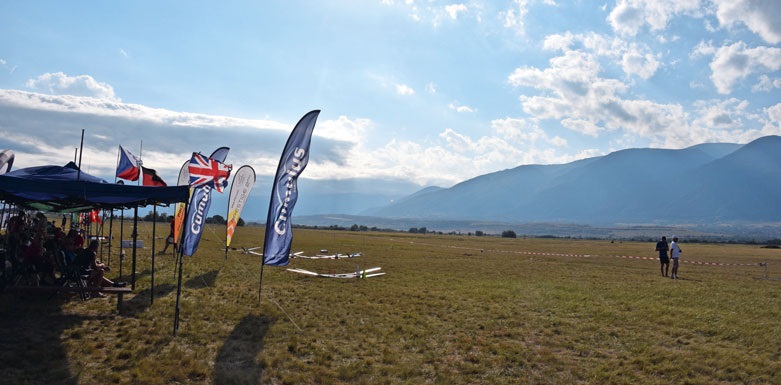
The opening ceremony on Dupnitsa’s town square was, once again, simple and festive. The people here are masters of improvisation. This was evident throughout the entire World Championship. Sotir Lazarkov led the event with a firm hand. His entire organizing committee worked reliably and cheerfully. Unlike the 2022 European Championship in Hungary, there is absolutely no infrastructure on the large, beautiful field. Everything has to be transported there first.
It became clear early on who would be among the top contenders. This includes not only the sometimes perfect flights and landings, but also “subtle” organizational details and excellent coaching of the pilots. These aren’t
the big, spectacular things, but often the small ones—which are indispensable at the decisive moment.
Time and again, I saw competitors trying to approach the landing field backward with the help of the wind—or to fly slightly over it—and then land facing forward. An interesting landing technique, but one that can quickly turn into a “wild ride” due to gusts. There were also numerous crashes, however.
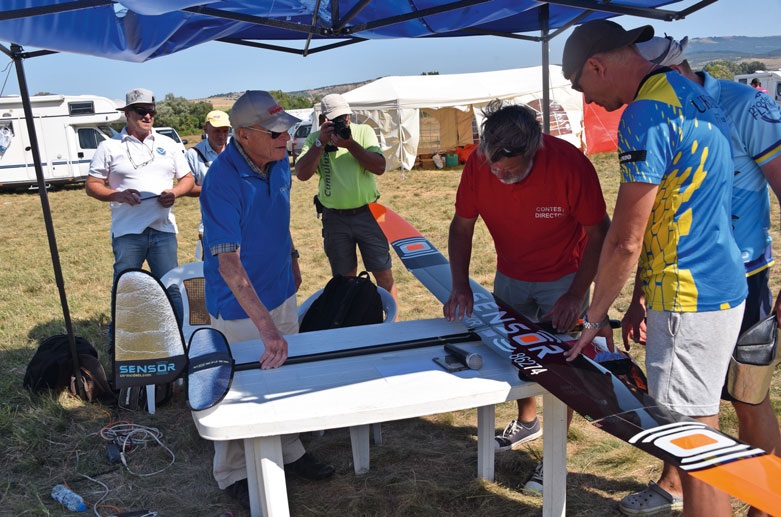
The importance of the coach—often rather innocuously referred to as a “helper”—is also massively underestimated here. Studies from other sports show that
coaching accounts for a very high percentage of success. Coaches do not necessarily have to be trainers, and certainly not team managers. There is a close relationship between the coach and the athlete. Ideally, the two work together over an extended period of time. The coach knows the pilot’s strengths and weaknesses and must act as a balancing force.
Three years ago, the Austrian Aero Club—impressed by the “great” EASA drone regulations—submitted a proposal to restrict the pilot’s “movement” during the competition flight. In Austria, model airfields are limited in size due to the increasing bureaucracy at Austro Control GmbH, which is fully in line with the EU trend. The motion was approved. Unfortunately, there was no
In addition, practical experience regarding the implementation of the rule. In this context, each individual organizer could impose such restrictions on their own based on the current situation. No more CIAM applications without sufficient practical experience. This helps prevent wasted effort. The discussions during the World Championships led those in charge to ultimately consult the CIAM protocols.
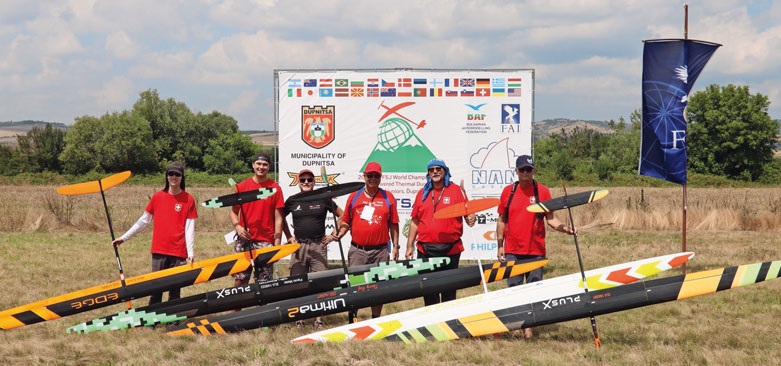
The juniors finished in good mid-pack positions—but they were close to doing even better. A bit of bad luck and a
few misjudgments prevented them from achieving more. Flavio Meier finished 14th and Alain Schad 18th. A total of 26 pilots competed.
Our seniors had a dismal showing due to bad luck and mishaps. Thomas Wackerlin (48th), acting as a coach for two or three pilots—in addition to his own flights—had to work far too hard for others—and this over 14 runs. In between, his advice and assistance with repairs were also in demand. In my view, the whole situation bordered on being overwhelming! Thierry Ruef finished 72nd and Pierre Maquelin 86th. A total of 88 pilots.


News from HEBU

TEAM MANAGER "THIS" BOSSHARD
 Rodito Nussbaumer

SUMMER FUN 2026 AT MG USTER
Martin Wunderli
BY YOUTH, FOR YOUTH
Lorena Betschen
SMALL, MODEL-LIKE SAILBOATS
Res Dauwalder
TRY-OUT DAY AT MFV WETTINGEN
Urs Keller
What's New at Leomotion.com

52. 2026 ALPS CUP
 Emil Giezendanner

ATOM, THE NEW DOUBLE-DECKER FROM CPLR
 Matthias Bosshard

INSIGHTS INTO THE HISTORY OF SEAPLANES

YOU KNOW WHAT I MEAN? 125 YEARS OF THE SWISS AERO CLUB
Emil Giezendanner
34th HAHNENMOOS ALPINE MODEL AIRPLANE CAMP
Res Dauwalder
CORSAIR F4U – A WARBIRD WITH A MEMORABLE LOOK
Jürgen Rosenberger, Jürgen Prinz
F3A EUROPEAN CHAMPIONSHIPS IN ST-MACAIRE, FRANCE
Matthias Bosshard
HORIZON HOBBY/LEMACO NEWS: MICRO OV-10 BRONCO 645 MM BY E-FLITE

PRIDE AND GOOD IDEAS
 Markus Nussbaumer

EURO CONTEST GLIDER ACRO TOUR AUSTRIA 2026

FREE FLIGHT IN THE MIDDLE OF SUMMER
Urs Muntwyler
THE PC-21 STORY
Emil Giezendanner
TWIN TOWN PARTNERSHIP
Wolfgang Voeller
WELCOME, NEW MEMBER!
Andrea Bolliger
COUPE DES ALPES – OBSERVE AND LEARN
Rodito Nussbaumer
NEWS FROM HEBU
 Julia Bucher

FROM 0 TO 100
Markus Nussbaumer
MEMORIES
Wolfgang Völler
NOS REGION – A HUB FOR ELECTRIC AVIATION
Emil Giezendanner
Have you almost forgotten about aircraft that take off and land vertically?
Emil Giezendanner
70 YEARS OF THE NIDWALDEN MODEL AIRPLANE CLUB
Martin Barmettler