
15th Free Flight Seminar 2013 in Aarau
Once again, the organizers succeeded in attracting a large number of interested free-flight enthusiasts and fans of this model aviation discipline to the free-flight seminar in Aarau. On February 2, 2013, a record-breaking 41 participants gathered at the Aarau Barracks for this traditional event.
Christian Gugger, the organizer and coordinator of this event, was delighted to welcome such a large group of free-flight enthusiasts. The high level of interest shows that free flight is thriving in Switzerland and that, thanks to the innovative work of the technical committee, new enthusiasts are continually discovering this oldest category of model aviation. To outsiders, it’s hard to imagine how this discipline has evolved over the years from plywood and pine-strip bombers to a high-tech category featuring state-of-the-art materials and electronic components. Moreover, free flight is the discipline that still offers the closest and most exciting connection to nature.
In the first part, various speakers provided an overview of the different categories and the sporting aspects of free flight:
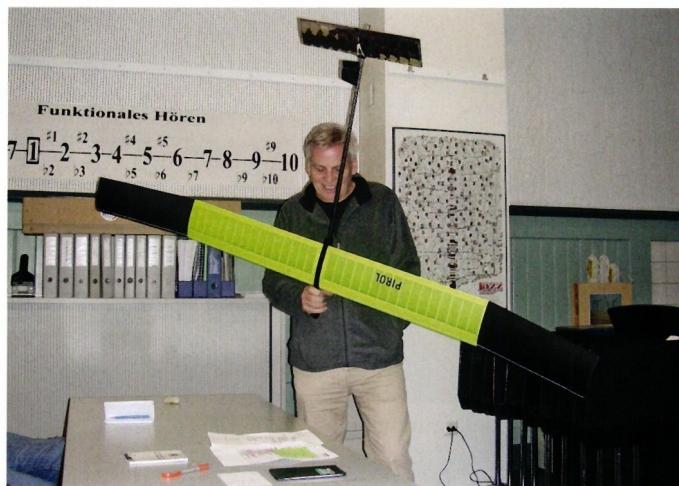
Dieter Siebenmann, a true expert in aerodynamics and modern aircraft engineering, has established himself as an F1B specialist in recent years. F1B—better known as the rubber-powered model category—traces its origins back to the first “motor-powered” model airplanes. His models are true marvels of cutting-edge engineering. Fiber-reinforced composites, electronic flight controls, and torque-adjustable propellers are just a few terms from his model-building vocabulary.
F1C is on the verge of extinction in Switzerland. These models, powered by 2.5-cm³ glow-ignition engines, are very tricky to handle, high-revving, and very loud. Only a few specialists still devote themselves to this category. In Switzerland, Peter Maurer is the only one left, though he is very successful internationally.
Urs Müller presented the F1E category (magnetic models). These models are launched by hand on a slope. For decades, they were kept on a preselected course by a built-in permanent magnet. But new technologies have made their way into this field as well. Electronic “magnets” transmit signals to microprocessors, which convert them into a predetermined course.
F1D (indoor flying) is Rainer Lotz’s specialty. It’s hard to imagine that these models, weighing just 1.2 grams (without rubber) and with a wingspan of up to 55 cm, can stay airborne for up to 40 minutes in indoor venues. The rubber cord may weigh no more than 0.6 g. These models consist of a paper-thin balsa frame and are covered with ultra-fine capacitor foil. Competition rules require that competitors build their own models.
The newest category in free flight is called F1Q electric flight. Wolfgang Gerlach traveled all the way from Germany specifically to introduce this category. Wolfgang is a veteran of free flight. Recently, he has been working intensively on this new discipline. The general consensus is that this category will eventually replace the F1C models with internal combustion engines. There are very few regulations for F1Q models. Only the power output of the electric motor is specified and regulated by a limiter. It’s a new, highly innovative model category with even greater potential for development.
The second part of the seminar included a series of practical tips and information. The FaKo F1 list—which includes addresses and websites of suppliers of parts, building materials, electronic components, and complete models for free-flight enthusiasts who don’t want to invent or build everything themselves—is very helpful.
In conclusion, it was agreed that newcomers to free flight can only be kept “on track” if they receive expert guidance and support. Based on this conviction, all members of the Free Flight Technical Commission (FaKo F1) have made themselves available as mentors and advisors. So if you’re looking for advice and support in this area, don’t hesitate to reach out to the members of FaKo F1. You can find the necessary contact information on the SMV website under “SMV – Technical Commissions – Technical Commission F1.” ■
Heiner Borer
| Alfred Andrist | familie.andrist@hispeed.ch | Thun |
| Dominik Andrist | domiandrist@gmx.ch | Thun |
| Christoph Bachmann | chbachma@solnet.ch | Richterswil |
| Michael Bleuer | michi.bleuer@gmx.ch | Langendorf |
| Walter Eggimann | walter.eggimann@belponline.ch | Belp |
| Christian Gugger | gugger.christian@yetnet.ch | Gretzenbach |
| Dieter Siebenmann | dieter.siebenmann@swissonline.ch | Russikon |
| Jörg Strub | j.strub@unibas.ch | Breitenbach |


TEAM MANAGER "THIS" BOSSHARD
 Rodito Nussbaumer

ATOM, THE NEW DOUBLE-DECKER FROM CPLR
 Matthias Bosshard

INSIGHTS INTO THE HISTORY OF SEAPLANES

CORSAIR F4U – A WARBIRD WITH A MEMORABLE LOOK
Jürgen Rosenberger, Jürgen Prinz
SUMMER FUN 2026 AT MG USTER
Martin Wunderli
F3A EUROPEAN CHAMPIONSHIPS IN ST-MACAIRE, FRANCE
Matthias Bosshard
What's New at Leomotion.com

HORIZON HOBBY/LEMACO NEWS: MICRO OV-10 BRONCO 645 MM BY E-FLITE

PRIDE AND GOOD IDEAS
 Markus Nussbaumer

News from HEBU

YOU KNOW WHAT I MEAN? 125 YEARS OF THE SWISS AERO CLUB
 Emil Giezendanner

34th HAHNENMOOS ALPINE MODEL AIRPLANE CAMP
Res Dauwalder
SMALL, MODEL-LIKE SAILBOATS
Res Dauwalder
TRY-OUT DAY AT MFV WETTINGEN
Urs Keller
52. 2026 ALPS CUP
Emil Giezendanner
TWIN TOWN PARTNERSHIP
Wolfgang Voeller
EURO CONTEST GLIDER ACRO TOUR AUSTRIA 2026

BY YOUTH, FOR YOUTH
Lorena Betschen
WELCOME, NEW MEMBER!
Andrea Bolliger
FREE FLIGHT IN THE MIDDLE OF SUMMER
Urs Muntwyler
THE PC-21 STORY
Emil Giezendanner
COUPE DES ALPES – OBSERVE AND LEARN
Rodito Nussbaumer
NEWS FROM HEBU
 Julia Bucher

FROM 0 TO 100
Markus Nussbaumer
NOS REGION – A HUB FOR ELECTRIC AVIATION
Emil Giezendanner
MEMORIES
Wolfgang Völler
Have you almost forgotten about aircraft that take off and land vertically?
Emil Giezendanner
70 YEARS OF THE NIDWALDEN MODEL AIRPLANE CLUB
Martin Barmettler