
RC Systems Worldwide
60 Years of Futaba
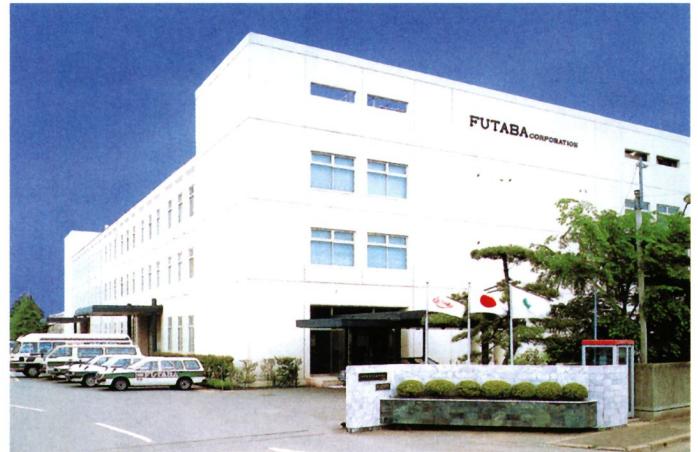
After a hiatus of several years, I once again had the opportunity to visit Futaba in Japan—coinciding with its anniversary year. Even this corporation could not remain immune to recent developments in a global economic environment, such as the outsourcing of jobs to so-called low-wage countries. Futaba RC systems are still gaining ground worldwide and are leaders in several areas.
Since the company expanded into a wide variety of technical fields, I will limit my discussion here largely to the RC model aircraft sector. Futaba began developing and manufacturing electronic vacuum tubes in 1948. Just one year later, land was acquired in Yatsumimura, Chosei-gun, in Chiba Prefecture, and new production facilities as well as the company headquarters were constructed. After a dozen years of growth, a sales office began distributing remote controls and plastic models. Just one year later, in 1962, the company began manufacturing and distributing RC systems and accessories. In 1962, Futaba developed its first superheterodyne receivers and RC systems, which enabled the simultaneous operation of multiple functions. Exports to the U.S. and Europe soon followed.
In 1967, the first joystick transmitter was developed, and the first proportional systems followed in 1969. The “modular era” began in 1978, and the first PCM systems followed as early as 1983. The major breakthrough for these systems came in 1987 with the PCM 1024. Another important step forward occurred in 1992 with the introduction of synthesizer controllers. In 1996, Futaba introduced a 2.4-GHz duplex communication system that paved the way for today’s modern RC systems. Looking back at this company’s 60-year history, it is striking that each individual development step took a few years but was ultimately successful and well-received. This serious business approach may be a thing of the past in many sectors—such as the toy and foam industries. In serious model aviation, where expensive and larger aircraft are used, a level of quality comparable to that sought in manned aircraft construction may well be appropriate. However, this quality also comes with higher costs. As is well known, we pay not only for manufacturing costs but also for development costs, and these are simply higher for original products than for any knockoffs. I have never heard of Futaba having to recall RC systems on a large scale.
Today, the RC system is the most faithful companion for most model aircraft pilots. Airplanes and airfields may change, but the RC system, so to speak, “stays with the pilot.” It transmits the pilot’s commands from his hand invisibly and reliably to the aircraft. As simple as these processes may seem, they are backed by a great deal of thought, extensive experience, and thousands of hours of hardware and software development. Who better to provide the necessary insights and critical evaluation than experienced top talents from the various model flying disciplines? With Giichi Naruke and Yoichori Akiba in F3A aerobatics, as well as Yukihiro Dobashi in the F3C helicopter division, Futaba has several world champions and internationally renowned top talents on its team. Consistent development over decades, combined with high standards for quality and safety, allows Futaba to keep the ever-accelerating competition at bay. With the new 2.4-GHz system, Futaba has even managed to pull ahead significantly. Once its expertise in this area becomes established and the decline in electronics prices continues, competitive pressure from China will become even more intense. I’m curious to see what strategy Futaba’s management will adopt to address these developments. Since serious and complex outdoor model flying ultimately revolves around actual flight safety issues, we must treat these high standards as our top priority. However, when it comes to purchase costs, a shift in mindset is needed here. Even in manned aviation, safety cannot be had at discount prices. If we increasingly base our requirements on the principles of “quality” and “flight safety” rather than on “which servos are the cheapest,” manufacturers like Futaba will be able to survive in the high-end market. Toy controllers produced by the millions may still have their place in indoor flying. However, we must ensure that children don’t bite into them, because they’re toxic...
More or less heated discussions about which RC system is the best are just as much a waste of time as the usual bar-table chatter about cars. Genuine product comparisons would have to be conducted analytically, although even selecting uniform criteria is only possible to a limited extent, since the various brands are based on different “user philosophies.” However, it should be noted right away that a certain degree of convergence has taken place in this area in recent years.
As mentioned earlier, Futaba’s development process is not rushed but rather thorough. Unlike other manufacturers, a product is not further developed until sufficient practical experience has been gained. The saying, “Master, the work is done—should I fix it right away?” does not apply here. Thus, in the coming months, the 12Z transmitter with an integrated 2.4 GHz RF section will be launched, followed shortly thereafter by the 14MZ. New servos and gyros are constantly being added to the already vast product lineup. In particular, two directions are being pursued: miniaturization on the one hand, and equipping large, powerful machines on the other. In doing so, Futaba can afford to use its own connector system for micro-receivers and mini-servos. Those who lead also set the tone. It has always been that way. When it comes to servos, the new BLS (brushless) generation is already a success story. The switch to a 7.2 V receiver power supply will clearly simplify powering with LiPo batteries. A bold move—congratulations!
For the transmitters briefly listed here, I’m limiting myself to the current lineup and to systems intended for model aircraft, meaning those suitable for RC carb operation are not listed here. Not all receivers are compatible with all transmitters. Use original servos whenever possible. Experience has shown that 2.4-GHz systems are highly recommended, especially in the context of courses aimed at promoting youth participation. This way, inexperienced and impatient participants are less likely to make the instructors nervous… It’s worth spending a few francs more here and opting for the T6EX, for example. The larger 12Z and 14Z transmitters are available from the Swiss distributor Pulte. After all, people are creatures of habit—me included—which is why I’ll tell you more about Japan in the next issue.
Emil Ch. Giezendanner
Unlike model airplane enthusiasts in countries with established manufacturers, Swiss model airplane enthusiasts have no qualms about purchasing the products that best meet their needs, regardless of where they are produced. This frees us from the proverbial tunnel vision and means that we accept and adopt new technologies much more quickly than model aircraft enthusiasts in countries with major manufacturers or importers. This may be one reason why, in Switzerland, U.S. RC systems and motors, for example, were able to spread quickly and successfully from very early on—starting around 1960. In the 1970s, Japanese manufacturers such as JR and Futaba also gained a significant foothold in the market with their RC systems. For years afterward, Swiss F3A specialists were virtually the only ones in Europe using Japanese Yamada motors.


TEAM MANAGER "THIS" BOSSHARD
 Rodito Nussbaumer

ATOM, THE NEW DOUBLE-DECKER FROM CPLR
 Matthias Bosshard

INSIGHTS INTO THE HISTORY OF SEAPLANES

CORSAIR F4U – A WARBIRD WITH A MEMORABLE LOOK
Jürgen Rosenberger, Jürgen Prinz
SUMMER FUN 2026 AT MG USTER
Martin Wunderli
F3A EUROPEAN CHAMPIONSHIPS IN ST-MACAIRE, FRANCE
Matthias Bosshard
What's New at Leomotion.com

HORIZON HOBBY/LEMACO NEWS: MICRO OV-10 BRONCO 645 MM BY E-FLITE

PRIDE AND GOOD IDEAS
 Markus Nussbaumer

News from HEBU

YOU KNOW WHAT I MEAN? 125 YEARS OF THE SWISS AERO CLUB
 Emil Giezendanner

34th HAHNENMOOS ALPINE MODEL AIRPLANE CAMP
Res Dauwalder
SMALL, MODEL-LIKE SAILBOATS
Res Dauwalder
TRY-OUT DAY AT MFV WETTINGEN
Urs Keller
52. 2026 ALPS CUP
Emil Giezendanner
TWIN TOWN PARTNERSHIP
Wolfgang Voeller
EURO CONTEST GLIDER ACRO TOUR AUSTRIA 2026

BY YOUTH, FOR YOUTH
Lorena Betschen
WELCOME, NEW MEMBER!
Andrea Bolliger
FREE FLIGHT IN THE MIDDLE OF SUMMER
Urs Muntwyler
THE PC-21 STORY
Emil Giezendanner
COUPE DES ALPES – OBSERVE AND LEARN
Rodito Nussbaumer
NEWS FROM HEBU
 Julia Bucher

FROM 0 TO 100
Markus Nussbaumer
NOS REGION – A HUB FOR ELECTRIC AVIATION
Emil Giezendanner
MEMORIES
Wolfgang Völler
Have you almost forgotten about aircraft that take off and land vertically?
Emil Giezendanner
70 YEARS OF THE NIDWALDEN MODEL AIRPLANE CLUB
Martin Barmettler