
A Look Back at the F3B World Championship
The 7th World Championship for remote-controlled model sailplanes in the F3B category took place from October 11 to 20 at the Melun-Villaroche airfield, approximately 30 km southeast of Paris. Nic Wright of England won the world championship by a wide margin, ahead of Peter Hoffmann of Austria and Joris ten Holt of the Netherlands. Austria won the team competition, ahead of the Netherlands and the Federal Republic of Germany. The Swiss competitors achieved the following results: Roland Müller placed 9th, Kurt Steiner placed 15th, and Rainer Ammann placed 28th out of 56 competitors. In the team competition, Switzerland placed 6th.
The vast, completely flat airfield was equipped with everything necessary, but the organizers had apparently failed to reach a binding agreement with the farmer in time. So for a week we found ourselves on a bone-dry stubble field that was also crisscrossed by deep tractor tracks. For the volunteers, this meant extra work setting up and taking down the winches, but fortunately the weather remained warm and dry—just like midsummer—with the exception of a single day of thunderstorms.
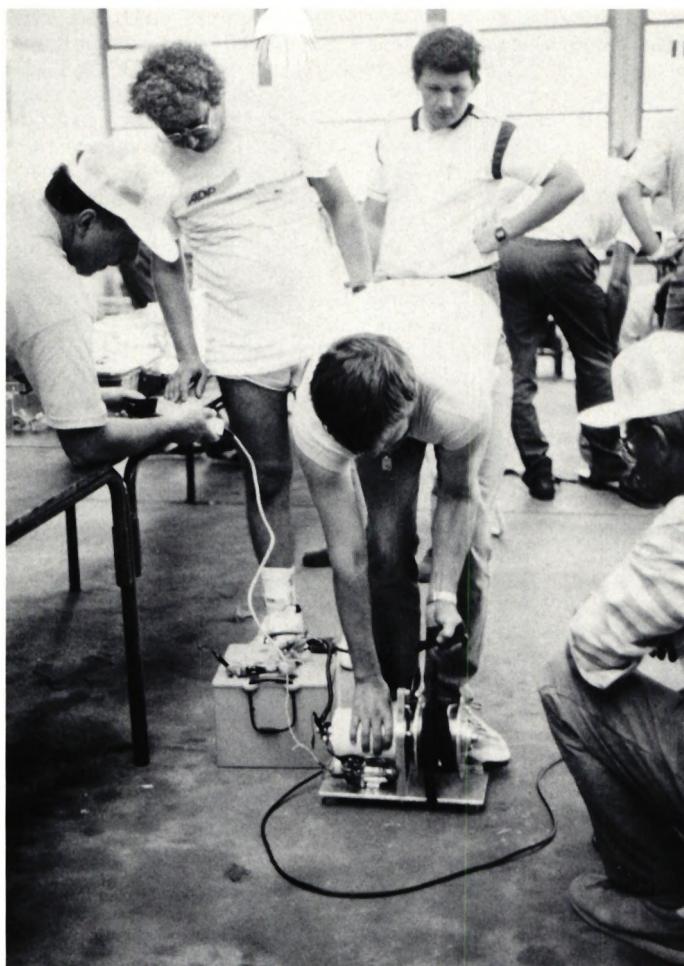
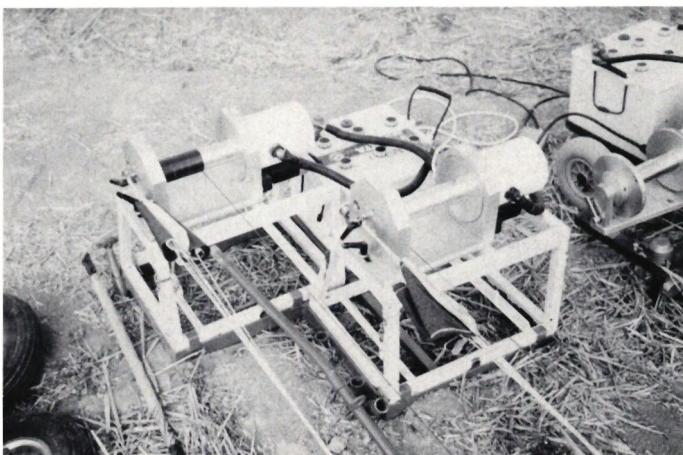
Of course, everyone was eager to see how the new winch regulation would hold up. The organizer had prepared well, and competent volunteers carried out the winch inspection efficiently. Anyone who did not achieve the required internal resistance value on the first measurement was allowed to try again. All critical points in the winch’s wiring were sealed with varnish after passing the test. Throughout the entire competition, the new winch regulations gave no cause for complaints or even protests!
Even before the World Championships, it had become clear that the best flight performance could be achieved with the existing models, provided they weren’t too heavy. Several top pilots, including Liese, Schlott, Hoffmann, and Wasner, reported that they had set aside their slightly smaller new designs and competed with the tried-and-true models. The question of the optimal model dimensions remains completely open and may still depend somewhat on further developments in the battery regulations. The cross-country flight proved to be exceptionally exciting. The rapidly changing thermals—often accompanied by strong winds—repeatedly led to surprising results and disappointed faces on the large field. The fact that not everything is predictable in this discipline and that piloting instinct plays an important role can only be a benefit for the further development of this model flying category.
There is little new to report regarding speed flight and endurance flight. Due to the mostly strong winds, good starting altitudes were achieved, even though strong crosswinds at times made high launches difficult. Although some teams had practiced the hand launch with pulleys, it was never used in the competition. With today’s models, even during a hand launch, significant forces are generated that are difficult to control. In general, it would be a mistake to build the models weaker just because of the new winches. Strong winds still generate very large forces, which must also be taken into account when selecting the launch line.
The competition director, who ran the entire championship with a very tight rein—some participants even described him as somewhat dictatorial—had also established very clear safety regulations from the very beginning. Violations of safety rules, such as flying low over winches and sighting devices, landing near winches, and similar infractions, were penalized with a 100-point deduction. After some initial uncertainty, these measures proved very effective and are expected to be incorporated into the official rules.
Now a few remarks on the flight performances. The best speed time—17.5 seconds—was achieved by Reinhard Liese as early as the first run. Particularly gratifying from a Swiss perspective was that Kurt Steiner managed to score a “thousand” with a time of 19.3 seconds in the third run. Rainer Ammann posted the best speed time among the Swiss competitors with 19.8 seconds. If a Speed Cup were scored based on the average of the six runs, Reinhard Liese would be in the lead with 19.18 seconds, just ahead of Nic Wright with 19.38 seconds. Based on this calculation, the Swiss results are as follows: Steiner 20.56 sec, Müller 20.87 sec, and Ammann 22.02 sec. If the total number of lengths flown were the deciding factor in the cross-country flight, the American Dawson would lead this Distance Cup with 119 lengths. That’s an average of nearly 20 lengths per flight! The next places would be taken by Jeroen Smits and Fritz Haupt, each with 112 lengths. According to this calculation, the Swiss pilots have flown 96 lengths (Steiner), 91 lengths (Müller), and 85 lengths (Ammann). Finally, a few remarks on the Swiss team led by Hans Stocker. Overall, they made a good impression, even if some of the high expectations leading up to the World Championships weren’t quite met. The two “World Championship rookies” placed very well right off the bat, while Rainer Ammann didn’t quite find his stride. Given the high level of competition, even with overall respectable results, one can quickly find oneself relegated to the middle of the pack. The team’s performance, with a 6th-place finish, is once again encouraging. The dedication of the support staff also made an excellent impression this year.
After the somewhat mixed impressions of the 1987 World Championships, this World Championships was a great success, attributable not only to favorable weather but also to the tremendous efforts of the organizers.
Rolf Girsberger
| 1. Wright Nic | GB | 14,742.12 |
| 2. Peter Hoffmann | A | 14,405.71 |
| 3. Ten Holt, Joris | HOL | 14,377.44 |
| 4. Wasner Junior | A | 14,348.67 |
| 5. Liese Reinhard | D | 14,333.93 |
| 6. Jeroen Smits | HOL | 14,166.82 |
| 7. Dawson Seth | USA | 14,146.65 |
| 8. Werner Vauth | D | 14,145.47 |
| 9. Roland Müller | CH | 14,132.84 |
| 10. Jolly Larry | USA | 14,075.84 |
| 15. Kurt Steiner | CH | 13,822.68 |
| 28. Rainer Ammann | CH | 13,362.48 |
| 1. Austria | 42,768.26 |
| 2. Netherlands | 42,487.57 |
| 3. Germany | 42,445.71 |
| 4. United Kingdom | 42,184.83 |
| 5. USA | 41,534.52 |
| 6. Switzerland | 41,318.00 |


News from HEBU

TEAM MANAGER "THIS" BOSSHARD
 Rodito Nussbaumer

YOU KNOW WHAT I MEAN? 125 YEARS OF THE SWISS AERO CLUB
 Emil Giezendanner

PRIDE AND GOOD IDEAS
 Markus Nussbaumer

ATOM, THE NEW DOUBLE-DECKER FROM CPLR
 Matthias Bosshard

SUMMER FUN 2026 AT MG USTER
Martin Wunderli
F3A EUROPEAN CHAMPIONSHIPS IN ST-MACAIRE, FRANCE
Matthias Bosshard
52. 2026 ALPS CUP
Emil Giezendanner
HORIZON HOBBY/LEMACO NEWS: MICRO OV-10 BRONCO 645 MM BY E-FLITE

TWIN TOWN PARTNERSHIP
Wolfgang Voeller
CORSAIR F4U – A WARBIRD WITH A MEMORABLE LOOK
Jürgen Rosenberger, Jürgen Prinz
TRY-OUT DAY AT MFV WETTINGEN
Urs Keller
WELCOME, NEW MEMBER!
Andrea Bolliger
EURO CONTEST GLIDER ACRO TOUR AUSTRIA 2026

BY YOUTH, FOR YOUTH
Lorena Betschen
INSIGHTS INTO THE HISTORY OF SEAPLANES

SMALL, MODEL-LIKE SAILBOATS
Res Dauwalder
What's New at Leomotion.com

COUPE DES ALPES – OBSERVE AND LEARN
Rodito Nussbaumer
34th HAHNENMOOS ALPINE MODEL AIRPLANE CAMP
Res Dauwalder
FREE FLIGHT IN THE MIDDLE OF SUMMER
Urs Muntwyler
THE PC-21 STORY
Emil Giezendanner
NEWS FROM HEBU
 Julia Bucher

FROM 0 TO 100
Markus Nussbaumer
MEMORIES
Wolfgang Völler
NOS REGION – A HUB FOR ELECTRIC AVIATION
Emil Giezendanner
Have you almost forgotten about aircraft that take off and land vertically?
Emil Giezendanner
DO YOU KNOW WHAT I MEAN IN THE LAND OF SMILES?
Emil Giezendanner