
The Low-Maintenance Warthog
A-10 Thunderbolt II TWIN 64 mm EDF by E-flite®
The U.S. Air Force's ground-attack aircraft, which its pilots also call the "Warthog" or "Hog" for short because of its appearance, has been deployed since 1975 in American theaters of war as a feared weapon against armored targets.
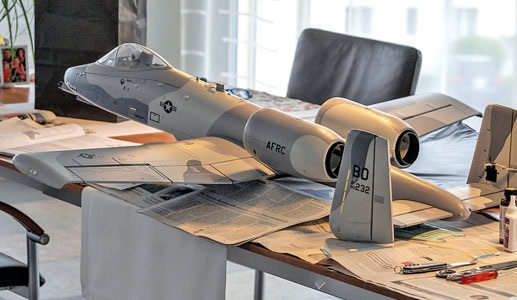
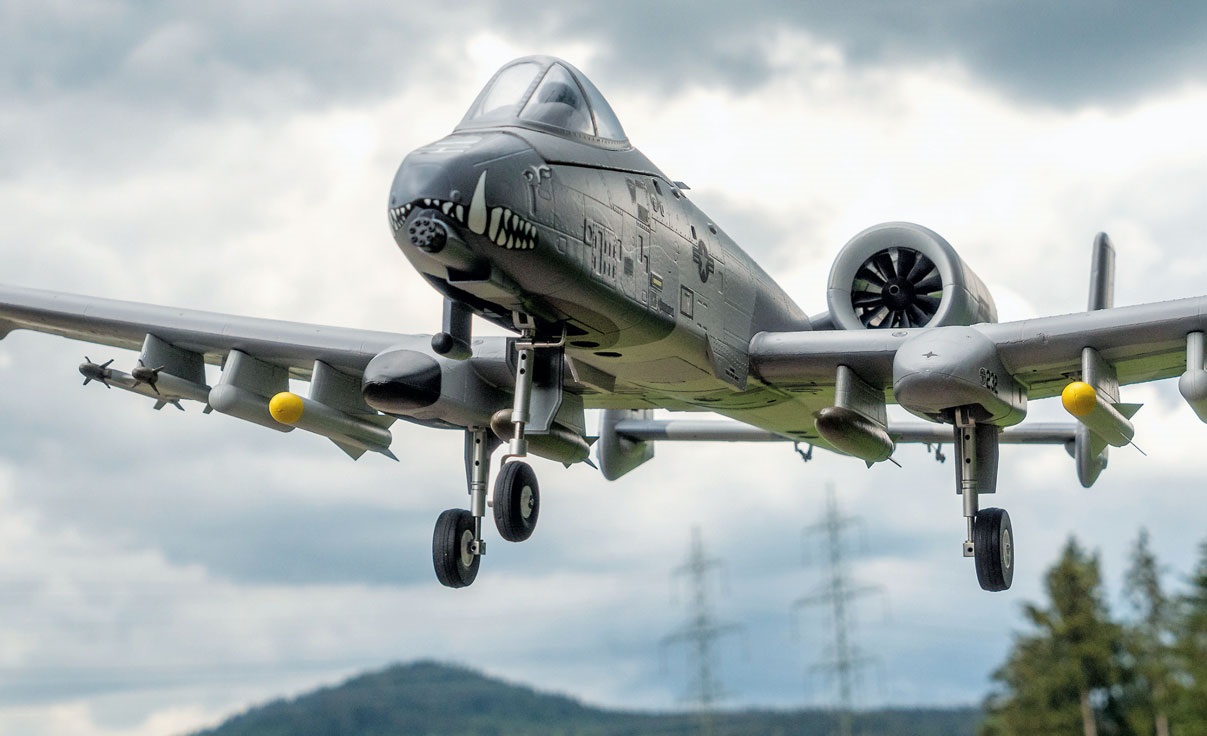
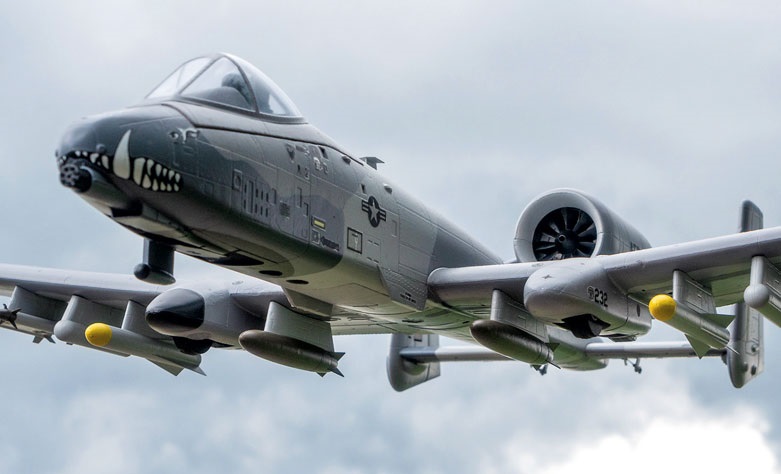
The E-flite® A-10 Thunderbolt II Twin 64 mm EDF is a true-to-scale replica of this legendary aircraft. This nearly fully assembled model stands out at first glance as a highlight among EPO hard foam model airplanes. The surface details, camouflage paint scheme, and extensive markings are impressively and largely faithful to the original. Even as you unpack the fuselage, the predatory expression of the nose makes a fearsome impression.
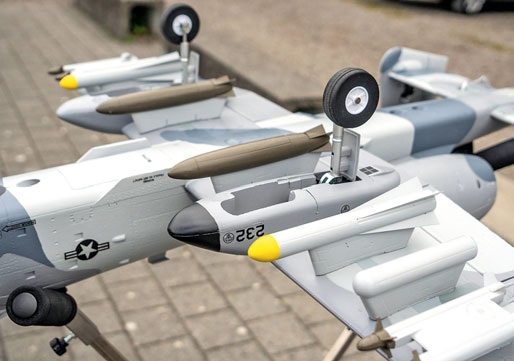
In addition to full aileron and motor control, this Bind-N-Fly® Basic version includes the two pre-installed impeller engines, the electric retractable landing gear, and the built-in Spektrum™ AR636 6-channel receiver. Only the Spektrum™ transmitter, the LiPo battery with charger, and the Styro instant adhesive must be purchased separately for the assembly and operation of the E-flite® A-10 Thunderbolt II.
The A-10 Thunderbolt II Twin 64 mm, distributed by E-flite®
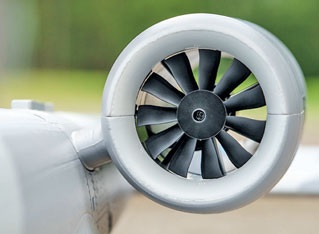
The EDF is a new design and is touted as the most powerful impeller model to date and the easiest to fly. Thanks to its two engines, each featuring 11-blade turbine impellers with a diameter of 64 mm and a rotational speed range of 2,840 to 2,200 kV (rpm/V), it is said to be capable of “unlimited” vertical climb performance as well as a top speed of up to 160 km/h. These two EDF (Electric-powered Ducted Fan) propeller engines
are controlled by two 40-A controllers and, in our configuration, powered by a 6S 3700-mAh LiPo battery.
Finishing the model requires only a small amount of model-building work. You’ll need to attach the horizontal stabilizer, the vertical stabilizers, and the wing; mount the weapons; and install the battery. After less than half a day of gluing and assembly—and without having to painstakingly study the instructions—the scale fighter jet is ready to be paired with the remote control.
If you are not familiar with the Spektrum RC philosophy, then—unlike what has been described so far—you must carefully follow the aircraft’s owner’s manual when binding and programming the transmitter.
However, this is easier said than done, because reading the manual—especially in German—has its challenges. It helps to grasp the confusing concepts in English and French and try to figure out the specific instructions.
(Applies to the Bind-N-Fly Basic version)
In addition to the procedure for programming the transmitter described in the owner’s manual, please note the following special consideration when using the Spektrum™ DX6 or DX6e transmitters.
If, as in our case, you wish to use SAFE-Select mode with such a 6-channel transmitter, you must first configure the landing flap switch to a reset (empty) model memory slot. This is the only way to enable the SAFE-Select function when operating the landing flaps. In addition, when pairing the transmitter with the receiver, follow the specific procedure described in the user manual.
The remaining settings differ only slightly from the familiar procedures for programming the various functions.
When flying, Spektrum™ distinguishes between two gyro-stabilized modes: AS3X mode and SAFE-Select mode. When using the 6-channel controller, AS3X mode is always enabled and cannot be disabled. This means that flight is always controlled by the gyro stabilization system. The AS3X mode, which is active during takeoff and general flight, does not differ from the standard operation without stabilization when controlling the model’s three axes.
In this mode, moving the control stick causes the model aircraft to move continuously in the desired direction. The corrections made by the gyro electronics are barely noticeable. If anything, the model aircraft’s movements are slightly smoother. The stability corrections are most noticeable when crosswinds or sudden gusts occur. The SAFE-Select mode for stabilizing the landing process, as already mentioned, is effective only when the landing flaps are extended and allows only limited preset roll and pitch attitudes. As soon as the control stick is moved to the neutral position, the model aircraft assumes a horizontal flight attitude. If, on the other hand, the control stick is held in a specific deflected position, the model aircraft remains in its current roll or pitch attitude. This stability aid can make a safer landing more likely.
In this context, it should also be noted that even the best gyro stabilization cannot prevent a stall caused by flying too slowly or an uncontrolled landing due to a depleted battery.
Pre-flight check: Just as it should be done as a routine before every flight, we begin our inspection of the model scheduled for its maiden flight by checking the center of gravity, performing a thorough control check, and testing the RC range using the corresponding function on the transmitter.
It is not uncommon for any careless errors made while programming the transmitter, loose control linkages, or unfavorable antenna positions to be detected in time, thereby preventing embarrassing incidents.
Additionally, by performing the binding process again—with the throttle stick deliberately set to a low position and, if necessary, with predefined control surface deflections—the failsafe settings configured in this way can contribute to an enhanced level of safety.
To initialize the stabilization system, first place the model aircraft on a level surface with its wheels down, turn on the transmitter, and connect the battery to the receiver. Shortly thereafter, the electronics will indicate a successful connection by making several brief movements of the control surfaces and emitting a series of beeps. Next, secure the model aircraft to prevent it from rolling away, and move the throttle stick from the neutral position to beyond 25% of its travel and back again. This starts the engines and definitively activates the AS3X technology.
Next, lift the model aircraft and move it along all three axes while visually checking the direction, speed, and amplitude of the control surface deflections generated by the AS3X system.
You will notice that the rudder deflections are very small when rotating about the vertical axis.
Takeoff Phase: A hard-surface runway is required to launch the A-40 model aircraft. In addition, less experienced pilots are advised to first practice rolling maneuvers to develop a confident feel for steering. →
| Manufacturer: | Horizon Hobby, E-flite®, China, USA |
| Construction: | Hollow-core construction made of EPO material |
| Wingspan: | 1149 mm |
| Fuselage length: | 1,061 mm |
| Center of gravity: | 55–70 mm behind the leading edge |
| Weight: | 226–2,410 g |
| Motor: | 2 brushless outrunner motors, 2840–2200 kV |
| ESC: | 2 × 40 A ESCs and separate BEC |
| Propellers: | 11-blade, Ø 64 mm |
| Servos: | 9 metal-gear servos |
| Gyro technology: | AS3X and SAFE®Select modes |
| Receiver: | Spectrum™ AR636A, 6-channel |
| Battery: | 22.2 V, 6S, 3200–4000 mAh, 30+C Li-Po |
| Transmitter: | Spektrum™ DSMX®/DSM2®, 6-channel |
Trim: When trimming the control surfaces in AS3X mode, we recommend the following procedure:
As usual, while the model is in level flight with the throttle stick at the ¾ position and the landing gear retracted, use the trim switches to make adjustments. Then, by keeping the control sticks still for three seconds, the receiver receives the information regarding the appropriate setting to optimize the AS3X control system. If this procedure is not followed, error-free flight cannot be guaranteed. As usual, the control surfaces must be mechanically adjusted after landing, and the trim switches must be reset to zero.
Larger flight envelope: Note that, unlike standard foam models, more space is required for flying. The higher speed and moderate control movements associated with flight attitude stabilization require a broad field of vision. Obstacles of all kinds can appear in the pilot’s path with unexpected speed, and long-standing habits can suddenly lead to serious conflicts.
Noise: It’s worth noting that the A-10 model aircraft doesn’t roar like real fighter jets but instead flies its laps with a subtle turbine hum.
Landing: With so much focus on staying clear of obstacles while flying, the battery’s charge runs out faster than expected. Therefore, it’s advisable to set the timer to about 3:30 minutes and to begin the landing promptly when the warning tones sound. At the latest during the landing turn, be sure to fully extend the landing gear and landing flaps. Although the SAFE-Select stabilization system is a great help for a smooth landing approach, special attention must be paid to maintaining a landing speed that is not too slow.
I consider the E-flite® A-10 Thunderbolt II to be a very attractive model airplane that’s a pleasure to fly. Its sophisticated attitude stabilization system plays a key role in ensuring safe and controlled flight. The impressive and precise flight maneuvers make flying it a lot of fun.
By the way, I've made sure of one thing: The A-10 Thunderbolt II is definitely not a warthog, because I've never seen it stick its tail straight up into the sky while fleeing, the way real warthogs do.


News from HEBU

TEAM MANAGER "THIS" BOSSHARD
 Rodito Nussbaumer

SUMMER FUN 2026 AT MG USTER
Martin Wunderli
SMALL, MODEL-LIKE SAILBOATS
Res Dauwalder
TRY-OUT DAY AT MFV WETTINGEN
Urs Keller
What's New at Leomotion.com

52. 2026 ALPS CUP
 Emil Giezendanner

ATOM, THE NEW DOUBLE-DECKER FROM CPLR
 Matthias Bosshard

INSIGHTS INTO THE HISTORY OF SEAPLANES

YOU KNOW WHAT I MEAN? 125 YEARS OF THE SWISS AERO CLUB
Emil Giezendanner
34th HAHNENMOOS ALPINE MODEL AIRPLANE CAMP
Res Dauwalder
CORSAIR F4U – A WARBIRD WITH A MEMORABLE LOOK
Jürgen Rosenberger, Jürgen Prinz
F3A EUROPEAN CHAMPIONSHIPS IN ST-MACAIRE, FRANCE
Matthias Bosshard
HORIZON HOBBY/LEMACO NEWS: MICRO OV-10 BRONCO 645 MM BY E-FLITE

PRIDE AND GOOD IDEAS
 Markus Nussbaumer

EURO CONTEST GLIDER ACRO TOUR AUSTRIA 2026

BY YOUTH, FOR YOUTH
Lorena Betschen
FREE FLIGHT IN THE MIDDLE OF SUMMER
Urs Muntwyler
THE PC-21 STORY
Emil Giezendanner
TWIN TOWN PARTNERSHIP
Wolfgang Voeller
WELCOME, NEW MEMBER!
Andrea Bolliger
COUPE DES ALPES – OBSERVE AND LEARN
Rodito Nussbaumer
NEWS FROM HEBU
 Julia Bucher

FROM 0 TO 100
Markus Nussbaumer
MEMORIES
Wolfgang Völler
NOS REGION – A HUB FOR ELECTRIC AVIATION
Emil Giezendanner
Have you almost forgotten about aircraft that take off and land vertically?
Emil Giezendanner
70 YEARS OF THE NIDWALDEN MODEL AIRPLANE CLUB
Martin Barmettler