
A Brief Guide to Building Lightweight and Sturdy Electric Model Airplanes
The growing popularity of electric flight calls for a completely new approach to design: a construction method that is lightweight yet as stable as possible. This guide is intended to help you successfully build and fly lightweight yet robust aerobatic and sport models. The construction method described here has been developed and refined through many models.
The airfoil thickness should not exceed 11–12% (flight time). The nose radius should be kept as sharp as possible (stall recovery). Apply two to three coats of finish varnish diluted 1:1. The use of film covering is generally not recommended (lacks stability). Please direct any questions to: H. Sommerauer, Waserstr. 21, 8053 Zurich
Lightweight wood that is not too soft should be used. Particular attention should be paid to ensuring that the grain runs straight and that the wood is not warped, especially in the case of pine spars and planking boards.
For most wood bonding applications, only a hard adhesive should be used (Uhu-Hart, Rudol-Hart, Stabilit-Dur). Two-component adhesives are used only for joints subject to high stress (engine mount, landing gear). Contact adhesive is the best choice for attaching the skin.
Cooling ports (cut-off aluminum tubing, Ø 10, angled) must be installed between the motor and the battery compartment. A safety clearance of approximately 5 mm must be maintained between the cells and the fuselage walls, and the rear end of the fuselage must be left open. Foam rubber must not be used when installing the system.
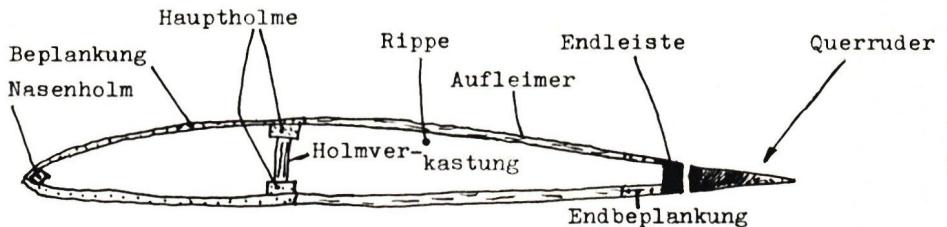
| Models up to approx. 1.2 kg | Models up to approx. 2.5 kg | |
| Ribs | 1.5 mm balsa | 1.5 mm balsa |
| Root ribs | 3 mm balsa | 3–4 mm balsa |
| Main spars | 2×4 – 2×5 mm pine | 2×5 – 3×6 mm pine |
| Nose spar | 2×2 mm pine | 2×2 mm pine |
| End strip | depending on the aileron | depending on the aileron |
| Wing joint | extending beyond the fuselage support | 25 g/m² glass fiber |
| Fabric covering (fuselage + wings) | 12 g/m² paper directly with tension varnish | |
| Spine framing | Double-T, 1–1.5 mm balsa | Double-T, 1.5 mm balsa |
| Planking | 1 mm balsa | 1 mm balsa |
| Front fuselage side | 3 mm balsa | 4 mm balsa |
| Rear fuselage side | 1.5 mm balsa | 2 mm balsa |
| Fuselage bottom + front cover | 3 mm balsa, crosswise | 4 mm balsa, transverse |
| Fuselage bottom + rear cover | 1.5 mm balsa crosswise | 2 mm balsa, cross-cut |
| Fuselage struts, engine compartment | 8×8 triangular balsa | 10×10 triangular balsa |
| Rear fuselage struts | 4×4 balsa | 4×4 or 5×5 balsa |
| Motor bulkhead | 2.5 mm plywood | 3 mm plywood |
| Fuselage frames | 2 mm plywood | 2.5 mm plywood |
| Tail sections | 4 mm perforated balsa or 4×4 mm balsa strip construction | 4–5 mm perforated balsa 5×4 mm balsa strip construction |
| Landing gear | 3 mm Ø wire (for sport models only) | Wire, 3–4 mm Ø, or Anticorodal, 1.5 mm |
| Wing Mounting | Rubber or nylon screws | M 4 or M 5 |
| Rib spacing | 40–50 mm | 40–60 mm |


TEAM MANAGER "THIS" BOSSHARD
 Rodito Nussbaumer

YOU KNOW WHAT I MEAN? 125 YEARS OF THE SWISS AERO CLUB
 Emil Giezendanner

F3A EUROPEAN CHAMPIONSHIPS IN ST-MACAIRE, FRANCE
 Matthias Bosshard

News from HEBU

SUMMER FUN 2026 AT MG USTER
Martin Wunderli
TRY-OUT DAY AT MFV WETTINGEN
Urs Keller
52. 2026 ALPS CUP
Emil Giezendanner
BY YOUTH, FOR YOUTH
Lorena Betschen
ATOM, THE NEW DOUBLE-DECKER FROM CPLR
Matthias Bosshard
CORSAIR F4U – A WARBIRD WITH A MEMORABLE LOOK
Jürgen Rosenberger, Jürgen Prinz
SMALL, MODEL-LIKE SAILBOATS
Res Dauwalder
What's New at Leomotion.com

TWIN TOWN PARTNERSHIP
Wolfgang Voeller
EURO CONTEST GLIDER ACRO TOUR AUSTRIA 2026

INSIGHTS INTO THE HISTORY OF SEAPLANES

34th HAHNENMOOS ALPINE MODEL AIRPLANE CAMP
Res Dauwalder
HORIZON HOBBY/LEMACO NEWS: MICRO OV-10 BRONCO 645 MM BY E-FLITE

COUPE DES ALPES – OBSERVE AND LEARN
Rodito Nussbaumer
PRIDE AND GOOD IDEAS
 Markus Nussbaumer

FREE FLIGHT IN THE MIDDLE OF SUMMER
Urs Muntwyler
THE PC-21 STORY
Emil Giezendanner
WELCOME, NEW MEMBER!
Andrea Bolliger
NEWS FROM HEBU
 Julia Bucher

FROM 0 TO 100
Markus Nussbaumer
MEMORIES
Wolfgang Völler
NOS REGION – A HUB FOR ELECTRIC AVIATION
Emil Giezendanner
Have you almost forgotten about aircraft that take off and land vertically?
Emil Giezendanner
70 YEARS OF THE NIDWALDEN MODEL AIRPLANE CLUB
Martin Barmettler