
WINTERMATT MODEL BUILDING
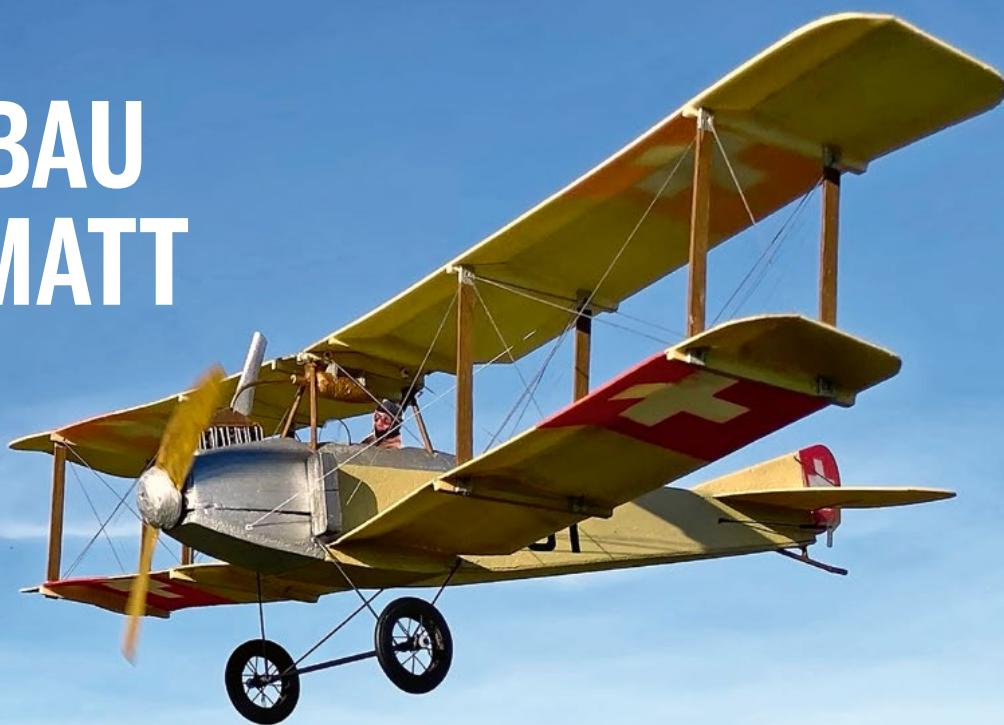
"Modellbau Wintermatt" actually brings together two stories: One recounts a chapter of aviation history that is likely largely unknown, and the second shows how a small model-building project can help revive the pioneering spirit of aviation.
First, let’s talk about Wintermatt: A farm by that name still exists northeast of the village of Kirchlindach. Most aviation enthusiasts—as well as many residents of Kirchlindach—are likely unaware that an airfield existed there in 1919. It was intended as a replacement for the Beundenfeld airfield in Bern, which was becoming increasingly unsuitable. On January 8, 1919, the first test mail flight took place from Dübendorf to Oberlindach, Bern; the flight lasted about an hour—depending on wind direction and strength(!)—and was carried out using a Häfeli DH-3 biplane. A pilot was stationed at Wintermatt, a restaurant was operated there, and eventually a hangar was built; However, the hangar was never put into operation and was moved to Dübendorf. There was even a pilot permanently stationed in Niederlindach; passenger flights were also offered. I am aware of a photograph from 1919.
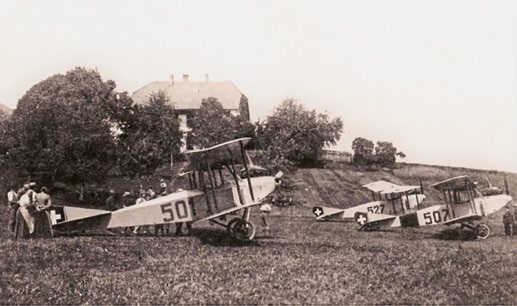
The Wintermatt airfield is less than two kilometers from the MG Münchenbuchsee flying field. The same is true of the model flying club’s founding location: It was established 50 years ago, in January 1976, at the restaurant Zur Waage, which is also less than two kilometers from Wintermatt.
All these connections meant that we had long been talking about reviving the history of Wintermatt through model building. But talking and doing are two different things—a well-known phenomenon...!
It has been gradually implemented over the past two years. Strictly speaking, Isidor von Arx, one of the builders of the manned Nieuport N23 HB-RNB, got the ball rolling: He built a small 1:24 scale model of the Nieuport, offered by the company Microaces. His questions about the remote-control components drew our attention to this type of model building. And: It sparked our interest in recreating aviation history in this way.
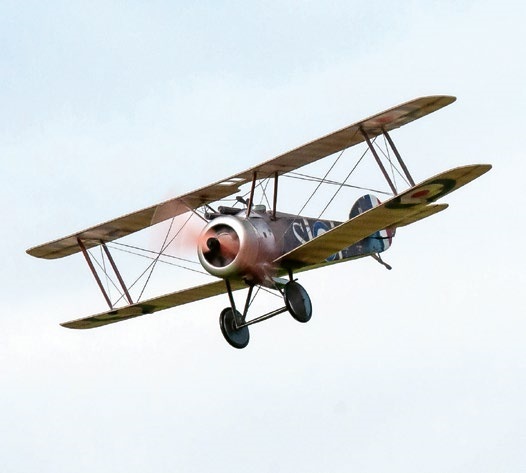
First, as an experiment, I built a Sopwith Camel kit from Microaces. The kit’s parts, made of thin, printed Depron, are impressively precise. Assembly is fun, but it’s definitely not for beginners. The sleek biplane ultimately weighed a good 40 g and flew surprisingly well right from the start—provided the flying conditions were right. Understandably, this little model doesn’t like wind!
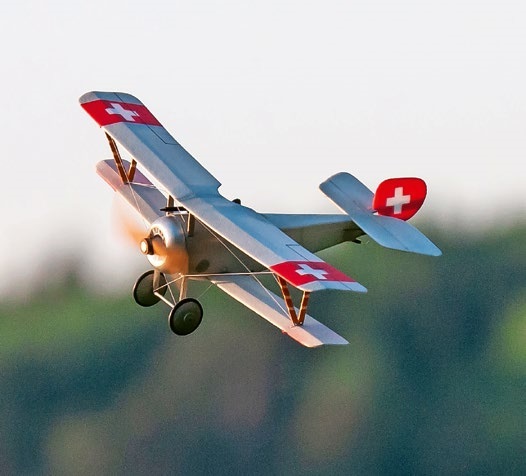
That success prompted me to tackle my second replica: a Swiss-designed Nieuport that I planned to build myself using Spaltdepron. The construction method is very similar to that of the Sopwith Camel. However, I deliberately omitted details such as the rotating dummy rotary engine in favor of greater practicality for everyday use. I used the material extremely sparingly, which meant that the airframe, including a 160-mAh 1S LiPo battery, weighed just 31 g ready to fly! The flight characteristics have improved accordingly—especially in the evening, flying this little biplane is a blast!
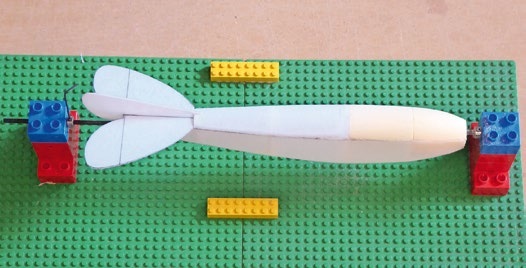
You’d think it should be possible to build the Häfeli DH-3 this way, right? Using a three-view drawing—which I scaled to the correct size with a copier—I made my initial design considerations; next, I cut out the Depron parts. The model’s assembly follows the now quite familiar construction method: I threaded the frames onto a CFRP tube; the CFRP tube is secured in the desired position using adjustment rings and, once the rings are loosened, can be rotated as needed depending on the step being worked on; the appropriate height for the task can be set using additional LEGO Duplo bricks. All parts that needed to be sanded into shape were made from Styrofoam and were hollowed out as much as possible during the shell construction; every missing gram counts! In any case, the hull shape already seemed to fit quite well.
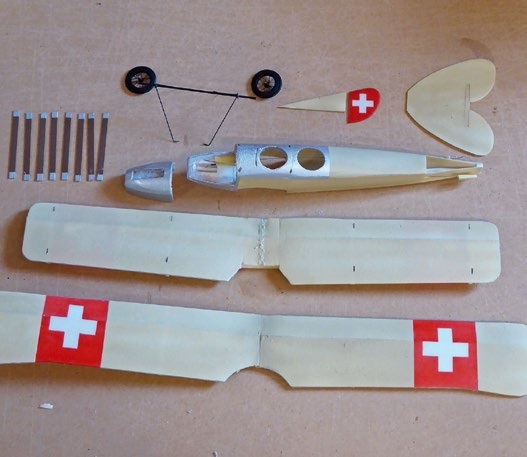
The wings were made from 1.5-mm split Depron; like the Microaces models, they have a bend in the top third of the wing. This works very well in flight! I tried fitting the parts together as a test—which turned out to be an extremely tricky task. For a moment, I doubted whether it would turn out right...! The landing gear was mounted in Bowden cable tubes—at least that part was straightforward and seemed stable enough! Before the final assembly, all the parts were painted:
The airbrush and a fine paintbrush were the right tools for the job. The scale-accurate bracing gave the little model the necessary stability—now the whole thing was looking a bit better. Assembling the tiny gear motor, the receiver module from the scrap box, and the control linkages was, once again, very nerve-wracking, but a silver lining was visible on the horizon—that kept me motivated...! Small details like a simulated engine, a matching spinner, a radiator, and a painted plastic propeller complete the little model.
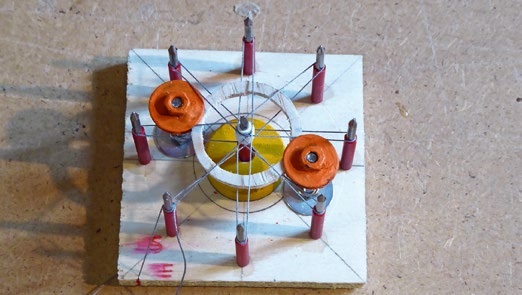
And yes, you’re right: I built spoked wheels! Using balsa wood, plywood, embroidery floss, and Bowden cable tubing—and with the help of a special tool—I created spoked wheels weighing just under 1.5 g each. I’m aware of even more precise ways to replicate spoked wheels; however, my version works reliably and quite quickly, and—despite all its flaws—meets my needs.
| Wingspan: | 52 cm |
| Length: | 35 cm |
| Scale: | 1:24 |
| Drive: | Gear motor from the scrap bin |
| Battery: | 160 mAh Lipo / 1S |
| Flight weight: | 44 g (including battery) |
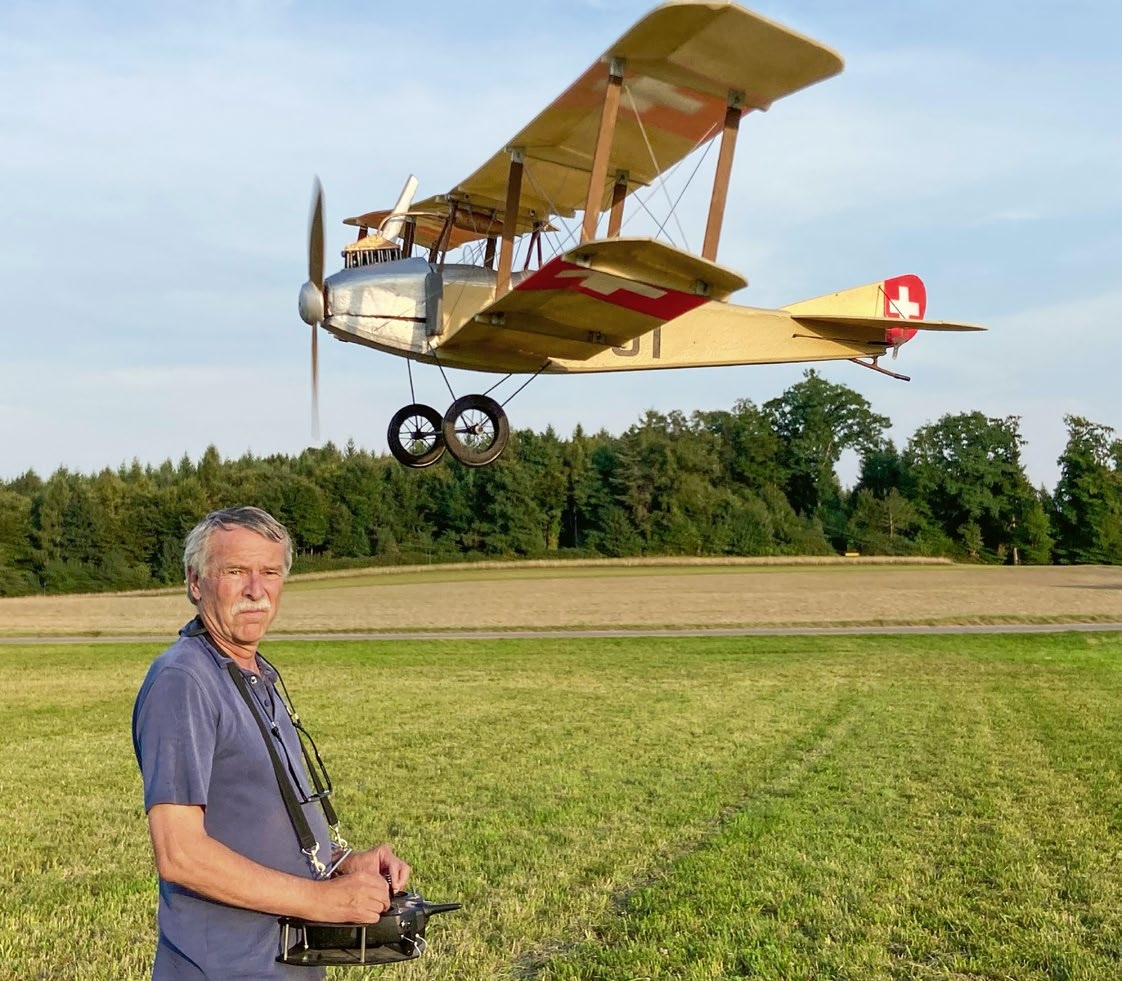
Now the three models were standing in front of me, and the big question was: Will the replica of the Häfeli DH-3 actually fly ...?!?
I’ll make it short: The little model flies superbly. What’s
particularly surprising is how well it handles, despite the small rudder: Even during the very first flights on a windless evening, there were near misses—but the pilot still seems quite focused—this is hardly what you’d call relaxation...! In the meantime, after numerous successful flights, the pilot’s tension has given way to sheer joy! More than 100 years later, a biplane flew over Wintermatt once again—joy reigns!
Photos by Philip Rickli and Res Dauwalder


News from HEBU

TEAM MANAGER "THIS" BOSSHARD
 Rodito Nussbaumer

YOU KNOW WHAT I MEAN? 125 YEARS OF THE SWISS AERO CLUB
 Emil Giezendanner

HORIZON HOBBY/LEMACO NEWS: MICRO OV-10 BRONCO 645 MM BY E-FLITE

PRIDE AND GOOD IDEAS
 Markus Nussbaumer

34th HAHNENMOOS ALPINE MODEL AIRPLANE CAMP
Res Dauwalder
TRY-OUT DAY AT MFV WETTINGEN
Urs Keller
F3A EUROPEAN CHAMPIONSHIPS IN ST-MACAIRE, FRANCE
 Matthias Bosshard

52. 2026 ALPS CUP
Emil Giezendanner
ATOM, THE NEW DOUBLE-DECKER FROM CPLR
Matthias Bosshard
SUMMER FUN 2026 AT MG USTER
Martin Wunderli
What's New at Leomotion.com

THE PC-21 STORY
Emil Giezendanner
COUPE DES ALPES – OBSERVE AND LEARN
Rodito Nussbaumer
TWIN TOWN PARTNERSHIP
Wolfgang Voeller
EURO CONTEST GLIDER ACRO TOUR AUSTRIA 2026

BY YOUTH, FOR YOUTH
Lorena Betschen
CORSAIR F4U – A WARBIRD WITH A MEMORABLE LOOK
Jürgen Rosenberger, Jürgen Prinz
SMALL, MODEL-LIKE SAILBOATS
Res Dauwalder
WELCOME, NEW MEMBER!
Andrea Bolliger
FREE FLIGHT IN THE MIDDLE OF SUMMER
Urs Muntwyler
INSIGHTS INTO THE HISTORY OF SEAPLANES

NEWS FROM HEBU
 Julia Bucher

FROM 0 TO 100
Markus Nussbaumer
MEMORIES
Wolfgang Völler
NOS REGION – A HUB FOR ELECTRIC AVIATION
Emil Giezendanner
DO YOU KNOW WHAT I MEAN IN THE LAND OF SMILES?
Emil Giezendanner
A SPECTACULAR F3A WORLD CUP IN THE PRINCIPALITY OF LIECHTENSTEIN
Emil Giezendanner