
Flying with Muscle Power
An Interview with Paul MacCready, Pasadena,
February 12, 1979
Age: 53, Ph.D. in Aeronautics.
President of AeroVironment, Inc., a company specializing in research, services, and products in the environmental and energy sectors.
Pilot: Gliders, single- and multi-engine light aircraft, instrument rating, hang gliders, human-powered aircraft. Flies for business, for pleasure, and in competitions. For some time now, a lack of time has prevented him from flying.
1956 World Gliding Champion.
Inventor of the “MacCready Speedring,” a gliding instrument for determining the
in downdraft zones.
He was there in the mid-1960s when Richard Miller, a journalist, made the first Rogallo flights with his “Bamboo Butterfly.”
In 1974, he let Taras Kiceniuk, a middle school student, use his computer to develop the profile of the Icarus V.
He has three sons: Parker (19), Tyler (17), and Marshall (11). Parker and Tyler have been flying hang gliders for seven years.
He recently proposed a wind tunnel program to study the stability characteristics of various Rogallo-type hang gliders. The program will be conducted later this year at Stanford University in San Francisco. NASA is funding the program and providing its facilities. Paul MacCready is a member of the advisory committee.
In July 1976, he decided to take on the Kremer Prize. His idea was to triple the
wingspan of a hang glider while maintaining the same weight. A year later, on August 23, 1977, he won the 50,000-pound prize with an aircraft called the “Gossamer Condor,” which was a slightly improved version of his original design.
He is currently working on yet another improved version, the “Gossamer Albatross,” in an effort to win a new, even more lucrative Kremer Prize for crossing the English Channel.
The attempt is scheduled to take place in the spring. The project leader is Stirling Stoll, one of
the world’s best hang gliders and an employee of Seagull Aircraft.
He is the author of various articles on turbulence and safety, aerodynamics, and the aerodynamic performance of birds, published in “Hang Gliding” in 1976–77.
Q: What are the most significant improvements in the Albatross compared to the Condor?
A: The proportions are the same, as is the control system, because we found that it works well. The airfoil is one-third shorter, and the entire design is more aerodynamic. The wings and stabilizer are built with greater care, more like those of a glider—not as crumpled or wrinkled. The entire structure is better, lighter, and more durable. As a result, the Albatross can be flown with less effort.
Q: Despite the smaller wing area?
A: Because we build the wing better, it performs better and yields higher lift coefficients. The efficiency of the old wing wasn’t very good because it was built a bit sloppily.
Q: Why is the wing swept?
A: The main reason was the placement of the center of gravity. If we didn’t have sweep, given the way the frame is designed—with the vertical spar passing through the connection point of the spars—the center of gravity would be too far back. The simplest way to adjust the center of gravity was to sweep the wings. The sweep might also improve stability. We haven’t investigated whether it offers any aerodynamic advantages.
Q: Would you like to say something about the wing profile? Wouldn’t it be a good profile for a hang glider?
A: The profile seems to work well. We use it for the wing, the stabilizer, and the propeller, all of which operate at roughly the same Reynolds number. We’ve never tested it thoroughly. My colleague, Dr. Lissaman, designed it, and when we installed it, we were satisfied. We had previously tried a number of other profiles, none of which were as good.
I can’t say whether it’s good for a hang glider. It would probably be quite good, but I can’t guarantee it. You can design an airfoil for very specific applications. If someone wants to build a hang glider, they must first consider what characteristics their aircraft should have. Then they can develop an airfoil that best meets their requirements.
Q: Did you calculate your airfoil to yield the highest possible lift-to-drag ratio at the desired operating speed?
A: The design methods aren’t that sophisticated. We aimed for a high lift coefficient just before stall, as well as the smallest possible moment of instability, low drag values over a wide range of angles of attack, and insensitivity to construction inaccuracies.
Q: Do you plan to publish your airfoil?
A: We already do. We sell the Gossamer Condor plans for $75: 60 pages of text and images, plus 12 drawings, including the airfoil. For those interested only in the airfoil, we also provide the airfoil
separately, including the drawing and coordinates.
(Contact: AeroVironment, Inc. – 145 Vista Avenue – Pasadena, CA 91107).
Q: Do you have a professional interest in human-powered aircraft, or is this just a hobby?
A: I found the prize of 50,000 pounds very enticing. It seemed as though one could win it without much effort and make a nice profit. Over time, we became increasingly interested in the project, even as it became increasingly clear that the effort required was greater than expected and that there wouldn’t be much financial gain. By that point, however, the project had already become a fascinating hobby.
Q: What do you think is the significance of your muscle-powered aircraft from the perspective of
aircraft technology in general?
A: I suspect that in the future, more attention will be paid to aerodynamic aspects in the field of ultralight aircraft. Hang gliders, whether motorized or not, can certainly be improved significantly. However, I don’t believe that any design features of our aircraft are transferable to future general-purpose aircraft. The only truly new aspect of our design is the combination of the tiltable stabilizer and the torsionally flexible wing. But basically, birds have been doing it this way for 100 million years. So the system isn’t really that new after all. Moreover, it’s probably not suitable for commercial aircraft either. In short, I don’t believe we’re on the verge of making a contribution to conventional aviation.
Q: Your airplanes seem to be connected to the Rogallos in some way. How exactly is that?
A: If I hadn’t been so interested in the Deltas back then, the Gossamer Condor would never have come to be. At the time, I spent many a weekend with my children, and together we built Rogallos. That’s how I gained knowledge about how to build Rogallos, which, by the way, impressed me with their simplicity. So the Deltas contributed some design concepts to the Condor. To be precise, the Condor was the result of computational studies I conducted to compare delta kites, birds, and gliders in terms of flight speed and the energy required to maintain a state of gliding flight.
Q: So the Rogallo hang gliders served as a source of inspiration for you?
A: Yes. They were one factor. Not the only one. There were others as well.
Q: Still, I find it remarkable that an eminent specialist like you would allow yourself to be influenced by a community where, for the most part, complete amateurs are toiling away without any knowledge or experience. The typical
attitude of less eminent specialists toward these efforts was skepticism, if not outright hostility.
A: Well, I’m also a layperson when it comes to building an airplane. Although I have a doctorate in aeronautics, I’ve never pursued aviation professionally—only as a hobby. And that hobby, moreover, was limited to flying airplanes. I’m a beginner in the field of aircraft construction. However, that may have been a key factor in the development of the Gossamer Condor. Had I had more experience, my ideas would have followed more conventional lines, like those of the other Kremer Prize competitors before me. The fact that I had no experience forced me to thoroughly rethink the whole thing, define a correct starting point, and then—as one element after another took shape—always do whatever seemed simplest, without worrying about how others had done it before me.
Q: That’s a remarkable thought—a lack of experience as an advantage in research.
A: Yes, that’s exactly how it can work out.
Q: Do you see any scientific significance in modern Rogallo-type hang gliders?
A: It surprised me—just as it did many other people in the aviation community—that this type of aircraft has achieved such a remarkable level of performance and controllability. I wouldn’t have believed that it would ever work as well as it does today. And the reason for this is that so many brilliant, hard-working people have dedicated themselves to its development, putting in an enormous amount of development work—the painstaking way, so to speak—through “trial and error.” I do believe, however, that the Rogallo wing has, in a sense, reached a dead end. It can’t be developed much further. I foresee that the most exciting developments over the next five years will come from the field of aerodynamic control, not only for rigid aircraft but also for flexible ones. We will have positive control around three axes. Many delta-wing enthusiasts are emotionally opposed to this. They prefer the freedom and simplicity of current aircraft, which give them a sense of direct contact with the air. But if they only had the chance once to fly in an aircraft with positive three-axis control—with slow-flight characteristics that are just as good or even better—and sitting inside it rather than hanging beneath it, they would very soon find that they felt just as connected to the air, if not even more so. I remember an open-cockpit glider that could fly slowly, at 45 km/h. That glider was just as exciting as a delta wing. I felt as connected to the air as it is humanly possible to feel.
Q: In your opinion, is a lack of stability an inherent characteristic of Rogallo wings?
A: No. The problem can certainly be solved. But I’m not sure if there’s a simple way to solve it. Every time you run into a problem, you have to find a solution, which usually results in increased complexity, so that in the end you have something that works perfectly but is so complicated that its original appeal has been lost.
Q: So will the Rogallo hang glider perhaps disappear over time?
A: That’s hard to predict. It’s simply difficult to make a flexible wing just as efficient as a rigid one. The exact shape of the first 20 cm of the airfoil, measured from the leading edge, is extremely important for a favorable lift-to-drag ratio. Now, the round wing tube of a Rogallo isn’t exactly a well-shaped leading edge. So one would first have to improve this contour to achieve a more favorable profile. Then one would have to add more ribs. That’s certainly possible. But I doubt it would be wise to go to great lengths to make a Rogallo rigid, as this would make it much more complicated. It would make much more sense to choose, as a starting point, a structure that best meets the requirements in terms of aerodynamics and elasticity.
Q: In conversations with a number of American hang gliding specialists, I have noticed that they no longer evaluate their gliders solely on the basis of aerodynamic performance, but rather on “effective performance.” By “effective performance,” they mean a glider’s ability to stay aloft. Most flights with these gliders take place under conditions where good controllability and quick response to control inputs have a more decisive impact on flight duration than a slightly better rate of descent. Efforts over the past two years have therefore been aimed at improving controllability, and remarkable results have been achieved—often at the slight expense of aerodynamic performance. Don’t you think that focusing solely on aerodynamic performance means neglecting important factors?
A: I agree. But with these flexible wings, it’s just the way it is—and what you’re saying confirms it—that controllability comes at the expense of performance. In reality, there’s a constant trade-off. You try to achieve maximum performance while still maintaining acceptable controllability and stability. The result is that you always have to operate close to the danger threshold. With a rigid wing, you can significantly increase performance while maintaining perfect controllability. This brings us back to the philosophy that it’s best to have a wing that does the job of a wing, a tail that does the job of a tail, and a fuselage that does the job of a fuselage. If you start mixing functions, you shouldn’t be surprised when performance drops. You gain simplicity, but the results are not as good.
Q: What do you think will be the impact of hang gliding on aviation?
A: I look forward to the future of ultralight aviation with enthusiasm. I expect to see the development of a huge industry that will produce safe, inexpensive, and fun aircraft. This is a very promising field that may well surpass current private aviation in terms of numbers within the next five years. We don’t yet have any viable aircraft. I think that closer collaboration between brilliant aerodynamicists and inventive hang gliders could produce viable ultralight aircraft.
Q: Do you see a future for motorized hang gliders?
A: Yes, but not with these heavy engines. Currently, the gliders are still too underpowered and too heavy, so they require a large engine that adds even more weight and causes a tremendous amount of noise and vibration. First and foremost, we would need to develop a glider with better aerodynamic performance and even less weight. Then a small engine would suffice, and the whole thing wouldn’t be any heavier than the non-motorized gliders commonly used today.
Q: Will ultralights get even lighter?
A: Yes. Lighter and with less horsepower. It’s possible to develop a hang glider with a sink rate of 50 cm/sec. A very small engine would then be sufficient for climb.
Q: What kind of weights are you thinking of?
A: Around 20 kg. Maybe a little less, with the motor and everything.
Q: I heard that you're involved in a research program at Stanford University.
A: I helped initiate it, and I'm a member of the advisory committee.
Q: What is the goal of the program?
A: To gain a better understanding of stability conditions and control mechanisms in hang gliders.
Q: Do you want to get professional and academic aerodynamicists interested in this topic?
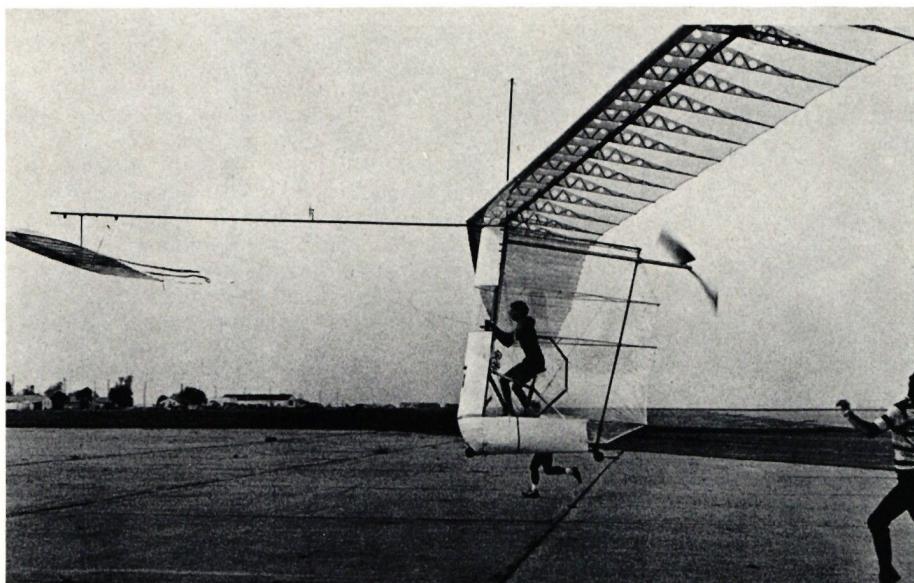
When, on August 23, 1977, at Shafter Airport in California, Bryan Allen flew the “Gossamer Condor,” a design by the renowned glider pilot Paul MacCready, had met the conditions for winning the Kremer Prize, the history of human-powered flight had entered a new phase. This prize had been open for eighteen years. It had since been increased to 50,000 pounds sterling and required a takeoff without any external assistance, followed by a flight at a height of three meters in a figure-eight pattern.
The aircraft took off at 7:30 p.m. and landed 7 minutes and 27.5 seconds later. The flight had lasted 6 minutes and 22.5 seconds, during which the official course—a figure-eight around two pylons 800 m ($ rac{1}{2}$ mile) apart at a height of 3.0 m (10 ft) at the start and finish. The flight speed was between 16 and 18 km/h. The total flight distance from takeoff to landing was 2.17 km, of which 1.85 km was along the required course.
Paul MacCready was awarded the prize on September 30.
A: Exactly. When hang gliding first began in the early 1970s, there were a lot of people—mainly among glider pilots—who had nothing but contempt for Rogallo hang gliders. It took a while for this type of aircraft to gain enough respectability that professionals began to take an interest in it. Now the field is open for the knowledge of the established aviation community to combine with the inventiveness and vitality of the hang gliding community.
Whenever something new begins, there are always people who resist it. The pioneer must simply ignore these negative influences. On the other hand, he must try to benefit from existing knowledge.
Q: Do you think the FAA (Federal Aviation Administration) is acting appropriately?
A: Yes.
Q: So you think it's right that she doesn't deal with hang gliders?
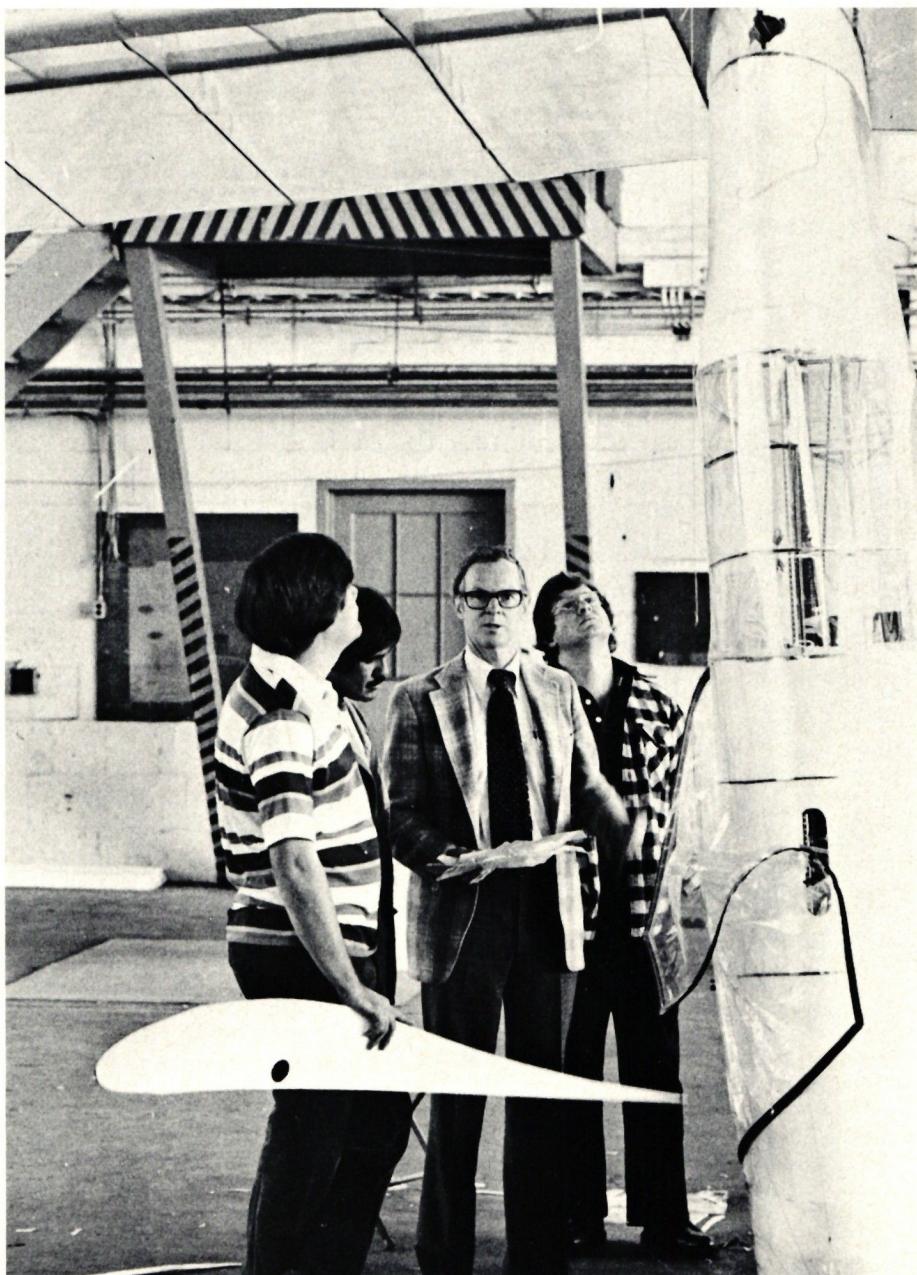
*Bill Watson is holding an unclad wing section. It consists of handcrafted graphite tubes and ribs made of fiberglass-reinforced foam with diagonal bracing. The visible wires are made of Kevlar.*
A: It doesn't try to help or promote anything. But it monitors developments and, for the most part, allows a fair and reasonable degree of freedom of action.
Of course, I can’t know how this will play out. But I’m confident that logic will prevail. Once better gliders come along and there are several hundred thousand in operation, the FAA will have no choice but to address the issue. Currently, there are perhaps 30,000 hang gliders in the U.S. They only make short flights and not very often. Thus, their “utilization rate” of airspace is minimal. That will change, of course, if their numbers multiply and they are flown more frequently and for longer periods using power units.
Q: Who is funding the Stanford program?
A: NASA.
Q: So the government?
A: Yes. NASA has been increasingly supporting private aviation lately. Previously, it had focused more on large-scale industry and military aviation.
Q: Do you have any advice for hang glider pilots?
A: The more the hang gliding community collaborates with the established aviation industry, the better. The sport of hang gliding still needs to mature a bit. You still read articles in hang gliding publications that romanticize the dangers of the sport in a foolish way and hold up the emotionally immature “tough guy” as a role model. Sure: flying is fun, but flying dangerously isn’t. This realization is gaining more and more traction in this country. Pilots and manufacturers are increasingly acting on the principle that safety takes precedence over performance. Unfortunately, this learning process has cost so many their lives or their health
cost. On the other hand, the HGMA’s type certification program is a good example of a smart initiative that proves the hang gliding community is capable of self-regulation in the interest of its own safety.
*It’s done!
**On June 12, 1979, Allen “cycled” to Calais in the Gossamer Albatros in 2 hours and 40 minutes, thereby winning the Kremer Prize (360,000 francs) for himself and the MacCready team.*
*This text, which I consider very noteworthy, was published in MFS through the Swiss Hang Gliding Association (SHV). Many thanks to Mr. Pfändler, President of the SHV! I would also like to thank the editors of Aero Revue for returning this interview to the author unpublished. Editor.*


TEAM MANAGER "THIS" BOSSHARD
 Rodito Nussbaumer

F3A EUROPEAN CHAMPIONSHIPS IN ST-MACAIRE, FRANCE
 Matthias Bosshard

News from HEBU

YOU KNOW WHAT I MEAN? 125 YEARS OF THE SWISS AERO CLUB
 Emil Giezendanner

SUMMER FUN 2026 AT MG USTER
Martin Wunderli
TRY-OUT DAY AT MFV WETTINGEN
Urs Keller
52. 2026 ALPS CUP
Emil Giezendanner
BY YOUTH, FOR YOUTH
Lorena Betschen
CORSAIR F4U – A WARBIRD WITH A MEMORABLE LOOK
Jürgen Rosenberger, Jürgen Prinz
SMALL, MODEL-LIKE SAILBOATS
Res Dauwalder
What's New at Leomotion.com

ATOM, THE NEW DOUBLE-DECKER FROM CPLR
Matthias Bosshard
INSIGHTS INTO THE HISTORY OF SEAPLANES

34th HAHNENMOOS ALPINE MODEL AIRPLANE CAMP
Res Dauwalder
HORIZON HOBBY/LEMACO NEWS: MICRO OV-10 BRONCO 645 MM BY E-FLITE

COUPE DES ALPES – OBSERVE AND LEARN
Rodito Nussbaumer
PRIDE AND GOOD IDEAS
 Markus Nussbaumer

EURO CONTEST GLIDER ACRO TOUR AUSTRIA 2026

FREE FLIGHT IN THE MIDDLE OF SUMMER
Urs Muntwyler
THE PC-21 STORY
Emil Giezendanner
TWIN TOWN PARTNERSHIP
Wolfgang Voeller
WELCOME, NEW MEMBER!
Andrea Bolliger
NEWS FROM HEBU
 Julia Bucher

FROM 0 TO 100
Markus Nussbaumer
MEMORIES
Wolfgang Völler
NOS REGION – A HUB FOR ELECTRIC AVIATION
Emil Giezendanner
Have you almost forgotten about aircraft that take off and land vertically?
Emil Giezendanner
70 YEARS OF THE NIDWALDEN MODEL AIRPLANE CLUB
Martin Barmettler