
Final Report from the Crew
Unlike the official report by the team leader, which is accessible only to the MFK, this report is intended for anyone interested in RC gliding. Copies of this report have therefore been distributed to a wider audience, including the editorial staff of *Aero Revue*. Written in a diary-like style, the report comes across as very lively and practical. Ed.
| 1. Miller | USA | 13185 |
| 2. Roos | South Africa | 12,919 |
| 3. Bannister | England | 12,844 |
| 4. Ten Holt | Netherlands | 12,508 |
| 5. O'Reilly | Australia | 11,960 |
| 6. Smith | Australia | 11,855 |
| 7. Decker | Germany | 11,829 |
| 8. Nutter | USA | 11702 |
| 9. Mattingley | England | 11343 |
| 10. Schiborr | Germany | 11106 |
| 11. Payne | USA | 10,692 |
| 12. Läderach | Switzerland | 10659 |
| 13. Meester | Australia | 10544 |
| 14. Baumgartner | Switzerland | 10523 |
| 15. Spavins | South Africa | 10510 |
| 16. van Leeuwen | Netherlands | 10,489 |
| 17. Keim | Holland | 10,465 |
| 18. O'Shea | England | 10302 |
| 19. van der Meulen | Belgium | 10194 |
| 20. Gassmann | Switzerland | 10185 |
| 21. van Nuffel | Belgium | 10181 |
| 22. Casadei | Italy | 9761 |
| 23. Saager | Germany | 9683 |
| 24. Reuland | Canada | 9679 |
| 25. Greis | Luxembourg | 9623 |
| 26. Humphreys | Canada | 9621 |
| 27. Givone | Italy | 9504 |
| 28. Drew | South Africa | 9092 |
| 29. Pagliano | Italy | 9002 |
| 30. Topf | Canada | 8629 |
| 31. Kemp | Luxembourg | 8599 |
| 32. Governor | Belgium | 8540 |
| 33. Sfredda | Luxembourg | 8129 |
| 34. Wasner | Austria | 7007 |
1. United States | 35,579 |
2. England | 34,489 |
3. Australia | 34,359 |
4. Netherlands | 33,462 |
5. Germany | 32,618 |
6. South Africa | 32,521 |
7. Switzerland | 31,367 |
8. Belgium | 28,915 |
9. Italy | 28,267 |
10. Canada | 27,929 |
11. Luxembourg | 26,351 |
12. Austria | 7,007 |
The 1st RC Gliding World Championship is now history. While this was certainly not an earth-shattering event, it did, at the very least, yield some important insights for RC gliding. It became clear that the current regulations for this category—which were enshrined in the Code Sportive in 1975—are in urgent need of revision, both from an organizational and a flying perspective. Various international competitions held last year, as well as this very first World Championship, revealed some serious shortcomings through practical experience. Unfortunately, the FAI’s International Sports Commission, CASI, has frozen all regulations for a period of four years. For regulations that have been in place for years and have been tested in practice, this decision may still be somewhat acceptable. In our case, however, an urgent revision must be possible to ensure fair treatment of competitors and to simplify the organization.
It is a well-known fact that luck plays a major role in gliding, especially given constantly changing thermal conditions. Just think of the endurance flight and the distance flight. Depending on the number of competitors, these disciplines each last between one and three hours. The luck factor will likely never be completely eliminated in gliding. However, we must seek ways to reduce these influences to a fair degree. In the very near future, we need to give this serious thought and seek solutions that, on the one hand, make the competition fairer and, on the other hand, help significantly alleviate the enormous organizational burden. As I have observed, the CIAM RC Gliding Subcommittee is working diligently on these issues but has not yet found a solution. I am convinced that we here in Switzerland can and must also play an active role in this effort.
On the occasion of this first World Championship, our new South African friends have shown us in an exemplary manner how, at such an event, the major problems that arise can be transformed from a fiasco into a resounding success through the uncompromising acceptance of objective criticism and the open acknowledgment of one’s own mistakes. The organizing committee’s clear motto—to make the entire World Championship an unforgettable experience for all participants and to accommodate the wishes of the teams traveling from different continents as much as possible—was well received by everyone present. Everyone was willing to contribute to the success, and the final two days in particular rewarded everyone—both the organizers and the competitors—with an exciting yet fair and dignified conclusion to this first World Championship.
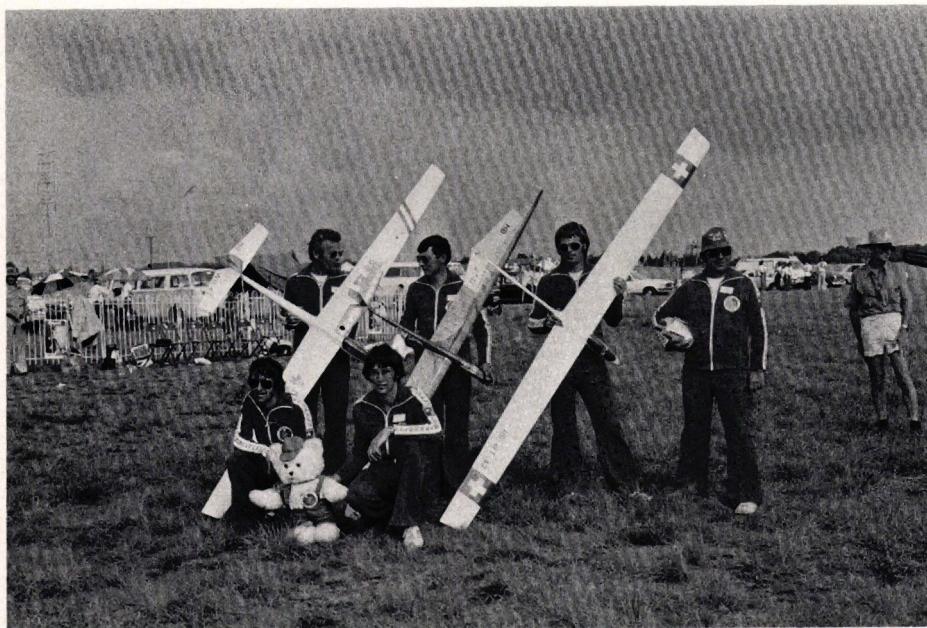
I would like to add a heartfelt thank you to the high-launch team to the following report from our teammate Karl. It’s not something to be taken for granted—the way our two teammates, Karl Voser from MFC Wehntal and Heinz Schenk from MG Thun, made themselves available to our team in such an exemplary manner. The trip to South Africa was certainly no small feat, especially from a financial standpoint, and there was no glory to be had for our tireless helpers. I am convinced that it was only thanks to this support that our pilots were able to achieve such impressive results in the first place.
This also highlights another problem that urgently needs to be resolved. Despite the financial contribution granted to us by the MFK—primarily from funds provided by the Pro Aero Foundation—the financial burden on each individual national team member was enormous. It’s fair to say that these expenses far exceeded what was affordable and reasonable. In the short time available to us, we were at least able to convince a few personal friends to provide some relief to the team in the form of a donation, for which we extend our heartfelt thanks to all these friends. The sticker campaign we launched also helped reduce the personal financial burden on our national team. Certainly, a personal sacrifice can be expected from our pilots. But consider that the preparations alone required nine full days of training, which were also paid for out of their own pockets. Swiss RC gliding certainly benefits from its national team. Every RC glider pilot in Switzerland can be confident that they will receive all available information—regarding flying, model construction, and organization—from the national team. We have no intention of selling our information, but it should be possible to support the immense work—including training through participation in international competitions and the World Championships—carried out by the large community of hundreds, even thousands, of active participants and supporters through personal contributions, donations, and other forms of assistance—such as support in aircraft development, the provision of aerodynamic documentation, and the like—to support the immense work involved in training through participation in international competitions and World Championships. To field a strong national team, pilots are required to sacrifice virtually all of their free time. But to expect these people to also dig deep into their wallets on top of that is certainly asking too much. In my very personal opinion, it is high time that RC performance gliding be granted the status of a competitive sport. However, since even the performance pilots in the manned category have so far fought in vain for this recognition, such demands in model aviation seem to be nothing more than a pipe dream. Performance model aviation certainly has much more to offer than just the foundations for the commercial exploitation of successful model aircraft. It can and should promote understanding among like-minded people nationally and, above all, internationally; and, last but not least, it helps ensure that even hobbyists and casual model aviators can participate in technical and flying developments, allowing the large and broad base of model aviators to improve their performance. It is precisely here that a great opportunity arises for anyone who wants to and is able to benefit from this development to make their modest contribution.
I would also like to sincerely thank our pilots, Geri, Ruedi, and Paul, for their excellent performance in South Africa. Through their willingness to learn from their mistakes and put their experiences into practice, they have certainly made a significant contribution to Swiss RC gliding. The commitment to excellent teamwork among all participants was soon recognized without envy by everyone present in South Africa, and so we were able to promote a positive image of Swiss model aviation.
Team Leader: Hans Ruedi Schläpfer
After a hectic day, we arrived at Kloten Airport on Thursday evening, March 24, at 9:30 p.m. We had a good laugh when Paul arrived in the departure hall with his massive model transport crate. The crate was so huge that we feared Paul would need an extra plane to transport it to South Africa. After the usual check-in formalities, we were able to board the British Airways jumbo jet—about an hour and a half late—and off we went toward South Africa. After 13 long hours, we landed in Johannesburg, south of the equator, at 2:00 p.m. local time.
To our surprise, we were given a royal welcome at the airport by representatives, led by the energetic master of ceremonies of the first World Championship, Monte Malherbe. We would only learn the reason for this grand reception later. All the great effort that had gone into preparing for this major event for RC glider pilots was nearly undone by the customs authorities in Johannesburg when Ralph Decker arrived the day before with his models and the customs officials sought to demonstrate all their petty bureaucracy. As the competition director so aptly put it, in those moments, the South African model aviation community came close to losing Monte to a heart attack. Thanks to the tremendous support of the organizing committee members present, the customs clearance of our models proceeded quickly and smoothly. While we were still at the airport, we were introduced to Mervin Brett. He explained that he had been delegated by his company to look after the Swiss team during the World Championships, to help us resolve any difficulties, and to ensure we maintained smooth communication with home. Mervin Brett is the branch manager of Schindler Lifts in Pretoria. Before long, our models—which, by the way, had survived the trip in excellent condition—were loaded onto a truck. We rented two VW buses, and off we went, guided by our new friends, to Pretoria, to the Burgerspark Hotel. During the 45-kilometer drive, we got our first taste of driving on the left side of the road. The accommodations at the four-star hotel were luxurious, located in the heart of the garden city of Pretoria and in a quiet area. However, the service sometimes left a bit to be desired, and this occasionally led to some rather amusing situations. All competitors, as well as the senior organizing committee members and the jury, were staying at the same hotel. This allowed for close contact as well as quick and reliable communication. In our opinion, this was an exemplary solution. After a well-deserved swim in the hotel’s pool and a restful night, we took an excursion crisscrossing Pretoria on Saturday. We visited Monte and asked for directions to the airfield. In the afternoon, we inspected the airfield together with the Italian team. Our impression was positive. We found a gently sloping plain—ideal for the high-launch team, provided the wind blew from the right direction. The grass was cut short. The arena was approximately 300 meters long and 200 meters wide, which was toward the lower end of the range. All larger stones and boulders had been removed thanks to a major effort by members of the SAAF. It was a massive undertaking, as competition director Jack Abbot assured us.


News from HEBU

TEAM MANAGER "THIS" BOSSHARD
 Rodito Nussbaumer

SUMMER FUN 2026 AT MG USTER
Martin Wunderli
BY YOUTH, FOR YOUTH
Lorena Betschen
SMALL, MODEL-LIKE SAILBOATS
Res Dauwalder
TRY-OUT DAY AT MFV WETTINGEN
Urs Keller
What's New at Leomotion.com

52. 2026 ALPS CUP
 Emil Giezendanner

ATOM, THE NEW DOUBLE-DECKER FROM CPLR
 Matthias Bosshard

INSIGHTS INTO THE HISTORY OF SEAPLANES

YOU KNOW WHAT I MEAN? 125 YEARS OF THE SWISS AERO CLUB
Emil Giezendanner
34th HAHNENMOOS ALPINE MODEL AIRPLANE CAMP
Res Dauwalder
CORSAIR F4U – A WARBIRD WITH A MEMORABLE LOOK
Jürgen Rosenberger, Jürgen Prinz
F3A EUROPEAN CHAMPIONSHIPS IN ST-MACAIRE, FRANCE
Matthias Bosshard
HORIZON HOBBY/LEMACO NEWS: MICRO OV-10 BRONCO 645 MM BY E-FLITE

PRIDE AND GOOD IDEAS
 Markus Nussbaumer

EURO CONTEST GLIDER ACRO TOUR AUSTRIA 2026

FREE FLIGHT IN THE MIDDLE OF SUMMER
Urs Muntwyler
THE PC-21 STORY
Emil Giezendanner
TWIN TOWN PARTNERSHIP
Wolfgang Voeller
WELCOME, NEW MEMBER!
Andrea Bolliger
COUPE DES ALPES – OBSERVE AND LEARN
Rodito Nussbaumer
NEWS FROM HEBU
 Julia Bucher

FROM 0 TO 100
Markus Nussbaumer
MEMORIES
Wolfgang Völler
NOS REGION – A HUB FOR ELECTRIC AVIATION
Emil Giezendanner
Have you almost forgotten about aircraft that take off and land vertically?
Emil Giezendanner
70 YEARS OF THE NIDWALDEN MODEL AIRPLANE CLUB
Martin Barmettler