
DON'T BELIEVE EVERYTHING – BY MAURICE BODMER
Editor’s note: Maurice is now 98 years old and remains a legend in the history of model building in Switzerland, in which he has been actively involved since the end of World War II. He is proud of his two medals: for 50 and 75 years of membership in the AéCS. Curious by nature, he possesses a rare firsthand account of a pioneering era that he has continued to help shape. A sign of his longevity: he still reads *Modellflug-sport*!!!
Until 1944, the only scale models built were swept-wing flying wings.
Guy Borgé, a mathematician from Lyon, had built the first “tailless” models, drawing inspiration from Fauvel’s airplanes and gliders. Airfoils with a raised trailing edge are characterized by being “self-stable.” Their center of thrust shifts only slightly if the aircraft, caught in a wake, nosedives or pitches up.
Guy, who was corresponding with Roger Stamm, had sent him the coordinates of two self-stable airfoil profiles. We tested them at the GMR events in Lausanne, Yverdon, and Vevey. The models we built flew well but had the drawback of flying very fast and, above all, having a high sink rate. While excellent for slope flying, they could not compete with flatland models—and especially not with motorized models.
In 1946, Guy took part in our model-building camp in Verbier. In the evening, in our chalet, we discussed things by candlelight. I asked Guy if it would be possible to improve the performance of our flying wings by using an S-shaped airfoil with a concave underside, as seems to be used by birds that are good gliders.
Guy asked for a pencil and a sheet of paper. And he gave us a presentation that was way over our heads, but full of double and triple integrals. And at the end, he summed it up: the finished model would go into a spin.
Roger, a third-year EPUL student, and I—who had just graduated from high school—didn’t understand a thing. It was the last evening. The next day, on Thursday, we headed home.
The following Sunday was the Philippe Jaquet Cup, named for a classmate who had drowned a year earlier in Lake Geneva. I had two days left. I quickly built a small flying wing, with an 80-cm wingspan and a hollow-bottomed airfoil.
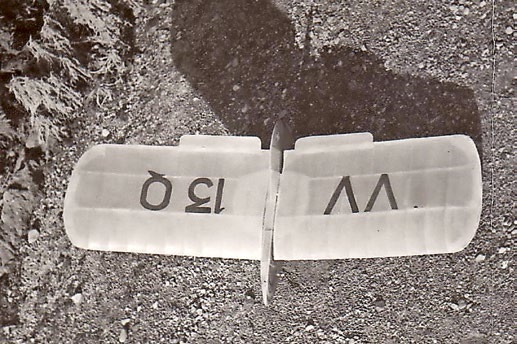
On Sunday, my flying wing was flying, and its sink rate was normal. Thanks to the 50% bonus for flying wings, I placed 4th. But most importantly, my model had proven that we could compete with swept-wing flying wings.
- 1946 Swiss Slope Championship: 1st place—Roger Stamm (flat-bottom profile).
- 1947 Swiss Championship in Lausanne Bléchet (flat field), SK winner: Charles Baumgartner, Yverdon (Charles had a longer flight time than the best standard model).
- 1947 Flying Wing Design Competition in Langenthal: my small motorized model with a 2 cm³ Movo engine was the only one to take off from a relatively short runway.
- And it completed three flights. Charles’s larger model would have taken off if the runway had been longer.
- Roger Stamm placed second in the glider category. He had brought only one ground-launch model. We didn’t know that takeoffs would also be made from a hill. In 1948, Roger participated in an international competition in Lognes (France), and his flatland flying wing performed very well among the standard gliders.
- Since 1969, I’ve had compass-guided flying wings (2nd place in the 1969 Swiss Championship) for slope flying.

TEAM MANAGER "THIS" BOSSHARD
 Rodito Nussbaumer

SUMMER FUN 2026 AT MG USTER
Martin Wunderli
TRY-OUT DAY AT MFV WETTINGEN
Urs Keller
52. 2026 ALPS CUP
 Emil Giezendanner

ATOM, THE NEW DOUBLE-DECKER FROM CPLR
 Matthias Bosshard

INSIGHTS INTO THE HISTORY OF SEAPLANES

34th HAHNENMOOS ALPINE MODEL AIRPLANE CAMP
Res Dauwalder
CORSAIR F4U – A WARBIRD WITH A MEMORABLE LOOK
Jürgen Rosenberger, Jürgen Prinz
SMALL, MODEL-LIKE SAILBOATS
Res Dauwalder
F3A EUROPEAN CHAMPIONSHIPS IN ST-MACAIRE, FRANCE
Matthias Bosshard
What's New at Leomotion.com

HORIZON HOBBY/LEMACO NEWS: MICRO OV-10 BRONCO 645 MM BY E-FLITE

PRIDE AND GOOD IDEAS
 Markus Nussbaumer

News from HEBU

BY YOUTH, FOR YOUTH
Lorena Betschen
YOU KNOW WHAT I MEAN? 125 YEARS OF THE SWISS AERO CLUB
Emil Giezendanner
FREE FLIGHT IN THE MIDDLE OF SUMMER
Urs Muntwyler
THE PC-21 STORY
Emil Giezendanner
TWIN TOWN PARTNERSHIP
Wolfgang Voeller
EURO CONTEST GLIDER ACRO TOUR AUSTRIA 2026

WELCOME, NEW MEMBER!
Andrea Bolliger
COUPE DES ALPES – OBSERVE AND LEARN
Rodito Nussbaumer
NEWS FROM HEBU
 Julia Bucher

FROM 0 TO 100
Markus Nussbaumer
MEMORIES
Wolfgang Völler
NOS REGION – A HUB FOR ELECTRIC AVIATION
Emil Giezendanner
Have you almost forgotten about aircraft that take off and land vertically?
Emil Giezendanner
70 YEARS OF THE NIDWALDEN MODEL AIRPLANE CLUB
Martin Barmettler