
Successful Swiss Free-Flight Pilots
A large field of participants at the 2024 European Championships in Simeria, Romania.
Five Swiss free-flight pilots traveled to Romania. The Andrist family and TM Urs Muntwyler went in two cars, while Lauri Malila flew to Romania. Due to flight delays, he had to take a detour and didn’t arrive in Romania until later. To prepare for the championship, we flew in the World Cup competition. However, none of us managed to complete our flights. The terrain is covered with many corn and sunflower fields, making the retrieval process very strenuous. We each left an F1B model in a very tall, thick hedge during the World Cup. It took us hours to dig the models out without damaging them.
Early Monday morning, we practiced F1A. At noon, the Swiss team’s technical inspection took place, with four models per pilot. In the early evening, there was a brief and uninspired opening ceremony at the small soccer stadium in Simeria. At the team managers’ meeting that evening, I got my first taste of how the event was organized.
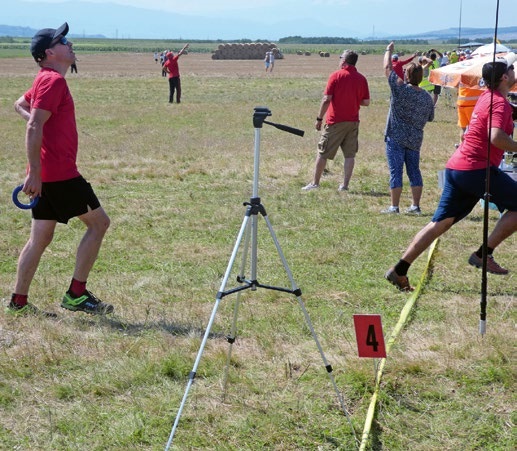
On Tuesday, 84 participants from 27 countries took to the field. Pilot Dominik Andrist reports: “Lauri Malila (F1A World Champion), Christian, and Dominik Andrist made up the team. Everyone safely completed the first round with a four-minute flight time. In the second round, Christian had a bit of bad luck—his line snapped at takeoff and the transition didn’t go well. The model fluttered for a long time before finally flying steadily for the full four minutes. We flew very well and very safely. Until the fifth round, when Lauri didn’t quite catch the thermal and his model came down at 2:20 minutes. Christian and Dominik went into a tiebreaker.
The first tiebreaker takes place with a wind speed of about 3 m/s. Eight minutes are required. Both fly the Flapper, both have great launches and fly safely for eight minutes. But the models are far away—about 2 kilometers from the launch site, in a village. We walk to retrieve the models for the next tiebreaker. Through the sunflower fields, across several railroad tracks, and between the parked freight trains into the village. Christian gets lucky and finds his model quickly; Dominik is in the middle of a residential neighborhood and, despite using GPS, can’t find his plane and has to return to the next round without his best model. Round 3: Now the flight time is 12 minutes. Christian has another top start. Unfortunately, the air conditions aren’t great at the beginning. But the model fights on and flies better and better. In the end, it’s enough for third place behind the new European champion from Slovenia, Bostian Bagarji, and the German Dietrich Sauter. As a team, we take third place. We already have two medals after the first day.”
| 1. | Christian Andrist (SUI) |
| 500 seconds in the 3rd fly-off | |
| 21. | Dominik Andrist (SUI) |
| 146 seconds in the 2nd fly-off | |
| 42 | Lauri Malila (SUI) |
| 1,340 seconds |
| 1. | France |
| 2. | Hungary |
| 3. | Switzerland |
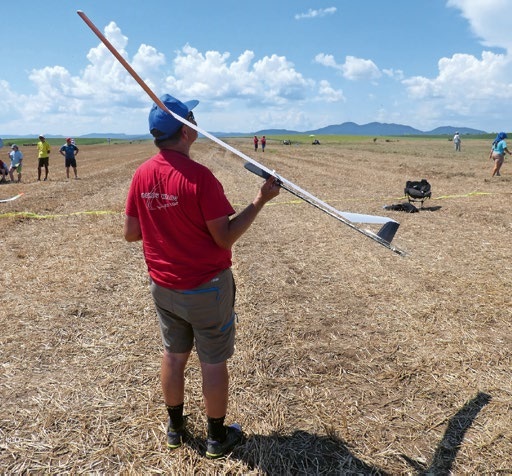
The Swiss F1B team is a family affair: Alfred Andrist and his sons Christian and Dominik Andrist. The three were also among the top finishers at the last Swiss Championship in 2022. Since then, Dominik Andrist has demonstrated his world-class skill by placing third at the 2023 World Championship. The three pilots fly models designed by Stepan Stefanchuck. These are primarily 6-panel gliders, which have proven themselves very effective in standard flights. At the 2024 European Championships, more than half of all pilots are expected to have chosen Stefanchuck models. The models’ functions are controlled via control lines. These are driven by a rotating servo and the SIDUS or Simplicity control system. Propulsion is provided by a rubber cord weighing a maximum of 30 grams, which is wound up with a winch to just short of its breaking point. All three Swiss pilots now also have Orcas in their arsenal for those “special moments.” The Orcas are full-carbon models by Stefanchuck and reach exceptionally high altitudes with minimal sink. They are used in late-evening or early-morning flights when thermals are no longer present. Some pilots also use the Orcas during the day. The Andrists, however, value the thermal performance of the 6-panel gliders covered with Icarex. The wings have two bends, which is why they are called 6-panel wings. Alfred Andrist didn’t receive his Orca until Sunday in Simeria and used the two days to break it in, which he did very successfully. The three Andrists have years of experience in F1B flying and support one another with equipment, training, and in competitions. In short: The best that Switzerland currently has to offer in F1B was on the starting line.
The competition setup for the 2024 European Championships posed a particular challenge for Christian Andrist. As one of four participants in the third F1A tiebreaker, he had his launch at 7:00 a.m. The F1B competition then began at 7:30 a.m. A total of 69 pilots from 25 countries competed.
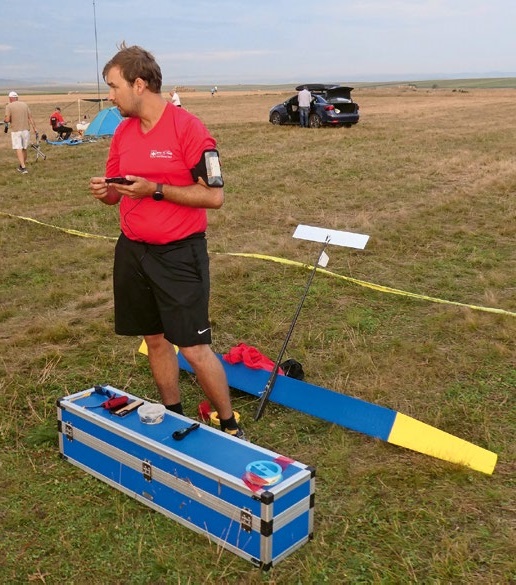
The fact that we were assigned a launch site next to the Ukrainians in the draw doesn’t seem like a disadvantage to us. Stepan Stefanchuck himself is flying there as well (a solid 6th-place finish). However, the Swiss pilots rely primarily on their own thermal detector and their interpretation of it (see Modellflugsport No. 2/2024, p. 46). It indicates where thermals are breaking off. The pilot is not allowed to move away from his launch site. The key, then, is to wait for the thermal lifts to form and launch the glider into them.
Dominik Andrist on how the competition unfolded: “After the F1A fly-off, we move right on to F1B. Seven rounds again. There was little wind in the morning, and the Swiss pilots flew safely. Everything went smoothly until the fifth round, when thunderstorms rolled in. There’s lightning and thunder all around us. The sixth round starts anyway—you can’t get any more reckless than that. We all fly very quickly one after another to get out of the storm’s way. During Christian’s flight, the round is interrupted. Our models are still toward the back of the field. Christian and Dominik are retrieving their models when the heavens open up. Completely soaked, we return with the models. Model flying is out of the question. The seventh round is then made up later that evening. All three Swiss pilots make it to the tiebreaker. The first tiebreaker is flown that same evening over six minutes. Christian and Dominik achieve the required flight time. Alfred Andrist’s model lands at 4:32 minutes (31st place). As dusk falls, we bring the models back to the launch site. On Thursday morning, the next fly-off—a 10-minute round—is scheduled. There’s fog, so we have to wait. At 10 a.m., the fog clears, and we fly the next fly-off. There’s a bit of wind again. Christian and Dominik take off at the start of the round. The air is very turbulent; both have to pump their controls repeatedly. Christian flies for 4:20 minutes, Dominik for 8 minutes. This puts Dominik Andrist in 9th place and Christian Andrist in 15th. As a team, it probably isn’t quite enough to make the podium. We suspect we’re in fourth place. However, there isn’t an official ranking yet.
The entire European Championship is very exhausting. We get up at 5:30 a.m. and head to the airfield without a proper breakfast. There’s a small snack stand at the field, but we skip it—the moldy bread put us off. We’re flying all day long. Christian walked 26 kilometers on the F1A day. Let anyone try to say that free flight isn’t a sport. We head back late in the evening; it’s already dark, and the only thing left to eat is something from the Food Corner in the shopping mall.
“We put in another very strong performance with our small team. Just like last year, we won two medals. We have great team spirit and support each other. We’ve definitely reached the world’s elite and established ourselves there. The Swiss free-flight pilots are definitely ones to watch in the coming years.”
| 9. | Dominik Andrist (SUI) |
| 480 seconds in the 2nd fly-off | |
| 15. | Christian Andrist (SUI) |
| 260 seconds in the 2nd fly-off | |
| 31 | Alfred Andrist (SUI) |
| 272 seconds in the 1st fly-off |
| 4. | Switzerland |
The organization of the European Free Flight Championships had many shortcomings. The FAI regulations provide helpful and detailed guidelines for organizers. What was offered in Simeria, however, had little to do with them. The poor value for money and the failure to adhere to the regulations generated little enthusiasm among the participants. It is imperative that the FAI conduct a critical inspection of the venue and the organizational work in the run-up to such an event. Given the fees charged for the event, there are sufficient funds available for greater oversight and support of the organizers. We are curious to see how the Romanians will manage the 2025 Free Flight World Championship in Salonta.
The Swiss Free Flight Team currently has four pilots in F1A who can compete at the very top. In F1B, too, about four pilots have the potential to compete at the very top. Unfortunately, there are no juniors and no women who could contribute a discard result, as Germany and some Eastern European countries do. In the F1C category (gliders with internal combustion engines), there is only one Swiss free-flight pilot left who occasionally competes.
*Urs Muntwyler, Team Manager
; Contributions: Dominik Andrist*


TEAM MANAGER "THIS" BOSSHARD
 Rodito Nussbaumer

SUMMER FUN 2026 AT MG USTER
Martin Wunderli
TRY-OUT DAY AT MFV WETTINGEN
Urs Keller
52. 2026 ALPS CUP
 Emil Giezendanner

ATOM, THE NEW DOUBLE-DECKER FROM CPLR
 Matthias Bosshard

INSIGHTS INTO THE HISTORY OF SEAPLANES

34th HAHNENMOOS ALPINE MODEL AIRPLANE CAMP
Res Dauwalder
CORSAIR F4U – A WARBIRD WITH A MEMORABLE LOOK
Jürgen Rosenberger, Jürgen Prinz
SMALL, MODEL-LIKE SAILBOATS
Res Dauwalder
F3A EUROPEAN CHAMPIONSHIPS IN ST-MACAIRE, FRANCE
Matthias Bosshard
What's New at Leomotion.com

HORIZON HOBBY/LEMACO NEWS: MICRO OV-10 BRONCO 645 MM BY E-FLITE

PRIDE AND GOOD IDEAS
 Markus Nussbaumer

News from HEBU

BY YOUTH, FOR YOUTH
Lorena Betschen
YOU KNOW WHAT I MEAN? 125 YEARS OF THE SWISS AERO CLUB
Emil Giezendanner
FREE FLIGHT IN THE MIDDLE OF SUMMER
Urs Muntwyler
THE PC-21 STORY
Emil Giezendanner
TWIN TOWN PARTNERSHIP
Wolfgang Voeller
EURO CONTEST GLIDER ACRO TOUR AUSTRIA 2026

WELCOME, NEW MEMBER!
Andrea Bolliger
COUPE DES ALPES – OBSERVE AND LEARN
Rodito Nussbaumer
NEWS FROM HEBU
 Julia Bucher

FROM 0 TO 100
Markus Nussbaumer
MEMORIES
Wolfgang Völler
NOS REGION – A HUB FOR ELECTRIC AVIATION
Emil Giezendanner
Have you almost forgotten about aircraft that take off and land vertically?
Emil Giezendanner
70 YEARS OF THE NIDWALDEN MODEL AIRPLANE CLUB
Martin Barmettler