
Robbe-Hornet
A Little About the Construction and Flying Experience
The Robbe Hornet has been on the market for about two years as part of the line of compact glider models. It is available in two versions: spar-reinforced and pre-assembled wings. The following report refers to the model with the pre-assembled wing.
With a wingspan of 210 cm, easy transport is guaranteed in every respect. In a Citroën 2CV, for example, the model can be stowed entirely under the front seats. This means that the cargo space available to individual family members is not restricted in any way.
| Technical Specifications: | According to the catalog | in reality |
| Wingspan | 2.115 m | |
| Fuselage length | 1.005 m | |
| Total wing area | 31.72 dm² | |
| Flight weight | 1,150 g | 1,350 g |
| Total wing loading | 36.25 g/dm² | 42.55 g/dm² |
The kit is fully equipped. The only items missing are the covering material and the two-component adhesive. The wood is of very good quality. The wings are also constructed using the standard method with a polystyrene core and veneer skin. The connecting ribs are already assembled and have holes drilled for the retaining pins.
The so-called “crashproof” fuselage is completely finished and painted yellow. It is similar to the Ferran pre-built fuselages found on Carrera models. The control linkage with deflection levers is installed. The wing mounts are also fully installed. The assembly instructions and construction plan are clear and easy to understand.
Depending on the time required for the finish, the model can be built and made ready to fly within 15–20 hours. The work can be completed quickly and easily. For the wings, all that’s needed is to attach the leading edges and wingtips, sand them to match the airfoil, and glue in the brass tubes for the retaining pins. The horizontal stabilizer is included as a rough-built unit. Here, too, only sanding is required. The only part that needs to be assembled from scratch is the rudder.
The cockpit frame is included as a pre-assembled part. The canopy must be cut to size with scissors and glued to the frame.
Installing the control system is also straightforward. The servo mounting plate is securely screwed to the fuselage, providing additional stability. A round battery is advantageous, as it can be housed in the nose of the fuselage and used as a trim weight at the same time.
Mounting the support for the horizontal stabilizer is somewhat problematic. See the notes under “Suggestions for Improvement.”
The wings and tail were covered with yellow Japanese paper and coated with a clear protective varnish. Of course, covering them with film is also possible. Alternatively, the wings can simply be painted with a two-component protective varnish. Decal sheets are included in the kit for further decoration of the model.
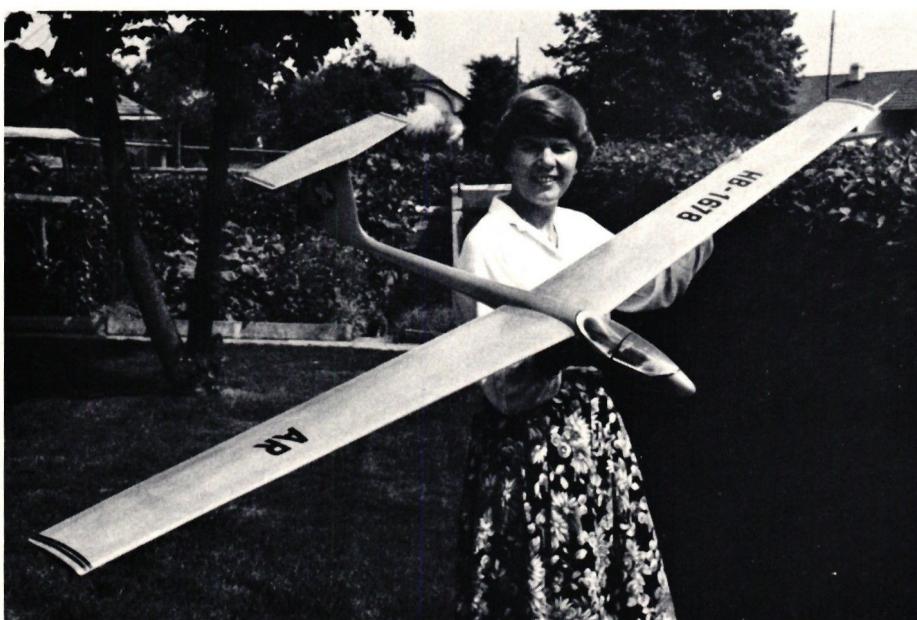
The Robbe-Hornet is an all-weather, all-purpose model that is easy to build and offers great satisfaction to pilots of all skill levels, from beginners to advanced.
- According to the assembly instructions, the rocker support for the horizontal stabilizer is to be secured to the damping fin of the vertical stabilizer with two wood screws. The screws are to be secured on the opposite side with two-component adhesive. This solution is clearly too weak. During hard landings, the screws can be torn out of the adhesive joint.
Solution: Secure the mount with M3 screws and lock it in place on the opposite side using a washer and nut, followed by the adhesive joint as mentioned above. Use tweezers to screw the nut into the interior of the shock absorber fin (just be patient—it’ll work!). Then seal with adhesive as mentioned above. This connection is incredibly sturdy. - The rear wing mounting pins have a diameter of only 2 mm. During hard landings, the wing can come loose from its mount. Due to the elastic band, the wing swings back, and the thin pin can easily punch a hole in the fuselage.
Solution: Use a steel pin with a diameter of at least 4 mm. However, this also requires brass tubes of the appropriate size in both the fuselage and the wing. - The canopy should also be secured to the fuselage at the front with a wood screw.
The model can only be balanced by properly installing the control components (battery, receiver, servos). For safety reasons, I trimmed the model to be slightly nose-heavy, which has proven to be very advantageous in flight, especially when flying on a slope.
Despite its short wingspan, the model flies very smoothly and stably. It needs to be flown at high speeds. Thanks to its airspeed and relatively high wing loading, the Hornet can cover very long distances. On the other hand, it is extremely maneuverable and can withstand all the stresses of flight. This means that all flight maneuvers typically reserved for two-axis-controlled models can be performed without hesitation. The glide angle is also remarkably good.
It can easily be described as a true all-weather, all-purpose model, as it is suitable for pure thermal flying and can handle even strong slope winds. After a bit of practice, it can be flown by beginners as well as experienced pilots for high-speed maneuvers.
With a rubber-cord launch, flight times of around 2–3 minutes can be achieved without the influence of thermals.
As demonstrated by various hard landings, including some where the model came to a complete stop, the model is, according to the catalog specifications, indeed exceptionally durable. Aside from the aforementioned torn-off tailplane mount, no damage to the model has occurred so far. The relatively soft plastic fuselage largely absorbs the impact of landing.
In summary, it can be said that the Hornet is a model that is easy to build and can provide full satisfaction to the pilot, whether a beginner or an advanced flyer. Finally, its attractive appearance and very robust and compact construction should not be underestimated.


News from HEBU

TEAM MANAGER "THIS" BOSSHARD
 Rodito Nussbaumer

SUMMER FUN 2026 AT MG USTER
Martin Wunderli
SMALL, MODEL-LIKE SAILBOATS
Res Dauwalder
TRY-OUT DAY AT MFV WETTINGEN
Urs Keller
What's New at Leomotion.com

52. 2026 ALPS CUP
 Emil Giezendanner

ATOM, THE NEW DOUBLE-DECKER FROM CPLR
 Matthias Bosshard

INSIGHTS INTO THE HISTORY OF SEAPLANES

YOU KNOW WHAT I MEAN? 125 YEARS OF THE SWISS AERO CLUB
Emil Giezendanner
34th HAHNENMOOS ALPINE MODEL AIRPLANE CAMP
Res Dauwalder
CORSAIR F4U – A WARBIRD WITH A MEMORABLE LOOK
Jürgen Rosenberger, Jürgen Prinz
F3A EUROPEAN CHAMPIONSHIPS IN ST-MACAIRE, FRANCE
Matthias Bosshard
HORIZON HOBBY/LEMACO NEWS: MICRO OV-10 BRONCO 645 MM BY E-FLITE

PRIDE AND GOOD IDEAS
 Markus Nussbaumer

EURO CONTEST GLIDER ACRO TOUR AUSTRIA 2026

BY YOUTH, FOR YOUTH
Lorena Betschen
FREE FLIGHT IN THE MIDDLE OF SUMMER
Urs Muntwyler
THE PC-21 STORY
Emil Giezendanner
TWIN TOWN PARTNERSHIP
Wolfgang Voeller
WELCOME, NEW MEMBER!
Andrea Bolliger
COUPE DES ALPES – OBSERVE AND LEARN
Rodito Nussbaumer
NEWS FROM HEBU
 Julia Bucher

FROM 0 TO 100
Markus Nussbaumer
MEMORIES
Wolfgang Völler
NOS REGION – A HUB FOR ELECTRIC AVIATION
Emil Giezendanner
Have you almost forgotten about aircraft that take off and land vertically?
Emil Giezendanner
70 YEARS OF THE NIDWALDEN MODEL AIRPLANE CLUB
Martin Barmettler