
1972 Scale Model World Championship
For the second time, the world's best scale model builders gathered in Toulouse to compete in a fair contest to determine their world champion. Just as two years ago in Cranfield (England), a small delegation from our country was also in attendance this year.
Tuesday, August 1. Led by team manager E. Wellenzohn, our small caravan—including pilots Dr. J. Ammann, W. Ruegger, the Swordfish Mk-2 and Polikarpov Po-2 model aircraft, and the mechanic duo L. Rosenasl and F. Meier—along with all their wives—set out on the long journey to Toulouse. After 600 km, we arrived at our stopover in Montélimar; after checking into our rooms, we enjoyed a well-deserved dinner and a cozy August 1 celebration at a local pub typical of the region.
Wednesday, August 2, Montélimar–Toulouse. After a grueling drive through heavy summer vacation traffic, we arrived around 3:30 p.m. at the grounds of the School of Civil Aviation, about 5 km southeast of Toulouse. General welcome, with particularly warm greetings for old acquaintances. Afterward, we checked into our rooms and then set up the models. The gymnasium of the “École Nationale de l’Aviation Civile” was made available for the static display. Each nation had its own tables, marked by the respective national flag. Even at first glance, it was clear that all the models on display were of the very highest caliber. An interesting observation: Virtually every team had brought a model that had already been entered in Cranfield. This confirmed the Americans’ argument that the World Championship cycle should be extended from 2 to 4 years, because 2 years is simply too short a time to build and test-fly a scale model.
Thursday, August 3. Model evaluation. The evaluation began with a significant delay. The randomly drawn order could not be maintained for long, as many competitors had left their designated spots. After the lunch break, it was our models’ turn; afterward, we were left sitting around idly again, because communication was very poor and we never knew what was supposed to happen in the next hour. The judging of the models was extremely thorough, though somewhat cumbersome; measuring the models with the scale rulers, in particular, took a lot of time. I’d also like to add that at the Münchner-Kindl Cup, the measurement evaluation was much more precise, and the tolerance limits could be determined more accurately using the large calipers.
Friday, August 4. Construction evaluation and practice flights. The remaining models were inspected, and the rankings were announced around noon. Terry Melleney from England achieved the highest score with 2,380 points, closely followed by the American Roth with 2,376.5 points. There was great satisfaction in the Swiss camp; for the Po-2, with 2,094.6 points, anything is still possible, while the Swordfish, with 1,868.5 points, has fallen somewhat behind. Starting at 3:00 p.m., the runway was opened for training flights. Only the Swedes, Germans, and our team are on the airfield. The models survived the long journey well; the Po-2’s flights gave no cause for concern, and despite the intense heat, the engine ran flawlessly. The Swordfish hadn’t been in the air since the crash in Munich and required significant re-trimming. After the third attempt, Dr. Ammann had the model safely back in his hands, but the engine wouldn’t run smoothly. The German pilot Heinz Simon had terrible luck; during the landing approach, his Me-163 veered too far to the left and crashed into a flagpole. The result: a cracked wing, a torn-out engine, and a crack in the engine casing. Thanks to exemplary dedication and a night shift, the model was repaired and ready for action again the next day.
It’s time to take off in his Po-2, and in the meantime, the Swede Levens-tam flies a clean routine with his “S. E. 5a.” Now it’s our turn. We start the engine, fine-tune it, but the engine cuts out as we hold it aloft. We try the same thing again, only with a slightly richer mixture. The taxi and takeoff go off without a hitch, and with the engine running at half throttle, W. Ruegger maneuvers the model through the figures. During the descent for the touch-and-go, the engine stalls, and the landing takes place within a 50-meter circle. The takeoff of the Me-163 rocket fighter is eagerly anticipated. Initially, there are also difficulties with the engine, but after changing the spark plug, it works. After a clean takeoff, the model retracts its landing gear and shoots steeply into the sky. Pilot Heinz Simon flies the program smoothly and with wide turns, landing the model true to the original with the engine shut off within a 25-meter circle. The rest of the competition remained a mystery to us, as the engine stalling on the Po-2 kept us on our toes. In several test runs, the flight path was reconstructed, and after about 7 minutes of flight time with the fuselage tilted slightly forward, the engine kept stalling. At first, we suspected poor air intake or foaming in the fuel. The real
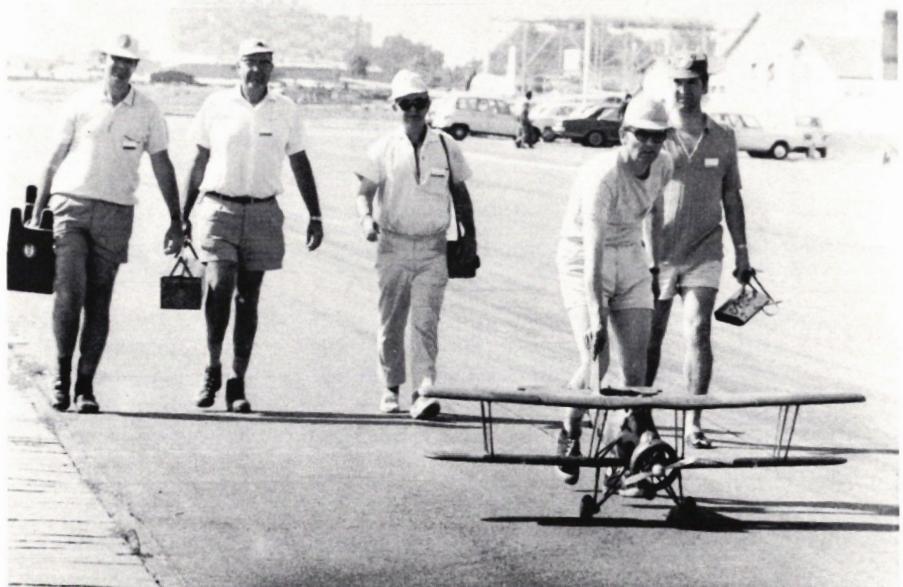
Saturday, August 5. It’s getting serious. Takeoff clearance at 9:00 a.m. It’s going to be another hot day; the runway is already shimmering in the heat. M. Hester from the U.S. drew lot No. 1 and kicks off the flying competition with his “Ryan ST Special.” The second model, the “Percival Proctor” flown by Roy Yates from England, already seems unstable at takeoff, and it crashes during the subsequent right turn. Total wreck. W. Ruegger was called to the starting line via the loudspeaker—
Reason: The fuel pendulum was too long, and after a certain amount of fuel had been consumed—and during the high-altitude, extended glide—the pendulum became exposed. After shortening it by 2.5 cm, the engine then ran at full throttle for 13 minutes. In the meantime, Dr. Ammann was at the starting line with the Swordfish but had to report a false start because the engine would not start within the prescribed time.
After the lunch break, the second round began, this time in reverse order. Dr. Ammann had a good start, but as he approached the figure-eight maneuver, the engine seized, and he landed off the runway. Around 5:00 p.m., it was the Po-2’s turn. There were no further engine problems, and W. Ruegger flew a routine that drew loud applause, ending with a smooth landing within a 25-meter circle. Thanks to this successful flight, W. Ruegger moved up to 4th place in the provisional standings, while Dr. Ammann took 10th place.
Sunday, August 6. Finals. What had already become apparent on Saturday was confirmed on Sunday. The weather had taken a turn for the worse, with a strong wind blowing from the southeast. M. Hester was the first to take off, and with an excellent flight, he scored 3,267 points. Next up was the Swede Levenstam, but due to a malfunction in the launch system, he was forced to forfeit. W. Ruegger was at the starting line, but with the strong wind, it was impossible to taxi the Po-2 across the runway; a false start was called due to exceeding the time limit, though the flight may be made up later. Heinz Simon achieved the highest score with a miraculous flight, thereby also becoming the world champion. Melleney also had trouble taxiing, and after
a long debate with the jury, permission was granted for the mechanic to guide the model by the wingtip. Despite the strong wind, the Englishman flew through the program flawlessly. Dr. Ammann, on the other hand, had another very good takeoff, but once again the engine failed to cooperate, and the pilot expressed his disappointment with a hearty “Damn it!” At 4:00 p.m., W. Ruegger is allowed to make up his flight; the wind is blowing even stronger, at 6–8 m/sec. With my help as a “guide,” the taxi goes reasonably well; the takeoff was clean, but otherwise all the maneuvers were blown off course by the wind. Around 5:30 p.m., the awards ceremony took place on the field, and the 1972 World Championships concluded with a truly French banquet. FM.
| Pl. | Name | Country | Aircraft | Fidelity | Craft | Complexity | Static Judging Total | 1st Flight | 2nd Flight | 3rd Flight | Total Score | Engine R/C |
|---|---|---|---|---|---|---|---|---|---|---|---|---|
| 1 | H. Simon | Germany | Me 163B | 985 | 867 | 260 | 2,112 | (3396) | (3,681) | 3,786 | 5698 OS 61/Varioprop | |
| 2 | T. Melleney | U.K. | DH Moth Minor | 1125 | 996.5 | 258.5 | 2380 | (2397) | 3,370 | (3,235) | 5750 HP 61/Futaba | |
| 3 | M. Hester | U.S.A. | Ryan STA | 875 | 731 | 377 | 1983 | (3264) | (3,190) | 3762 | 5745 Webra 61/EK pro | |
| 4 | B. Klupp | Germany | Piper Arrow | 1003.5 | 893 | 287 | 2,183.5 | 3182 | (3038) | (2,331) | 5365.5 Webra 61/Simprop | |
| 5 | J. Roth | U.S.A. | Evans VP | 1104 | 1048 | 224.5 | 2376.5 | (2713) | (2941) | 2,989 | 5,365.5 Ross Twin/Kraft | |
| 6 | W. Ruegger | Switzerland | Po-2 | 966.1 | 792.5 | 336 | 2094.6 | (2285) | 3,230 | (2,200) | 5,324.6 Enya 61/Kraft | |
| 7 | B. Wischer | U.S.A. | Piel Emeraude | 1021 | 967 | 284 | 2272 | 2912 | (705) | (1,464) | 5184 Ross Twin/Royal | |
| 8 | F. Ebermayr | Germany | N.A. T-28 | 658 | 578 | 174 | 1,410 | (3068) | 3,430 | (2,660) | 4840 Super Tigre G 60/Rowan | |
| 9 | M. Reeves | U.K. | Airmark Cassutt | 1066 | 730 | 236 | 2032 | (2323) | (2072) | 2495 | 4527 HP 61/Futaba | |
| 10 | J. Levenstam | Sweden | S.E. 5a | 639.5 | 468 | 233.5 | 1341 | 2,345 | (2,254) | (1258) | 3686 Veco 61/Micronic | |
| 11 | C. Jones | South Africa | Ryan STA | 988 | 896.5 | 376 | 2,260.5 | --- | --- | 1134 | 3,394.5 Webra 61/EK Pro | |
| 12 | J. Stromqvist | Sweden | N.A. P-51 Mustang | 698 | 547.5 | 242.5 | 1,488 | --- | (1,333) | 1,862 | 3,350 HP 61/Logictrol | |
| 13 | R. Yates | U.K. | Percival Proctor | 952.5 | 715 | 229.5 | 1,897.5 | 1156 | --- | --- | 3053 Merco 61/Skyleader | |
| 14 | J. Amman | Switzerland | Fairey Swordfish | 809 | 702.5 | 357 | 1,868.5 | --- | 1145 | (1125) | 3013.5 Webra 61/Multiplex | |
| 15 | J. Lyrzell | Sweden | BHT-1 | 822 | 681 | 275.5 | 1,778.5 | --- | --- | 165 | 1943.5 HP 61/Digiplex | |
| 16 | R. Fouquereau | France | CAP-10 | 713 | 464 | 189 | 1,366 | 215 | --- | --- | 1581 Super Tigre G 60 |


News from HEBU

TEAM MANAGER "THIS" BOSSHARD
 Rodito Nussbaumer

YOU KNOW WHAT I MEAN? 125 YEARS OF THE SWISS AERO CLUB
 Emil Giezendanner

PRIDE AND GOOD IDEAS
 Markus Nussbaumer

ATOM, THE NEW DOUBLE-DECKER FROM CPLR
 Matthias Bosshard

SUMMER FUN 2026 AT MG USTER
Martin Wunderli
F3A EUROPEAN CHAMPIONSHIPS IN ST-MACAIRE, FRANCE
Matthias Bosshard
52. 2026 ALPS CUP
Emil Giezendanner
HORIZON HOBBY/LEMACO NEWS: MICRO OV-10 BRONCO 645 MM BY E-FLITE

TWIN TOWN PARTNERSHIP
Wolfgang Voeller
CORSAIR F4U – A WARBIRD WITH A MEMORABLE LOOK
Jürgen Rosenberger, Jürgen Prinz
TRY-OUT DAY AT MFV WETTINGEN
Urs Keller
WELCOME, NEW MEMBER!
Andrea Bolliger
EURO CONTEST GLIDER ACRO TOUR AUSTRIA 2026

BY YOUTH, FOR YOUTH
Lorena Betschen
INSIGHTS INTO THE HISTORY OF SEAPLANES

SMALL, MODEL-LIKE SAILBOATS
Res Dauwalder
What's New at Leomotion.com

COUPE DES ALPES – OBSERVE AND LEARN
Rodito Nussbaumer
34th HAHNENMOOS ALPINE MODEL AIRPLANE CAMP
Res Dauwalder
FREE FLIGHT IN THE MIDDLE OF SUMMER
Urs Muntwyler
THE PC-21 STORY
Emil Giezendanner
NEWS FROM HEBU
 Julia Bucher

FROM 0 TO 100
Markus Nussbaumer
MEMORIES
Wolfgang Völler
NOS REGION – A HUB FOR ELECTRIC AVIATION
Emil Giezendanner
Have you almost forgotten about aircraft that take off and land vertically?
Emil Giezendanner
DO YOU KNOW WHAT I MEAN IN THE LAND OF SMILES?
Emil Giezendanner