
RC Sailboat Model CYGNUS – A Foreword for the Average Model Aircraft Enthusiast
Are you an average model airplane enthusiast? Then you’re sure to get frustrated when browsing through our technical literature (especially the German-language versions). There’s nothing left here for the average person; ordinary model airplanes haven’t existed for a long time. Everything is “super,” “ultra-super,” “super-super,” and tuned for “high performance.”
High-performance aerobatic models with a super-fast “super finish” made from highly elastic and super-light “super” covering material. Or do you perhaps know of any RC glider model that isn’t a “high-performance thermal model” or something else truly special? “High-performance products turn every buyer into a super model aviator”—that’s what advertising tries to drum into model builders. Are they trying to steer our consumer behavior by appealing to our ambition? If you don’t believe it, just flip through a trade magazine, or even a sales catalog or brochure: Anything that isn’t super-light, super-fast, super-strong, super-smooth, and super-elastic is at least super-expensive. Disgusting, isn’t it?!
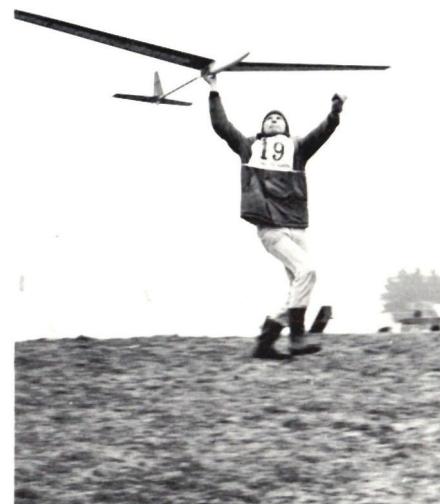
Well, what I’m actually getting at is that the CYGNUS is an ordinary glider model (not so much that it’s almost “special” again—“super-ordinary,” so to speak), whose design is based specifically on free-flight glider models. Just like modern free-flight gliders, the CYGNUS is built to be lightweight—yet still relatively fast. The wings are delicate and light and may seem fragile and sensitive at first glance. Although the CYGNUS is designed for thermals and light slope winds, it handles loops, turns, and spins without any trouble, provided these maneuvers are flown with finesse. That said, we believe the ideal aerobatic glider model should look different. We also don’t feel the urge—once we’ve launched our gliders and are barely airborne—to burn through all our altitude with acrobatics! We simply want to glide.
The original CYGNUS version was equipped with a double-trapezoidal wing that featured an aerodynamic sweep (a change in the airfoil profile from semi-symmetrical at the root to fully symmetrical at the wingtip) along its entire length. Although this wing version has proven itself excellently when well-built, we opted for parallel wings with a slight bevel in the outer third of the wing, as the construction effort required for the double-trapezoidal wings was far too great. Only a few model builders were able to construct the wing precisely and without warping. Comparative flights using parallel surfaces and trapezoidal surfaces showed that the enormous construction effort is hardly worth it in terms of performance—at any rate, it is out of proportion.
The new CYGNUS wing is assembled on a flat board. The wing outline templates cut from the construction plan are pinned to the board and protected with clear plastic film. The size of the ribs remains unchanged throughout the entire wing. Only after the ribs, stringers, and nose spar have been carefully glued in place are the ribs of the tapering wing section cut to the required length with a knife according to the plan. Now we can attach the previously notched leading edges. The aerodynamic sweep is achieved quite simply by attaching the leading edges to the trimmed ribs in the tapered section so that they run flush with the top of the ribs. The lower adjustment of the excessively thick rib ends is done last, after the wing has been removed from the building stand. Using a balsa plane, the corresponding ribs are tapered down to the thickness of the end strips.
The fuselage design is rather unconventional for RC gliders, since in this field, models that closely resemble their real-world counterparts are the norm. Building a model-accurate fuselage from scratch has always seemed quite labor-intensive to us and has never really inspired us. That’s why we started looking for “new” possibilities. With the CYGNUS, free flight once again served as our inspiration. This fuselage design (wooden block and aluminum tube) has long been well-known and popular in free flight. The front section of the fuselage can be sawed out of balsa boards and glued together relatively easily. It can also be carved out quite well from a solid block. Since we had the opportunity some time ago to meet an expert in CNC-milled wooden parts, we naturally had our fuselages—including the wing center section—CNC-milled from balsa blocks. This saved us a lot of work and a great deal of balsa dust.
The aluminum tube is turned to a tapered shape to optimize the center of gravity and has a wall thickness of no more than 3/10 mm at the rear. Even after this process is complete, these tubes remain more than sturdy enough and have survived even severe crashes unscathed.
If you want to be a bit more economical with lead ballast, you can not only build the tail unit as light as possible but also shorten the fuselage tube by 3 to 5 cm. The CYGNUS won’t hold that against you at all.
All wooden parts are treated with a hard primer (pore filler) and sanded clean several times with fine-grit sandpaper. For covering the wings and tail surfaces, we recommend paper (highest quality), which gives the wing excellent resistance to twisting. We have not had good results with various synthetic fabrics or plastic films on the CYGNUS, as these materials do not become stiff enough. After several coats of sanding primer, the wooden fuselage can be painted directly with synthetic resin paints.
We form the canopy from transparent plastic sheets by preheating them in the oven and then using a piece of car tire tube to pull them over a wooden mold (positive).
Anyone who also wants to use the CYGNUS as a motor glider should additionally coat the surfaces treated with tension varnish with a two-component varnish (e.g., Aloporesit). In this case, the self-adhesive lettering should also be carefully painted over, as this paint is not alcohol-resistant (this has nothing to do with drinking).
The lightweight metal skid, which is attached later, is highly recommended. It provides the fuselage with additional stability and protects it from scratches.
Before the first flight, the position of the center of gravity must be checked again and compared with the construction plan. Under no circumstances should you neglect to check the angle-of-attack difference (AOD). This can be easily measured using a straightedge or, if necessary, a spirit level. The CYGNUS is characterized by stable and docile flight behavior. If this is not the case—if you find yourself constantly having to correct, push the controls, and compensate—then the entire model must be thoroughly checked again. gi
RC Sailboat Model
Wingspan 293 cm
, Length 140 cm
, Wing Area 69 dm²
, Weight approx. 1800 gr
GERB BRUNO & EMIL GIEZENDANNER
CH 8330 PFAFFIKON
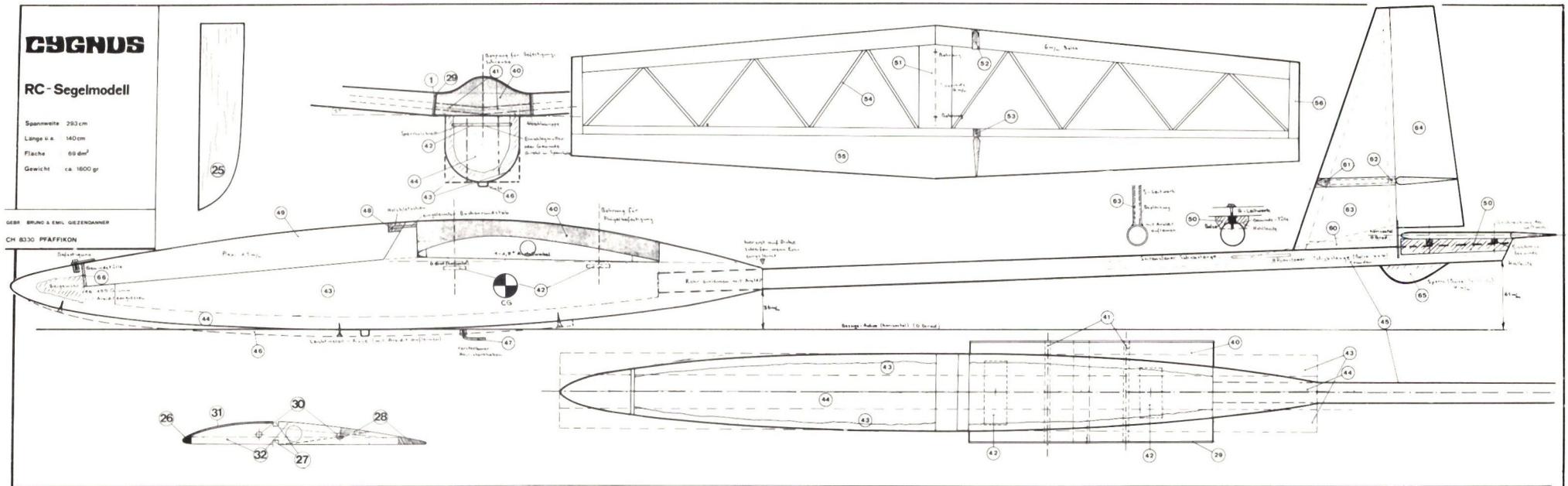
| No. | Quantity | Description | Material | Dimensions in mm | Remarks |
|---|---|---|---|---|---|
| 1–3 | 6 | Ribs | Plywood | 2 mm as per plan | |
| 4–24 | 42 | Ribs | Balsa | 2 mm as per plan | |
| 25 | 2 | Edge curve | Balsa | 20 x 40 x 170 | |
| 26 | 2 | Nose strip | Balsa | 8 x 12 x 1400 | hard |
| 27 | 4 | Strut | Pine | 4 x 4 x 1400 | |
| 28 | 2 | End strip | Balsa | 8 x 25 x 1400 | |
| 29 | 2 | End rib | Plywood | 3 mm as per drawing | |
| 30 | 4 | Tube for wing mounting | Brass | 6 x 5.1 (inner diameter) x 122 | |
| 31 | 2 | Facing | Balsa | 2 x 80 x 1,400 | hard |
| 32 | 14 | Center Planking | Balsa | Fit 6 mm | |
| 33 | 4 | Corners | Balsa | Fit to 20 mm | |
| 34 | 2 | Hook screws for rubber | Steel | ||
| 40 | 1 | Wing connector | Limba or linden | 220 x 90 x 40 | |
| 41 | 4 | Tubes for sash mounting | Brass | 6 x 5.1 (inner diameter) x 46 | |
| 42 | 2 | Brackets for wing screw fastening | Plywood | approx. 3 x 20 x 58 | |
| 43 | 2 | Fuselage boards (outer) | Balsa | 20 x 100 x 685 | hard |
| 44 | 1 | Fuselage panel (inner) | Balsa | 30 x 100 x 685 | hard |
| 45 | 1 | Fuselage tube | Aluminum | 16 x 770 x 16.4–18 | tapered |
| 46 | 1 | Skid | Aluminum | 6 x 9 x 490 | U-channel |
| 47 | 1 | High-start hook | Steel | ||
| 48 | 1 | Cabin mounting | Hardwood blocks or beech dowels (3 mm) | ||
| 49 | 1 | Cabin | Plexiglass or similar | 1 to 1.5 | thermoformed |
| 50 | 1 | Vertical stabilizer mount | Limba or linden | 15 x 30 x 102 | |
| 51 | 1 | Horizontal Stabilizer Center Section | Plywood | 6 x 30 x 77 | |
| 52 | 2 | Nose strips | Balsa | 6 x 17 x 320 | hard |
| 53 | 1 | Facing strip | Balsa | 6 x 8 x 640 | hard |
| 54 | Struts | Balsa | 3 x 6 x 1000 | ||
| 55 | 1 | Elevator | Balsa | 6 x 40 x 660 | tapered |
| 56 | 2 | End ribs | Balsa | 6 x 10 x 70 | |
| 60 | 1 | Vertical stabilizer root rib | Balsa | 4 x 6 x 80 | |
| 61 | 1 | Nose strip | Balsa | 4 x 10 x 230 | |
| 62 | 1 | Rear spar | Balsa | 4 x 8 x 220 | |
| 63 | 2 | Planking | Balsa | 2.5 x 100 x 220 | |
| 64 | 1 | Rudder | Balsa | 8 x 60 x 200 | tapered |
| 65 | 1 | Tail skid | Plywood | 4 mm | as per drawing |
| 66 | 1 | Nose stringer for cabin centering | Plywood | 3 mm | Adjust |
| also | 2 | Slide rods | Balsa (hard) | 1000 x 4 x 4 | rounded, sanded, and varnished |
| 2 | Rudder horns | Nylon | ready | ||
| 4 | Steel wires for wing attachment | 166 long, 5 φ | |||
| 4 | Screws for wings and tail | and threaded inserts and drive-in nuts (M3) |


TEAM MANAGER "THIS" BOSSHARD
 Rodito Nussbaumer

SUMMER FUN 2026 AT MG USTER
Martin Wunderli
52. 2026 ALPS CUP
 Emil Giezendanner

ATOM, THE NEW DOUBLE-DECKER FROM CPLR
 Matthias Bosshard

INSIGHTS INTO THE HISTORY OF SEAPLANES

34th HAHNENMOOS ALPINE MODEL AIRPLANE CAMP
Res Dauwalder
CORSAIR F4U – A WARBIRD WITH A MEMORABLE LOOK
Jürgen Rosenberger, Jürgen Prinz
SMALL, MODEL-LIKE SAILBOATS
Res Dauwalder
F3A EUROPEAN CHAMPIONSHIPS IN ST-MACAIRE, FRANCE
Matthias Bosshard
What's New at Leomotion.com

HORIZON HOBBY/LEMACO NEWS: MICRO OV-10 BRONCO 645 MM BY E-FLITE

PRIDE AND GOOD IDEAS
 Markus Nussbaumer

News from HEBU

BY YOUTH, FOR YOUTH
Lorena Betschen
YOU KNOW WHAT I MEAN? 125 YEARS OF THE SWISS AERO CLUB
Emil Giezendanner
TRY-OUT DAY AT MFV WETTINGEN
Urs Keller
FREE FLIGHT IN THE MIDDLE OF SUMMER
Urs Muntwyler
THE PC-21 STORY
Emil Giezendanner
TWIN TOWN PARTNERSHIP
Wolfgang Voeller
EURO CONTEST GLIDER ACRO TOUR AUSTRIA 2026

WELCOME, NEW MEMBER!
Andrea Bolliger
COUPE DES ALPES – OBSERVE AND LEARN
Rodito Nussbaumer
NEWS FROM HEBU
 Julia Bucher

FROM 0 TO 100
Markus Nussbaumer
MEMORIES
Wolfgang Völler
NOS REGION – A HUB FOR ELECTRIC AVIATION
Emil Giezendanner
Have you almost forgotten about aircraft that take off and land vertically?
Emil Giezendanner
70 YEARS OF THE NIDWALDEN MODEL AIRPLANE CLUB
Martin Barmettler