
SB 14 – a glider that can fly anywhere
After building several model gliders ranging from 3 to 4 meters in length, I was looking for a larger model for flatland flying, but one that was light enough to launch on its own from a slope. The 1:3.5 scale model of the SB 14 by Akaflieg Braunschweig (wingspan 5.14 m) has already been presented in detail in “Aufwind,” but a summary in French of this modern glider was missing. Only a single prototype of the original exists (wingspan 18 m and glide ratio estimated at 50).
In Switzerland, Georges Staub built an initial scale model prototype of the glider, developing a modern airfoil that was slimmer than the standard 13% or 15% HQ airfoils used in our models. The HN-474 airfoil was redesigned in collaboration with an aerodynamicist to reduce the curvature to 1.6%, while maintaining a thickness of 11% at the root that tapers to 9% at the wingtip.
Since this prototype proved to be very versatile and high-performing, Chocofly (ZH) invested in its production in the Czech Republic. The result is magnificent: the all-fiber wings are smooth and glossy, with RDS articulation, and the fuselage is lightweight and sturdy. The kit for my Alpine version with a spring-loaded landing gear weighs 4,700 g; the light version weighs less than 4 kg!
My fully equipped glider, with pilot and scale cockpit, weighs 5,730 g: quite light for a 5-meter glider. Remarkably, it’s balanced with just the pilot—no additional lead—just two 2,500 mAh LiFe batteries! Installing the removable motor mount and its 5S battery adds about 1 kg, bringing the flying weight to 6,800 g. A comparable weight can be achieved by replacing the carbon wing spar with the optional steel spar, which adds 1,320 g, bringing the total to 7,050 g.
I’ve been flying the SB 14 since 2014—whether towed, from a slope, or with a self-launch.
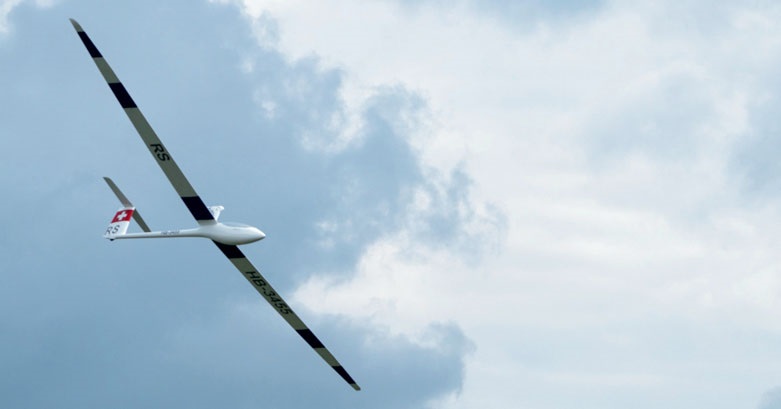
with its removable mast. Weighing 5.7 kg, the glider performs excellently in thermals. On several occasions, I’ve caught a thermal while flying downwind to land, circled it at a 45° angle, and then climbed back up. You should always maintain a bit of speed in a spiral, around 50 km/h on the GPS. In cruise flight, you’re around 70 km/h, and you can smooth out the
airfoil to cruise at 130 km/h without losing much altitude. For full-throttle dives, you have to be reasonable—it’s a performance glider, not a Fox. With the steel key or its engine pylon (removable but not retractable), the 7 kg weight keeps the glider very stable in stronger winds or turbulence.
A nose-mounted engine (FES) is also an option.
Converting the SB 14 from a pure glider to a self-launching motor glider takes just 5 minutes: very handy if the tow plane isn’t available or if slope conditions are uncertain. At first, you’ll need to practice several times to take off on your own along the runway axis, pulling back on the elevator to
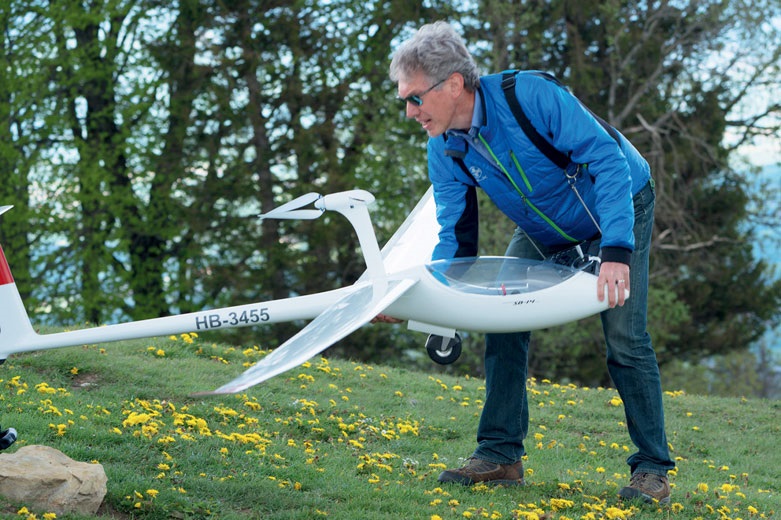
The SB 14 is easy to install once the "crocos" mix is properly adjusted.
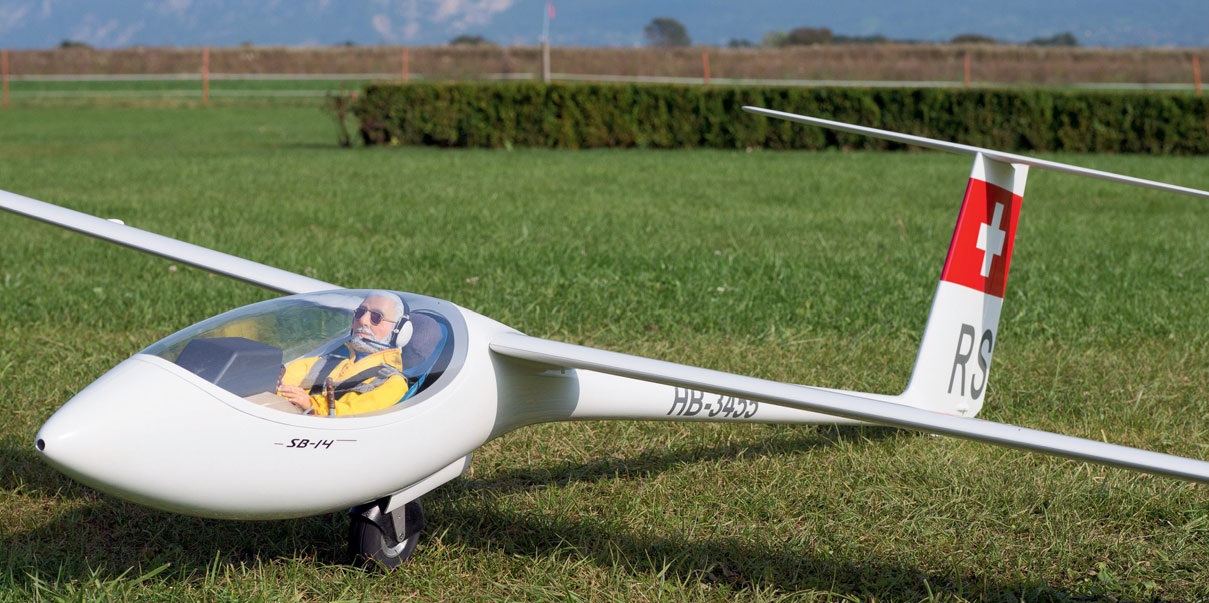
In a pure glider, a pilot at the correct scale (1:3.5) is sufficient for trim, which is therefore achieved without lead weights. To achieve its natural position, I rebuilt a deeper cockpit.
Optionally, all the servos can be pre-installed, leaving only the receiver and a dual LiFe power supply to install. →
throttle to the floor and gradually increasing the throttle. The glider climbs quite realistically, at a 20° angle, quickly reaching the desired altitude. With a 5S1P 5000 mAh LiPo battery, you’ll get 4 to 5 climbs, enough for 1 to 2 hours of flight, depending on the thermals.
When you remove the pylon, you can cover the hole with a small cowling that was previously molded onto the top of the fuselage and fitted with a “solar panel”-style sticker to restore the glider’s model-like appearance. The SB 14 is easy to fly once the crocos mix is properly adjusted. (I’m available to French-speaking pilots for more information)*.
Conclusion: While this glider is certainly more expensive than average, it’s so high-performing (Daniel Aeberli’s one-third-scale [6 m] version has earned several podium finishes in GPS flying) and enjoyable to fly that it’s worth the investment. ■
*Robert Slooves, GAM Geneva*
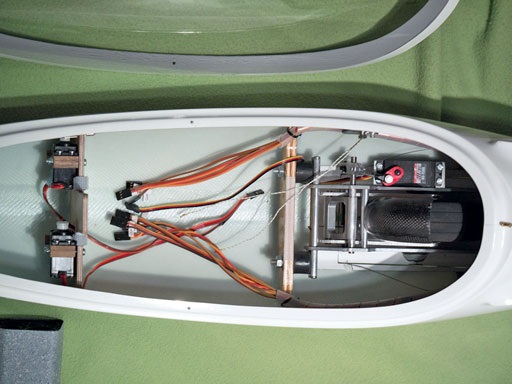
In just a few minutes, you can set up the pure glider and its lightweight design—whether for towing or launching it on its own from a slope.
* (president@gamgeneve.ch)


TEAM MANAGER "THIS" BOSSHARD
 Rodito Nussbaumer

ATOM, THE NEW DOUBLE-DECKER FROM CPLR
 Matthias Bosshard

INSIGHTS INTO THE HISTORY OF SEAPLANES

34th HAHNENMOOS ALPINE MODEL AIRPLANE CAMP
Res Dauwalder
CORSAIR F4U – A WARBIRD WITH A MEMORABLE LOOK
Jürgen Rosenberger, Jürgen Prinz
SUMMER FUN 2026 AT MG USTER
Martin Wunderli
F3A EUROPEAN CHAMPIONSHIPS IN ST-MACAIRE, FRANCE
Matthias Bosshard
What's New at Leomotion.com

HORIZON HOBBY/LEMACO NEWS: MICRO OV-10 BRONCO 645 MM BY E-FLITE

PRIDE AND GOOD IDEAS
 Markus Nussbaumer

News from HEBU

YOU KNOW WHAT I MEAN? 125 YEARS OF THE SWISS AERO CLUB
 Emil Giezendanner

SMALL, MODEL-LIKE SAILBOATS
Res Dauwalder
TRY-OUT DAY AT MFV WETTINGEN
Urs Keller
52. 2026 ALPS CUP
Emil Giezendanner
TWIN TOWN PARTNERSHIP
Wolfgang Voeller
EURO CONTEST GLIDER ACRO TOUR AUSTRIA 2026

BY YOUTH, FOR YOUTH
Lorena Betschen
WELCOME, NEW MEMBER!
Andrea Bolliger
FREE FLIGHT IN THE MIDDLE OF SUMMER
Urs Muntwyler
THE PC-21 STORY
Emil Giezendanner
COUPE DES ALPES – OBSERVE AND LEARN
Rodito Nussbaumer
NEWS FROM HEBU
 Julia Bucher

FROM 0 TO 100
Markus Nussbaumer
NOS REGION – A HUB FOR ELECTRIC AVIATION
Emil Giezendanner
MEMORIES
Wolfgang Völler
Have you almost forgotten about aircraft that take off and land vertically?
Emil Giezendanner
70 YEARS OF THE NIDWALDEN MODEL AIRPLANE CLUB
Martin Barmettler