
David vs. Goliath 0–1
A supposed mistake by NASA turns into an embarrassment for the European media.
*Spe.* The U.S. space agency NASA is a powerful institution. And as such, it has many envious critics. That’s why the media gleefully exploits every misstep NASA makes. In early April, it happened again. Under the headline “I calculated the end of the world … and NASA said I’m right,” the German newspaper *Bild* reported on a 13-year-old student from Potsdam who, as part of the “Jugend forscht” competition, had calculated the probability that the asteroid Apophis would strike Earth in 2036. The student claimed the probability of impact was 1 in 450—a hundred times greater than what NASA experts had calculated.
A week later, the “Potsdamer Neueste Nachrichten” reported that NASA had admitted its mistake. This story was picked up without verification by the French news agency Agence France-Presse (AFP) and subsequently spread like wildfire around the world.
Just one day later, on April 16, however, NASA denied ever having been asked about this matter and expressly stood by its original calculations. This report, too, spread like wildfire—though this time with a media-critical undertone.
This isn’t the first time Apophis has made headlines. For a brief time, it actually looked as though the asteroid—which is about 250 meters in diameter—could pose a threat to Earth if it were to
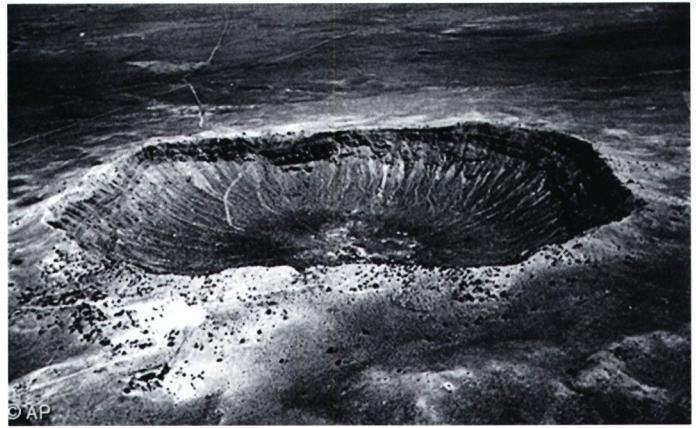
which will make its first close approach in 2029. Later, however, NASA gave the all-clear. Apophis will fly past Earth in 2029 at a safe distance of more than 30,000 kilometers. It’s not so easy to calculate how high the probability of a collision will be seven years later, when the asteroid approaches Earth for the second time. That’s because it depends on how much its orbit is disrupted during the first flyby. This is where the 13-year-old student stepped in. He calculated how the risk would change if one took into account that the asteroid could collide with a satellite in geostationary orbit in 2029. What the student didn’t know was that
NASA had been able to rule out this possibility with nearly 100 percent certainty based on the asteroid’s orbit.
Even some of the media outlets that picked up the story are having trouble admitting their mistake. For example, the German news magazine “Focus” did remove the false report from its website that same evening. However, when asked, the online editorial team stated that the report was not important enough to warrant a correction. The fact that the powerful NASA retains the upper hand simply doesn’t sell as well as a David-versus-Goliath victory. *From NZZ, April 23, 2008*



News from HEBU

TEAM MANAGER "THIS" BOSSHARD
 Rodito Nussbaumer

SUMMER FUN 2026 AT MG USTER
Martin Wunderli
BY YOUTH, FOR YOUTH
Lorena Betschen
SMALL, MODEL-LIKE SAILBOATS
Res Dauwalder
TRY-OUT DAY AT MFV WETTINGEN
Urs Keller
What's New at Leomotion.com

52. 2026 ALPS CUP
 Emil Giezendanner

ATOM, THE NEW DOUBLE-DECKER FROM CPLR
 Matthias Bosshard

INSIGHTS INTO THE HISTORY OF SEAPLANES

YOU KNOW WHAT I MEAN? 125 YEARS OF THE SWISS AERO CLUB
Emil Giezendanner
34th HAHNENMOOS ALPINE MODEL AIRPLANE CAMP
Res Dauwalder
CORSAIR F4U – A WARBIRD WITH A MEMORABLE LOOK
Jürgen Rosenberger, Jürgen Prinz
F3A EUROPEAN CHAMPIONSHIPS IN ST-MACAIRE, FRANCE
Matthias Bosshard
HORIZON HOBBY/LEMACO NEWS: MICRO OV-10 BRONCO 645 MM BY E-FLITE

PRIDE AND GOOD IDEAS
 Markus Nussbaumer

EURO CONTEST GLIDER ACRO TOUR AUSTRIA 2026

FREE FLIGHT IN THE MIDDLE OF SUMMER
Urs Muntwyler
THE PC-21 STORY
Emil Giezendanner
TWIN TOWN PARTNERSHIP
Wolfgang Voeller
WELCOME, NEW MEMBER!
Andrea Bolliger
COUPE DES ALPES – OBSERVE AND LEARN
Rodito Nussbaumer
NEWS FROM HEBU
 Julia Bucher

FROM 0 TO 100
Markus Nussbaumer
MEMORIES
Wolfgang Völler
NOS REGION – A HUB FOR ELECTRIC AVIATION
Emil Giezendanner
Have you almost forgotten about aircraft that take off and land vertically?
Emil Giezendanner
70 YEARS OF THE NIDWALDEN MODEL AIRPLANE CLUB
Martin Barmettler