
Bristol 171 Sycamore – Original and Model
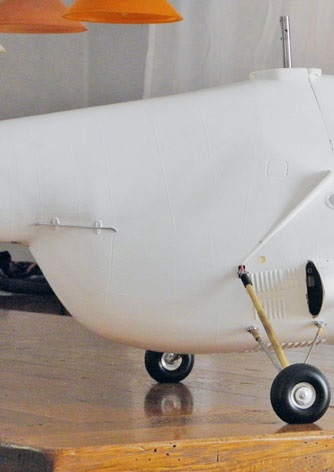
The Bristol 171 Sycamore is a British five-seat helicopter. It was the first helicopter built in the United Kingdom after World War II. A total of 178 were manufactured and used by several armies. Uli Friedgen from Wiesbaden spent several years meticulously recreating this helicopter—which has an unusual shape—down to the last detail.
With the Allied invasion of Europe in the summer of 1944, numerous engineers who had previously been working on cargo glider projects became available again. The Bristol Aeroplane Company was able to draw on these resources and began developing a
new type of helicopter. After more than two years of development and design—during which particular attention was paid to the durability of the technical components—the Sycamore prototype was completed and took off on its maiden flight on July 27, 1947.
However, several changes were made during series production. The cabin was widened to accommodate three passengers behind the pilot. The cabin structure was reinforced to allow for the installation of a winch, and, upon request, the main rotor was designed to be foldable.
From February 1952 to 1959, a total of 178 aircraft were manufactured for the Royal Air Force, the German Bundeswehr, the
Belgian Armed Forces, and the Royal Australian Air Force, as well as for the civilian operators British European Airways and Ansett Australia.
The Bundeswehr received 50 Sycamore helicopters, the first of which were delivered to the Air Force beginning in May 1957. The first three helicopters were designated Mk14, and the next 47 were designated Mk52 G; they largely corresponded to the latest model, the HR Mk14, delivered to the Royal Air Force. Beginning in June 1958, a total of 10 helicopters were delivered to the Naval Aviation. Starting in January 1967, the Navy transferred the helicopters to the Air Force. Two years later, the Sycamore’s service with the Bundeswehr came to an end.
The aircraft is made entirely of metal, has a non-retractable three-legged wheeled landing gear, and features a conventional main-rotor/tail-rotor configuration. Both rotors have three blades each, which are meticulously crafted from wood. The Bristol 171 was the first helicopter to be developed and manufactured entirely in Great Britain. While the prototype was still equipped with a Pratt & Whitney R-985 engine, the second aircraft built already featured the new and more powerful Alvis-Leonides radial engine. This engine was to be used as standard in all subsequent Sycamores built. →
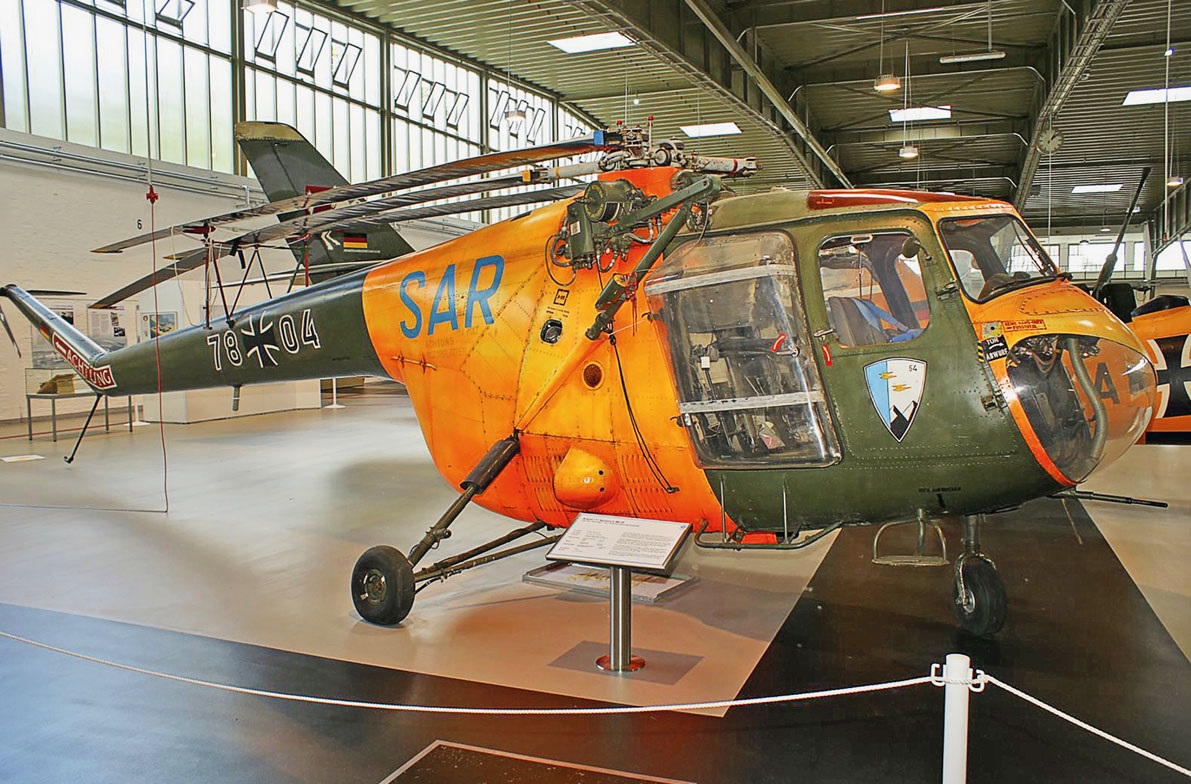
The German Air Force initially operated the Bristol Sycamore at the Pilot Training School (FFS) in Memmingen and later also in Fassberg. It was primarily used by air rescue and liaison squadrons. A few helicopters were used as liaison helicopters in a wide variety of units. In February 1962, Sycamores from both the Air Force and the Navy were involved in rescue operations during the storm surge disaster in Hamburg.
The helicopters of the air rescue and liaison squadrons bore the registration codes CB+..., CC+..., CD+..., and later also LB+..., LC+... Otherwise, they bore the registration codes of their respective units. Following the introduction of the new registration system, they continued to bear the registration codes 78+01 through 78+37 for a short time starting in 1968.
A Bristol 171 appears in the American feature film *Westwind*
(1980) as a pseudo-Mi-1. It also
appears in the “Tatort” episode “Kielwasser,” starring Götz George as Inspector Schimanski (1983). The aircraft in question bore the registration number D-HALC. The D-HALC was completely destroyed in an engine fire
in 1986. But as early as 1987, another Bristol 171 was registered: the D-HALD. In 1988, the D-HALD was registered, and in 1989, the former D-HELM, with
Peter Schmid, from Eastern Switzerland, purchased five helicopters—three for spare parts; one was transported by truck (the future HB-RXB); and the D-HELM, which arrived in Switzerland by air. On June 13, 1989, the D-HELM was entered into the Swiss registry as HB-RXA. On August 19, 1992, the helicopter was involved in an accident
near Widnau, SG. It was damaged so severely that it was never rebuilt. In the following years, the HB-RXB was completely restored and repainted in the original Royal Air Force livery. In 2012, Peter Schmid sold his entire collection to Red Bull in Salzburg, Austria.
Between 2010 and 2013, Red Bull's Flying Bulls restored one aircraft to airworthy condition. It is the former D-HALD. It is registered in Austria under the registration number OE-XSY.
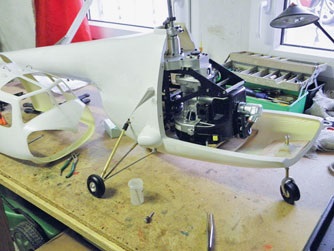
In the mid-1990s, Uli Friedgen from Wiesbaden visited the Helicopter Museum in Bückeburg. From then on, he couldn’t stop thinking about the Sycamore’s unusual shape, and he was determined to build a model replica. Over the course of about two years, he created the rough contours of the original using Styrofoam and plywood. To achieve a hard surface, Uli covered the preliminary model with fiberglass cloth and epoxy resin. This allowed him to use putty to give the model its final shape in the finer details. Many details of the original (openings, hatches, ventilation slots), as well as well over 20,000 rivets in the form of white glue dots, were then applied to the final master model. However, some scale details that would have caused undercuts in the mold had to be omitted from the master model. This would have made it impossible to remove the model from the mold later on. Separate master models and molds were later produced for these details, such as fuel and oil filler necks and others. However, since Uli had a great deal of respect for the molding process, several years passed before, around the turn of the century, his model flying club colleague Heiner Barrois offered to help with creating the molds and laminating the fuselage. Thanks to his work in large glider construction, he had ample experience and expertise in fiberglass mold making. Thus, a separation was made in the fuselage at the level of the rotor mast, making the forward section of the fuselage removable. Soon after, the first fuselage emerged from the molds.
The initial mechanism was a Futura Gold with a ZG-23—
| Prototype | Model | |
| Scale: | 1:8 | |
| Rotor diameter: | 14.80 meters | 1.85 meters |
| Length: | 14.10 meters | 1.76 meters |
| Height: | 4.49 meters | 0.56 meters |
| Width: | 3.40 meters | 0.43 meters |
| Curb weight: | 1,850 kilograms | |
| Takeoff weight: | 2,500 kilograms | 8.6 kilograms |
| Speed: | 160 km/h | |
| Range: | 531 kilometers |
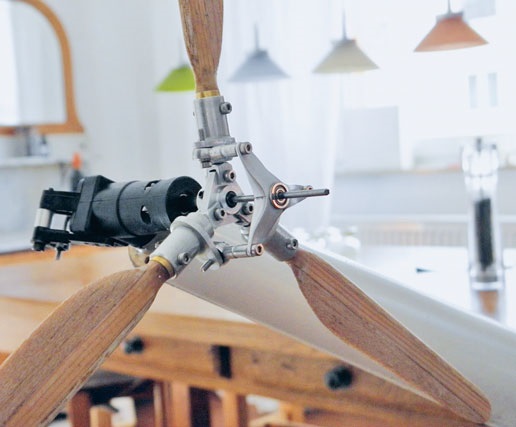
A distinctive feature of the original is the control system for the main rotor. A “spider” mounted on the rotor head is raised or lowered (collective pitch) or tilted (cyclic control) through the hollow rotor mast. Implementing this in the model would certainly have been a challenge, but it would have been extremely difficult with a 10-mm rotor shaft. For this reason, a CCPM 120° linkage was chosen. An existing three-blade Bendix head from OF was used as the rotor head, and aluminum M-blades were used as the rotor blades. The main rotor speed of 950 rpm proved to be just right right from the start. The system ran very smoothly and with minimal vibration. It also achieved control responsiveness that was very close to the control stick.
In November 2011, after a development and construction period of
over 15 years, the maiden flight took place. Without any significant problems or incidents, the model was fine-tuned through numerous gliding flights. Soon, sightseeing flights and appearances at air shows became a source of great enjoyment for the builder.
Due to a technical problem that caused severe resonance, the model crashed from a low altitude in late summer 2013. Fortunately, there was no damage that could not be repaired
. But what preoccupied Uli Friedgen more was the question of whether the gasoline engine was still up to date. After much deliberation and calculation, he decided to convert the model to electric propulsion. Once the fuselage was repaired, work began on the design and construction of a suitable electromechanical system. Parts from the first version of the Futura mechanism were used, supplemented by toothed belt pulleys from Mädler. The side plates and motor mount were fabricated from aluminum. The motor and controller used are Kontronik products: the Pyro 700 motor and the Power-Jazz controller. The model is flown with a 10S battery.
Just under a year later, the second maiden flight took place—this time powered by electricity. Here, too, there were no problems of any kind to report from the very beginning.
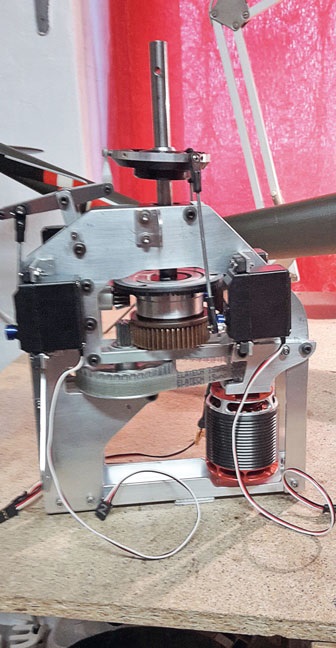
“Of course, after the crash—which happened after a relatively short period of operation—I was initially very disappointed, and that led me to focus on other projects for a while. But looking back, the conversion to an electric powertrain, which was carried out as part of the repairs, has had many positive effects. Thanks to the significantly more compact mechanical system, I was able to move forward with the cockpit’s redesign; in addition, an electronic sound module now provides a ‘real’ radial engine sound, which really comes into its own when ‘starting’ and ‘shutting down’ the engine and makes the
makes the model seem even more realistic. The quiet, low-vibration electric drive is also very advantageous for delicate scale accessories, such as the hydraulic rescue winch. The design of the motor-gear unit for speeds of 900–1,000 RPM and 10s LiPo batteries has proven itself and, with a capacity of 5,300 mAh, allows for flight times of a good 12 minutes with a 25% reserve.
Conclusion: A building project that has been fascinating for many years is now once again a lot of fun to fly, and the flight characteristics of this unique helicopter model never fail to inspire me anew.»
Photos: Uli Friedgen, Anton Laube


TEAM MANAGER "THIS" BOSSHARD
 Rodito Nussbaumer

ATOM, THE NEW DOUBLE-DECKER FROM CPLR
 Matthias Bosshard

INSIGHTS INTO THE HISTORY OF SEAPLANES

CORSAIR F4U – A WARBIRD WITH A MEMORABLE LOOK
Jürgen Rosenberger, Jürgen Prinz
SUMMER FUN 2026 AT MG USTER
Martin Wunderli
F3A EUROPEAN CHAMPIONSHIPS IN ST-MACAIRE, FRANCE
Matthias Bosshard
What's New at Leomotion.com

HORIZON HOBBY/LEMACO NEWS: MICRO OV-10 BRONCO 645 MM BY E-FLITE

PRIDE AND GOOD IDEAS
 Markus Nussbaumer

News from HEBU

YOU KNOW WHAT I MEAN? 125 YEARS OF THE SWISS AERO CLUB
 Emil Giezendanner

34th HAHNENMOOS ALPINE MODEL AIRPLANE CAMP
Res Dauwalder
SMALL, MODEL-LIKE SAILBOATS
Res Dauwalder
TRY-OUT DAY AT MFV WETTINGEN
Urs Keller
52. 2026 ALPS CUP
Emil Giezendanner
TWIN TOWN PARTNERSHIP
Wolfgang Voeller
EURO CONTEST GLIDER ACRO TOUR AUSTRIA 2026

BY YOUTH, FOR YOUTH
Lorena Betschen
WELCOME, NEW MEMBER!
Andrea Bolliger
FREE FLIGHT IN THE MIDDLE OF SUMMER
Urs Muntwyler
THE PC-21 STORY
Emil Giezendanner
COUPE DES ALPES – OBSERVE AND LEARN
Rodito Nussbaumer
NEWS FROM HEBU
 Julia Bucher

FROM 0 TO 100
Markus Nussbaumer
NOS REGION – A HUB FOR ELECTRIC AVIATION
Emil Giezendanner
MEMORIES
Wolfgang Völler
Have you almost forgotten about aircraft that take off and land vertically?
Emil Giezendanner
70 YEARS OF THE NIDWALDEN MODEL AIRPLANE CLUB
Martin Barmettler