
First Water-F Towing Event with Model Airplanes
Right at the start of this article, a word of warning to all “serious” model airplane enthusiasts who feel they have to keep explaining to the neighbor lady—who always watches with interest as we load our models into the car—that our hobby is an exclusively serious pursuit that has nothing to do with the playful antics of the boys next door. Please don’t read this article, because it deliberately falls under the category “Against Deadly Seriousness”! Besides, water-based model aviators usually take life a bit more lightly than land-based model aviators.
It must have been on a gloomy, cold, and rainy day when my son Benjamin and I were pondering meaningful and meaningless activities and records. That’s how we came across the Guinness Book of World Records. My absolute favorite silly record is: How long can someone sit on a pole before falling off? Benjamin, on the other hand, finds the longest kiss—which, according to the Guinness Book, is said to have lasted 31 hours, 30 minutes, and 30 seconds—much more exciting.
Then Benjamin and I reflected on everything that had—and hadn’t—already been done in the world of model aviation. From brushless motors to turbines, from hexacopters to swing-wing aircraft, hovering, torque, 3D to 4D… we’d seen it all before… old news…
But then a flash of inspiration: Never before had a model glider been towed into the air from the water by a tow plane! Yeah, of course—we absolutely have to do this and go down in history as heroes of the skies. But just at that moment, the sun must have peeked out from behind the clouds, because Benjamin and I went water flying and forgot all about our project. That would have been the (almost) end of our story, had someone else not come up with the same idea…
Since Peter Hofer, my good friend and seaplane guru from the Uri region, knows that I’m very open to crazy ideas, he told me one day about his latest, absolutely brilliant idea: the world’s first water-F-
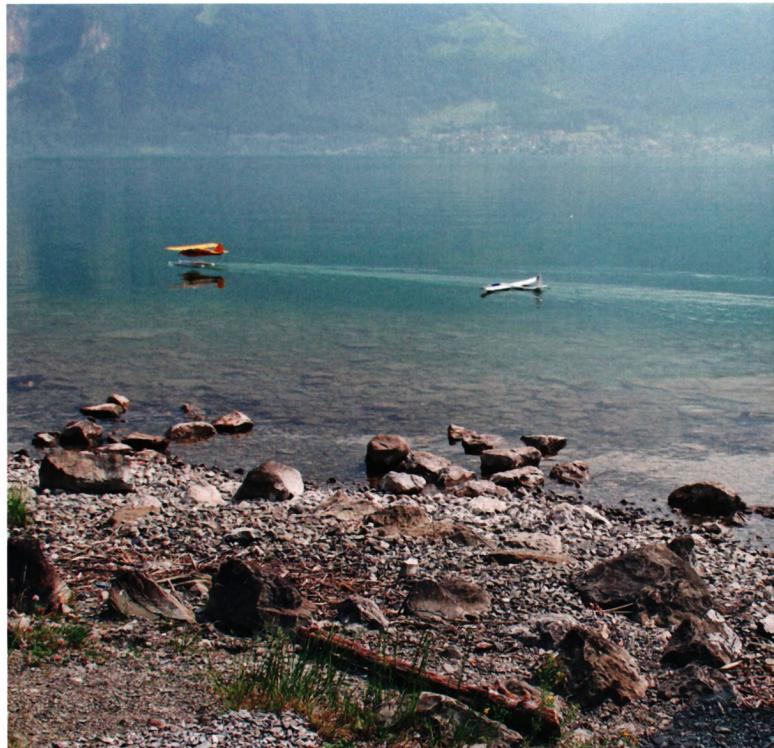
Tow! But since Peter always sees things through to the end, the story continued this time. Now there was a “serious” discussion about what would be needed for this fun project. A tow plane—my Jamara Piper Cub J3 with a 1.72 m wingspan and an “enormously powerful” 4S motor (cover photo of mfs 1/2008, story: “Winter Flying by the Lake”)—along with a tow
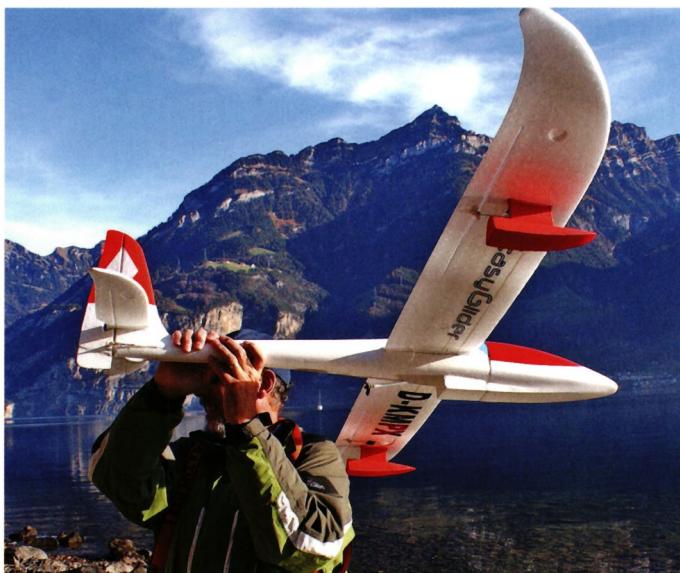
coupling—was already on hand and ready to be sacrificed for this project. Peter’s model could be the Easy Glider from Multiplex, a glider with a 180 cm wingspan. This lightweight foam glider should be easy to get airborne—or so we thought. As another brilliant idea, Peter wanted to install a mini auxiliary motor in his glider so that
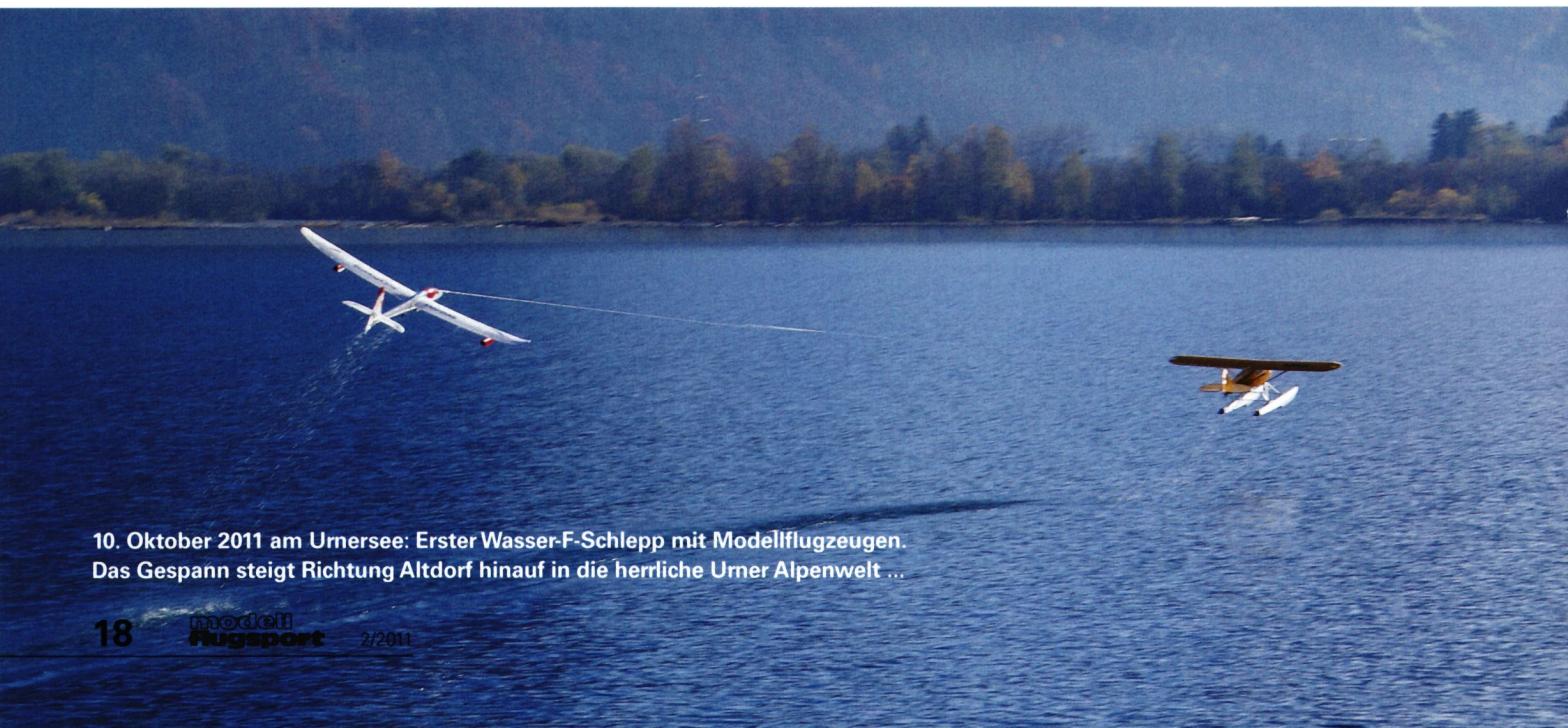
The sailor keeps the tugboat on a straight course at all times, making any turns impossible.
First observation: The towed combination cannot turn on the water.
Another problem with launching is that, during the brief waiting period before takeoff—that is, until the sailor-pilot has finished his meditations—the wind slowly but surely pushes the towboat to the side. Launching in a crosswind, however, would be sheer suicide. Since the combination cannot turn, the tow plane must be pulled back on the tow rope and can only then resume heading into the wind.
But soon the moment arrives: Gently applying throttle, the rope tightens, and the combination roars off. After a few meters, the glider lifts off, and a little later, the tow plane does as well. But the tow rope proves to be too short. Peter struggles to keep the glider on course, lurching back and forth in the tow plane’s wake, and has to unhook after just a few meters. Since Peter’s mini-glider propulsion system isn’t working yet, he has to retrieve the glider far out at sea with the rescue cruiser—that is, a rubber boat. But the first step has been taken
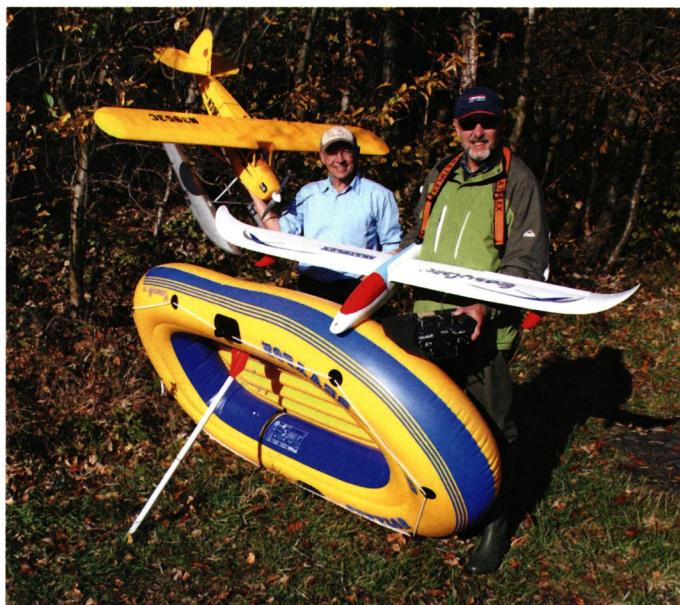
that it might be able to return to shore under its own power after landing. They decided to attempt a tow as soon as Peter had his sailboat ready. And sure enough, the first attempt took place about two weeks later.
Peter, my wife Maja (who’s a photographer), and I meet at Lake Uri—more specifically, at Bolzbach—where the Uri water gliders gather every Sunday morning against what is arguably the most magnificent Alpine panorama in the world to enjoy water gliding, and guests are always welcome. I hand Peter the roll of rope tied to a mason’s line, and he estimates a length of about 5–6 meters. The flying conditions are ideal: just a light breeze, hardly any waves. So we attach the tow rope to the tow plane and head out onto the water. Of course—and as is customary—we want to take off into the wind. So I try to align the tandem. But that doesn’t work because
Success on the first try! Towing a model seaplane glider is possible—and has been accomplished for the first time in the world! Technical problems make further attempts impossible; for now, it’s time to celebrate. But we know this: We haven’t won yet. The goal is a perfect tow with the aircraft and glider flying low as they pass by. Then perfect landings and a safe return of the glider under its own power.
So for the next attempt, we’ll first need to use a much longer tow rope. And about 10 days later, the next attempt takes place.
Another beautiful, sunny Sunday morning. The tow rope is now 15 meters long. Here we go! But the glider just won't take off, and
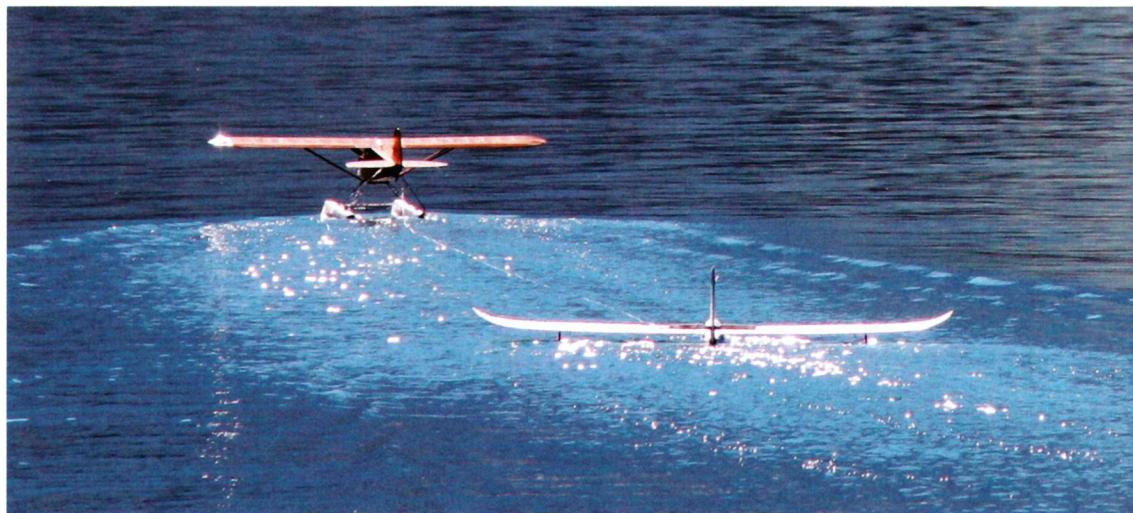
It’s stuck on the water. After several attempts without making any headway, we end the session to take a break and think things over. We wonder if the tow plane might be a little underpowered. Maybe my larger Piper Super Cub, powered by a 5S motor, would be the solution. But solving problems with brute force doesn’t seem like the right approach to us after all. And “big tow plane pulling a small glider” looks pretty pathetic, too. Out of the question! First, we have to find and fix the problem(s); then it should—indeed, it must—be possible to get the relatively light glider airborne with reasonable force. As Maja’s photos show, it’s almost certainly the long, relatively heavy, soaked line
that won’t come out of the water, is pulling the glider down, and preventing it from taking off. We decide to conduct the next tests using a tow rope made of Silch. My son Felix borrows a spool of 0.35 mm diameter craft Silch from his kids, which seems strong enough to me.
While preparing for the tow on the beach, the thin, curly, and practically invisible Silch keeps getting tangled up in rocks and twigs lying on the ground and wraps itself disgustingly around legs and feet...! Nevertheless, the first launch takes place. The glider takes off much too early, shoots steeply into the air, performs a novel, very attractive aerobatic maneuver, and then—
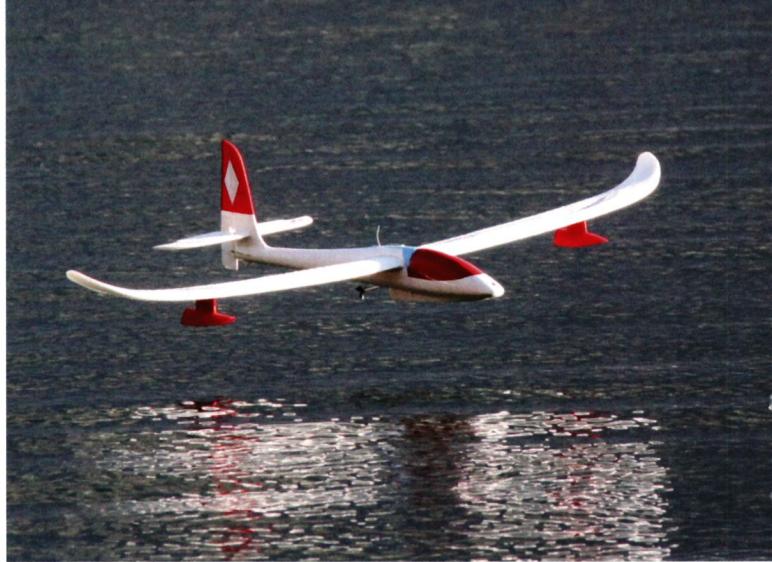
To come crashing back down so steeply and plunge into the cool water with an impressive fountain of spray! Damn it all! What had happened? After the recovery, the cause was quickly found: The corrugated Silch had become caught in the drive during the preparation and launch phase. As a result, the rope’s attachment point was located beneath the glider and relatively far aft. While checking whether my release mechanism was actually working, I also noticed that a knot in the tow rope had become caught in the relatively narrow gap between the vertical stabilizer and the rudder—and, thank God, the Silch rope snapped! This gap was subsequently widened to a whopping 2 mm. The bracing on the tail surfaces had already been removed prior to the tests due to previous negative experiences.
Peter's return drive is now working, and all the preparations are going smoothly. But the glider just won't take off. When trying to hold the sailboat by its tail on land and only suddenly let go at full throttle, the homemade Silch—which is simply too weak—breaks. So the tug isn’t that weak after all! After all, 52 amperes are flowing to the little motor, generating a static thrust of about 2.5 kg. As a result, we need top-notch Fischer-Silch! Furthermore, we need to find a way to ensure that the glider lifts its nose during acceleration so that air can flow under
the wings. After putting our thinking caps on, we came to the conclusion: Peter is going to install a step! All decent seaplanes have this step, and we certainly need one too...
Peter shows up at the site with a fishing line featuring a perfectly shaped step. The stepped design extends from the tip of the nose to just past the center of gravity. That’s how it should be—no, that’s exactly how it has to be! We have a hunch—no, we know for sure: Today it’s going to work! From my new, professional Silch collection, we choose the strongest Fischer Silch, the one with a menacing-looking pike on the packaging. It—the Silch—has a diameter of 0.4 mm and a remarkable tensile strength of 10 kg. While Peter, standing unsteadily on a boulder and still holding his bird by the tail, my Piper at the other end of the tow line is going full throttle, and its powerful, spinning APC 13x6.5-inch electric propeller can hardly wait to finally lift the rig into the air. The tow rope is now completely out of the water, and Peter lets the tandem take off. After a few meters, the glider levels off, then—as expected—begins to glide and takes off beautifully and not too steeply. Peter skillfully keeps his glider low at first, and then my Piper is airborne as well. We’re now climbing rapidly. Then the tow rope is released a little too early. I’m hurtling steeply down toward the
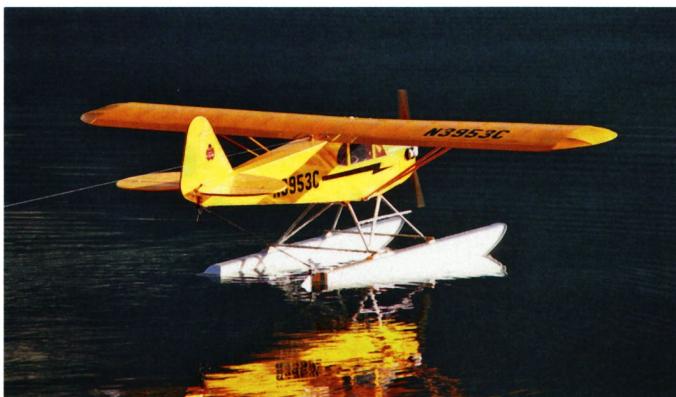
Water. Since there’s no photographer around, I’d like to capture Peter’s next maneuver on camera. But by the time I’ve landed and safely positioned my model on the meadow—without stalling the water propeller—Peter is already back down and leisurely making his way ashore with his perfectly functioning propulsion system. After the next takeoff—which was also a success—he cuts the throttle at a higher altitude. Once again, I hurtle steeply downward, grab my camera, and snap a photo of Peter beautifully searching for “lake thermals” (which aren’t even supposed to exist) between the mountains and then gliding leisurely down toward the water. After a perfect
landing, his model returns under its own power once more.
The obligatory pats on the back follow, and we’re bombarded with chants like “We Are the Champions,” etc. Now nothing can go wrong! But overconfidence rarely does any good, and we still want to practice the close, low fly-by in formation. So, another perfect takeoff, and we’ve gained a bit of altitude. But then we want to sink a bit again to fly past each other just above the water. I throttle back my Piper, and the slowly turning propeller slows me down as intended. This way, I can
slowly descend. Not so Peter’s foam aircraft—which isn’t bad aerodynamically at all—that picks up speed without any brakes or spoilers and threatens to pass me. What follows is an uncomfortable scene, the turbulent and dramatic course of which I can’t—or don’t want to—remember exactly. The singer’s politeness prevents me from discussing the consequences. We decide not to attempt any more low-altitude flybys with a glider that lacks spoilers.
We eagerly await responses from other eccentric seaplane enthusiasts who may have been conducting “top secret” seaplane-glider tows years before us. Together with them, we could then found the “NGDVFWS” (Not-Quite-Serious Association for the Promotion of Seaplane Glider Towing). Anyone who wants to learn more about the construction of the seaplane glider and about seaplane flying in general should contact Peter Hofer: info@modellbau-zentral.ch/079 429 62 25. Anyone who also enters the search term “water-glider-tow” on www.youtube.com can watch a video of one of the first water-glider tows on Lake Uri.
With what is—to the best of our knowledge—the first-ever water-based F-tow with model airplanes, a wild and fun idea was brought to life. The world is now one more model-airplane spectacle richer—but given its historical background, it doesn’t seem quite as silly as we first thought. We’re proud of that—because: Fun is a must! And cheers!
Hans Jürg Baum & Peter Hofer Photos: Markus Ramseyer, Maja Baum


TEAM MANAGER "THIS" BOSSHARD
 Rodito Nussbaumer

ATOM, THE NEW DOUBLE-DECKER FROM CPLR
 Matthias Bosshard

INSIGHTS INTO THE HISTORY OF SEAPLANES

CORSAIR F4U – A WARBIRD WITH A MEMORABLE LOOK
Jürgen Rosenberger, Jürgen Prinz
SUMMER FUN 2026 AT MG USTER
Martin Wunderli
F3A EUROPEAN CHAMPIONSHIPS IN ST-MACAIRE, FRANCE
Matthias Bosshard
What's New at Leomotion.com

HORIZON HOBBY/LEMACO NEWS: MICRO OV-10 BRONCO 645 MM BY E-FLITE

PRIDE AND GOOD IDEAS
 Markus Nussbaumer

News from HEBU

YOU KNOW WHAT I MEAN? 125 YEARS OF THE SWISS AERO CLUB
 Emil Giezendanner

34th HAHNENMOOS ALPINE MODEL AIRPLANE CAMP
Res Dauwalder
SMALL, MODEL-LIKE SAILBOATS
Res Dauwalder
TRY-OUT DAY AT MFV WETTINGEN
Urs Keller
52. 2026 ALPS CUP
Emil Giezendanner
TWIN TOWN PARTNERSHIP
Wolfgang Voeller
EURO CONTEST GLIDER ACRO TOUR AUSTRIA 2026

BY YOUTH, FOR YOUTH
Lorena Betschen
WELCOME, NEW MEMBER!
Andrea Bolliger
FREE FLIGHT IN THE MIDDLE OF SUMMER
Urs Muntwyler
THE PC-21 STORY
Emil Giezendanner
COUPE DES ALPES – OBSERVE AND LEARN
Rodito Nussbaumer
NEWS FROM HEBU
 Julia Bucher

FROM 0 TO 100
Markus Nussbaumer
NOS REGION – A HUB FOR ELECTRIC AVIATION
Emil Giezendanner
MEMORIES
Wolfgang Völler
Have you almost forgotten about aircraft that take off and land vertically?
Emil Giezendanner
70 YEARS OF THE NIDWALDEN MODEL AIRPLANE CLUB
Martin Barmettler