
Gyrocopters – rarely seen at model airfields
Many people, including passionate model aircraft enthusiasts, often wonder how a gyrocopter actually works. That’s why I’ve first put together a brief history and an explanation of how it works.
For a long time, the Spaniard Juan de la Cierva was credited as the inventor of the autogyro, having registered “Autogiro” as a trademark in 1923. However, the basic principle of the autogyro had already been devised earlier by Pere Sastre Obrador from Mallorca.
A gyrocopter—also known as an autogyro, gyrocopter, or gyro-copter—is a rotary-wing aircraft that functions similarly to a helicopter. However, in this case, the rotor is not driven by an engine but is set in rotation passively by the airflow, or simply through autorotation. Lift is generated by the drag of the rotating rotor blade when the rotor surface is tilted backward. Autogyros are suitable for applications where low speeds are desired but vertical takeoff and landing are not necessary. Advantages include stall resistance (i.e., a stall is not possible), low construction, maintenance, and operating costs, low weight and space requirements, as well as ease of operation.
Propulsion is provided by an engine with a propeller. The rotor is mounted on a mast. A swivel joint that allows the rotor blade to move up or down is a key feature of a gyrocopter. A swashplate is not required; the entire rotor is pivoted for control. In addition, a conventional rudder is needed for steering. Due to the low speed, a fixed landing gear is usually used. An enclosed cockpit is rather rare. Some models also incorporate wings.
Autogyros require only a very short takeoff roll of a few meters to about 100 m and thus belong to the ESTOL (Extended Short Takeoff and Landing) category of aircraft. The landing roll ranges from 0 to a few meters. To further shorten the takeoff distance, the rotor can be accelerated to takeoff speed by an additional engine before takeoff or started manually. Autorotation occurs because the rotor blade has such a high angle of attack in the inner region of the rotor plane that a force accelerating the blade results. At the outer diameter, however, the resultant force slows the blade down. These forces are in equilibrium during steady flight. If the angle of attack of the rotor plane is increased, the boundary between the accelerating and decelerating regions shifts outward, creating an imbalance in favor of acceleration; consequently, the rotor increases its rotational speed. This explains how the gyrocopter rotor automatically maintains the necessary rotor speed to keep the aircraft aloft.
Since the rotor is driven solely by the airflow, it is subject to minimal mechanical stress, and no complicated transmission is required. A loss of propulsion is also not critical. Gyrocopters have no minimum speed and therefore cannot enter a stall. This was also the motivation of the inventor, Juan de la Cierva. Proper handling of these aircraft still requires thorough training, however, because negative angles of attack are not permitted, as they—similar to excessive angles of attack in other aircraft—can lead to a critical flight condition. Negative angles of attack are achieved by pushing the control stick forward forcefully, which would cause airflow to strike the rotor from above; at the same time, high thrust amplifies this negative effect.
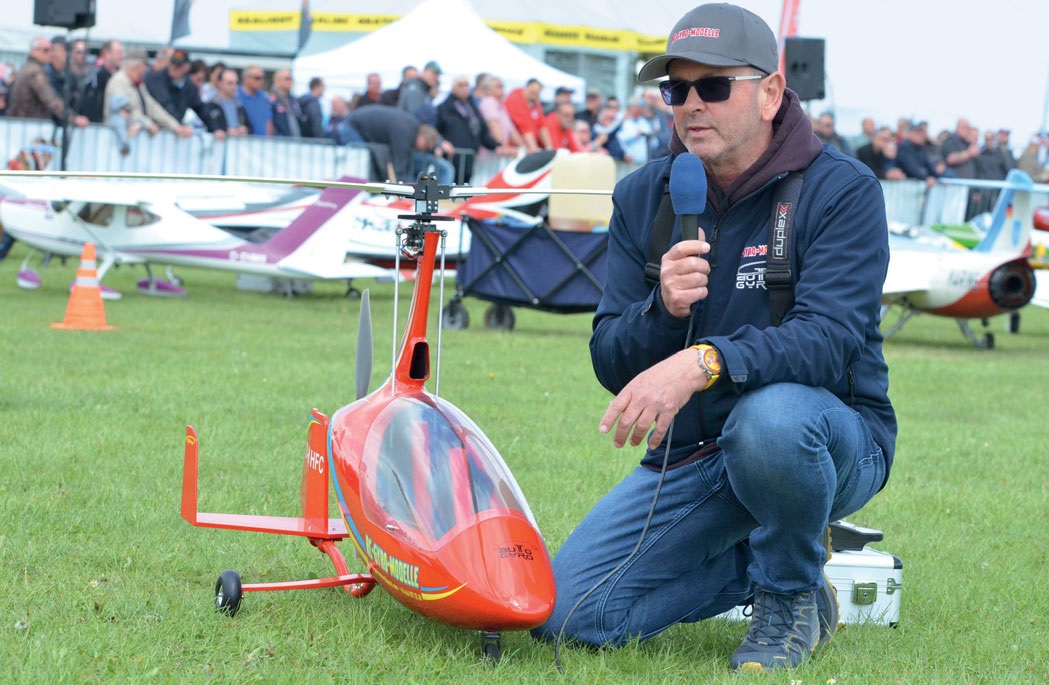
Ernst Keplinger, www.rc-gyro-modelle.at, from Katsdorf in Upper Austria near Linz, caught the gyrocopter bug nine years ago. From that point on, he was determined to design and build a gyrocopter that was fully functional in every respect and capable of being flown by anyone. Over tens of thousands of hours of development and flight testing, many ideas were conceived, built, and tested in flight—only to be discarded. But the effort paid off, and today Ernst produces and flies gyrocopters modeled after the Auto Gyro, which are 100% airworthy and in no way inferior to their larger counterparts.
Keplinger currently offers two models: one with a rotor diameter of 1.36 meters (1:6 scale) and the other with a rotor diameter of 2.5 meters (1:3.5 scale). Customers can choose and order the model kits in three different base colors: blue, yellow, or red. (Any RAL color is available for an additional charge.) The models are constructed primarily of fiberglass-reinforced plastic (FRP). The rotor head is made of carbon fiber-reinforced plastic (CFRP), and the blade holders are made of carbon fiber—both of the highest quality. The model is equipped with 4 servos, a main motor, and a prerotation motor; the 2.5-meter model also includes an additional 40-A ESC for the prerotation motor. A high-quality BEC supplies power to the receiver from the main battery. The smaller model uses a 4S 5000mAh LiPo for both motors and the RC system, while the larger model uses a 3S 2200mAh LiPo for the pre-rotation motor and a 6S 5000mAh LiPo for the flight motor and RC system. This provides ample flight time and pure flying enjoyment. We also tested a variety of fiberglass blades. However, no other blade could match the characteristics achieved by Herbert Sitar, drawing on his 40 years of experience in rotor blade manufacturing. To ensure that the joy of owning the model and the fun of flying are truly long-lasting, Ernst Keplinger supports his customers not only by providing high-quality kit sets, but also with comprehensive information and explanations regarding the technology and construction of the model, as well as the powertrain design. Detailed instructions on how to launch, fly, and safely land such a high-quality gyrocopter model are part of the service provided to every Copter customer.
However, great importance is placed on the high availability of replacement parts for all of its copters currently on the market. After all, only a 100% supply of replacement parts guarantees the pilot pure flying pleasure.
Unfortunately, many products on the market today come from the Far East, but as soon as the first minor damage occurs, the owner realizes that spare parts are either unavailable or extremely difficult to obtain.
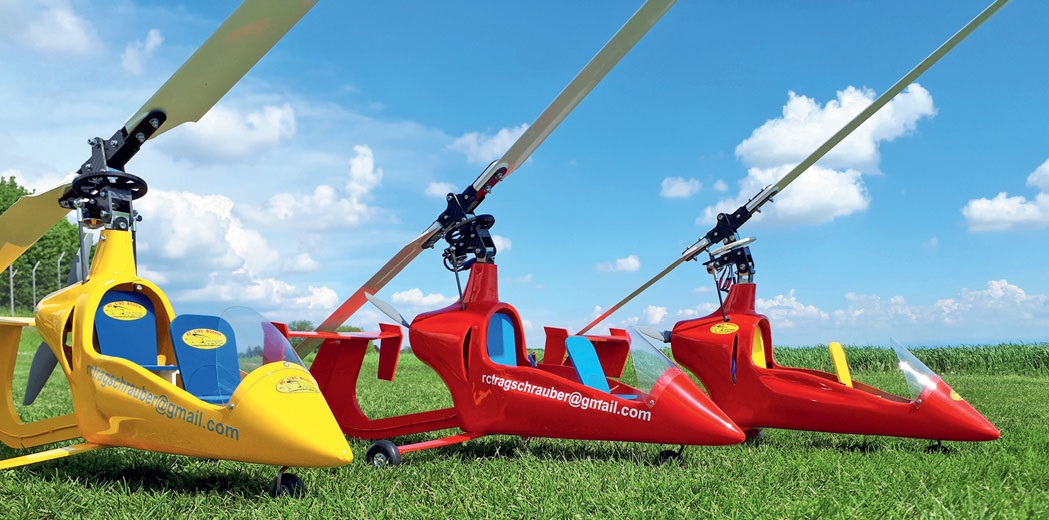
Flying an RC gyro model is easy and hassle-free to learn. Any average model pilot can fly the model they’ve built from a kit with complete ease. With a copter, model pilots will be able to bring their visions of flying a truly extraordinary model to life in no time at all.
A gyrocopter is one of the safest aircraft of all, because it can neither stall nor go into a spin. The copter is just as immune to stalls as it is to problems caused by engine failure. It has no design-specific minimum speed—which means completely stress-free flying! Since the rotor is driven in flight solely by the airflow, it experiences minimal mechanical stress and requires no complicated gearbox. Its simplicity and low complexity, combined with its exceptionally safe flight characteristics, practically invite you to create extraordinary scale models and maneuver them through the air in spectacular ways.
For more information, visit: www.rc-gyro-modelle.at//rctragschrauber@gmail.com or, for France and Switzerland: www.swiss-scale-helikopter.ch


News from HEBU

TEAM MANAGER "THIS" BOSSHARD
 Rodito Nussbaumer

SUMMER FUN 2026 AT MG USTER
Martin Wunderli
SMALL, MODEL-LIKE SAILBOATS
Res Dauwalder
TRY-OUT DAY AT MFV WETTINGEN
Urs Keller
52. 2026 ALPS CUP
 Emil Giezendanner

ATOM, THE NEW DOUBLE-DECKER FROM CPLR
 Matthias Bosshard

INSIGHTS INTO THE HISTORY OF SEAPLANES

YOU KNOW WHAT I MEAN? 125 YEARS OF THE SWISS AERO CLUB
Emil Giezendanner
34th HAHNENMOOS ALPINE MODEL AIRPLANE CAMP
Res Dauwalder
CORSAIR F4U – A WARBIRD WITH A MEMORABLE LOOK
Jürgen Rosenberger, Jürgen Prinz
F3A EUROPEAN CHAMPIONSHIPS IN ST-MACAIRE, FRANCE
Matthias Bosshard
What's New at Leomotion.com

HORIZON HOBBY/LEMACO NEWS: MICRO OV-10 BRONCO 645 MM BY E-FLITE

PRIDE AND GOOD IDEAS
 Markus Nussbaumer

BY YOUTH, FOR YOUTH
Lorena Betschen
FREE FLIGHT IN THE MIDDLE OF SUMMER
Urs Muntwyler
THE PC-21 STORY
Emil Giezendanner
TWIN TOWN PARTNERSHIP
Wolfgang Voeller
EURO CONTEST GLIDER ACRO TOUR AUSTRIA 2026

WELCOME, NEW MEMBER!
Andrea Bolliger
COUPE DES ALPES – OBSERVE AND LEARN
Rodito Nussbaumer
NEWS FROM HEBU
 Julia Bucher

FROM 0 TO 100
Markus Nussbaumer
MEMORIES
Wolfgang Völler
NOS REGION – A HUB FOR ELECTRIC AVIATION
Emil Giezendanner
Have you almost forgotten about aircraft that take off and land vertically?
Emil Giezendanner
70 YEARS OF THE NIDWALDEN MODEL AIRPLANE CLUB
Martin Barmettler