
ROUND 1
Much has already been written about electric flight technology. In my opinion, however, there are perfectly serviceable propulsion systems available on the market that guarantee quite respectable flight performance without much effort or specialized knowledge. So I’d like to limit myself to discussing just one model that’s currently giving me a lot of enjoyment.
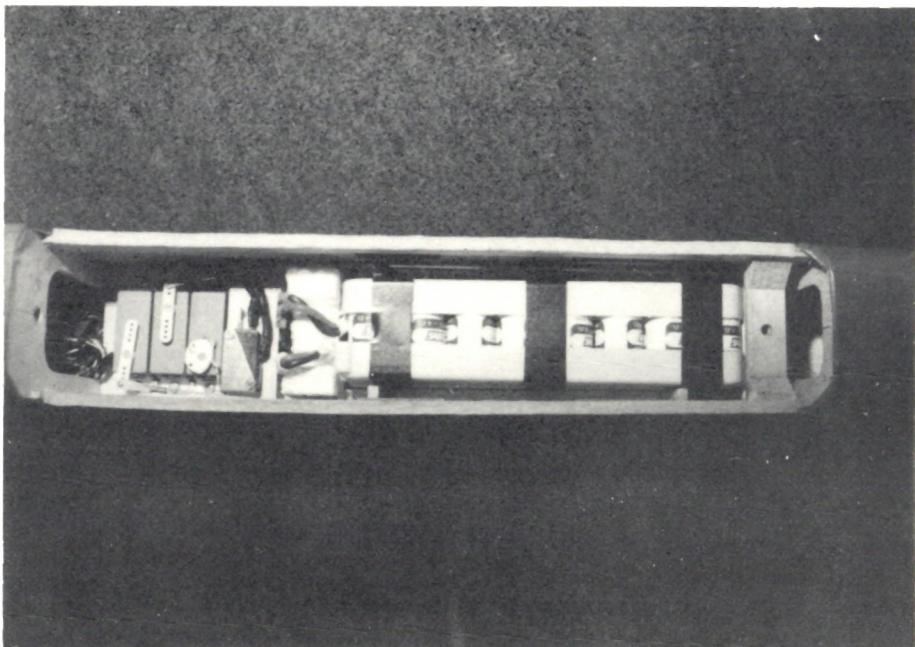
The Volta 1 was designed for electric aerobatics. I deliberately did without any luxuries, such as landing gear, a cockpit, a nice finish, etc. On the other hand, the aerodynamic design of the fuselage, wings, and tail unit has been kept as “clean” as possible. Here, every effort is worth it to keep overall drag low. I considered lightweight construction to be the most important factor—every unnecessary gram costs not only performance but also flight time! The fuselage structure is kept simple (a box frame with rounded triangular spars). The wings and tail are made of Styrofoam and are perforated to save even more weight—before skinning, of course.
Once launched with a strong swing into the air, the model climbed away at a shallow angle and immediately turned into a sweeping, steep turn. From then on, I felt like I was flying a slightly underpowered Marabu high-wing glider. The entire F3A National program is definitely manageable, and as a bonus, it can even perform some nice slow rolls and four-point rolls. Mind you, not with a launch from the stratosphere, but with a modest steep turn from level flight. Since there’s no gearbox, the running noise is similar to that of a high-speed fan, and during roll maneuvers, you can clearly hear the control surfaces “whistling.” I can report a flight time of about 6 minutes at 0°C, after which the speed drops but it’s still capable of one or two go-around maneuvers; these figures also match the manufacturer’s specifications. The Astro 25 is quite energy-efficient for its performance and exceptionally robust, even though its appearance might suggest it’s just a cheap windshield wiper motor.
In closing, I’d like to say that electric flight is certainly no longer in its infancy, even if it isn’t quite fully developed yet. In any case, without much prior knowledge and using conventional methods, I’ve now built a high-performance electric aerobatic model, and I’m convinced you can do it too!
| Wingspan | 174 cm |
| Wing loading | approx. 52 dm² |
| Empty weight | approx. 550 g |
| Weight ready to fly | approx. 2,250 g |
| Motor | Astro 25 |
| Battery | 19.2 V, 1.2 Ah |


News from HEBU

TEAM MANAGER "THIS" BOSSHARD
 Rodito Nussbaumer

YOU KNOW WHAT I MEAN? 125 YEARS OF THE SWISS AERO CLUB
 Emil Giezendanner

F3A EUROPEAN CHAMPIONSHIPS IN ST-MACAIRE, FRANCE
 Matthias Bosshard

52. 2026 ALPS CUP
Emil Giezendanner
PRIDE AND GOOD IDEAS
 Markus Nussbaumer

CORSAIR F4U – A WARBIRD WITH A MEMORABLE LOOK
Jürgen Rosenberger, Jürgen Prinz
SUMMER FUN 2026 AT MG USTER
Martin Wunderli
TRY-OUT DAY AT MFV WETTINGEN
Urs Keller
BY YOUTH, FOR YOUTH
Lorena Betschen
ATOM, THE NEW DOUBLE-DECKER FROM CPLR
Matthias Bosshard
SMALL, MODEL-LIKE SAILBOATS
Res Dauwalder
What's New at Leomotion.com

HORIZON HOBBY/LEMACO NEWS: MICRO OV-10 BRONCO 645 MM BY E-FLITE

COUPE DES ALPES – OBSERVE AND LEARN
Rodito Nussbaumer
TWIN TOWN PARTNERSHIP
Wolfgang Voeller
EURO CONTEST GLIDER ACRO TOUR AUSTRIA 2026

INSIGHTS INTO THE HISTORY OF SEAPLANES

34th HAHNENMOOS ALPINE MODEL AIRPLANE CAMP
Res Dauwalder
WELCOME, NEW MEMBER!
Andrea Bolliger
FREE FLIGHT IN THE MIDDLE OF SUMMER
Urs Muntwyler
THE PC-21 STORY
Emil Giezendanner
NEWS FROM HEBU
 Julia Bucher

FROM 0 TO 100
Markus Nussbaumer
MEMORIES
Wolfgang Völler
NOS REGION – A HUB FOR ELECTRIC AVIATION
Emil Giezendanner
Have you almost forgotten about aircraft that take off and land vertically?
Emil Giezendanner
DO YOU KNOW WHAT I MEAN IN THE LAND OF SMILES?
Emil Giezendanner