
C 3605 – the Swiss Army's last in-house design
An impressive presentation of two models at the Langenthal Airfield
The C 3605 was the Swiss Air Force’s last domestically produced aircraft. It remained in service until 1988. Every now and then, models are built—though rarely off-the-shelf, but rather as elaborate one-of-a-kind pieces. Just two such one-of-a-kind models were recently completed in northwestern Switzerland and were on display not long ago at the Langenthal airfield.
It was a peaceful gathering of aviation enthusiasts on Sunday morning at Langenthal Airfield—a scene that is actually quite rare in Switzerland: Thanks to the cooperation of the airfield operator, the AeCS Langen-
thal, and the Bleienbach Powered Flight Group—and not least thanks to the flexibility of the “tower” (many thanks!)—Fredy Gass and Marco Zaugg were able to present their two C 3605s during normal Sunday flight operations. Thus,
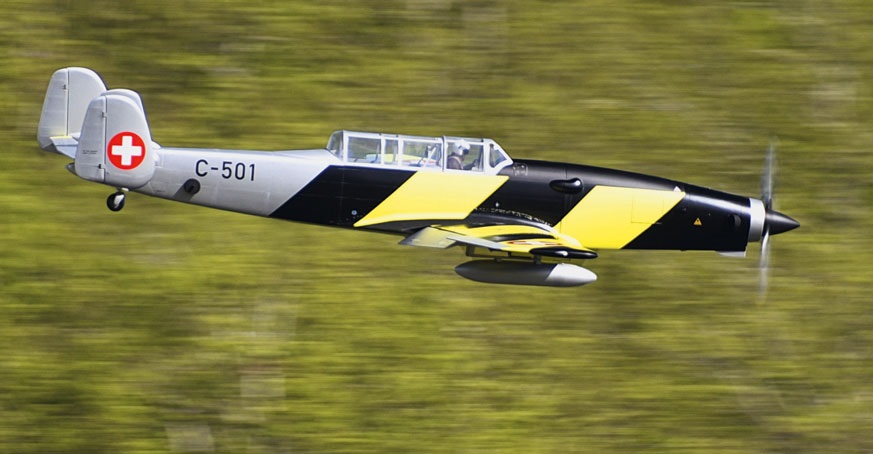
the usual airfield crowd by a small group of model aircraft enthusiasts in warm, southerly wind conditions. They didn’t want to miss the demonstration, which would hardly be possible at a model airfield due to the size of the models: 29.5 kg takeoff weight, a wingspan of a good 360 cm at a 1:4 scale, and a length of 330 cm. The Kingtech turboprop engine packs quite a punch, yet the C 3605 requires ample runway length for safe and true-to-prototype takeoffs and landings. The realistic flight performance generates excitement; just like with the original
, simple aerobatic maneuvers are possible; the pilots execute them smoothly in the sky, and spectators applaud clean landings.
Things didn’t always go so smoothly for the two C-3605 models. Model builders in the Zug region had taken on this challenging project and completed the initial construction steps. However, work then came to a standstill until Fredy Gass, president of MG Unterburg, and his club colleague Toni Leuenberger took over the plans and the work that had already been started. The
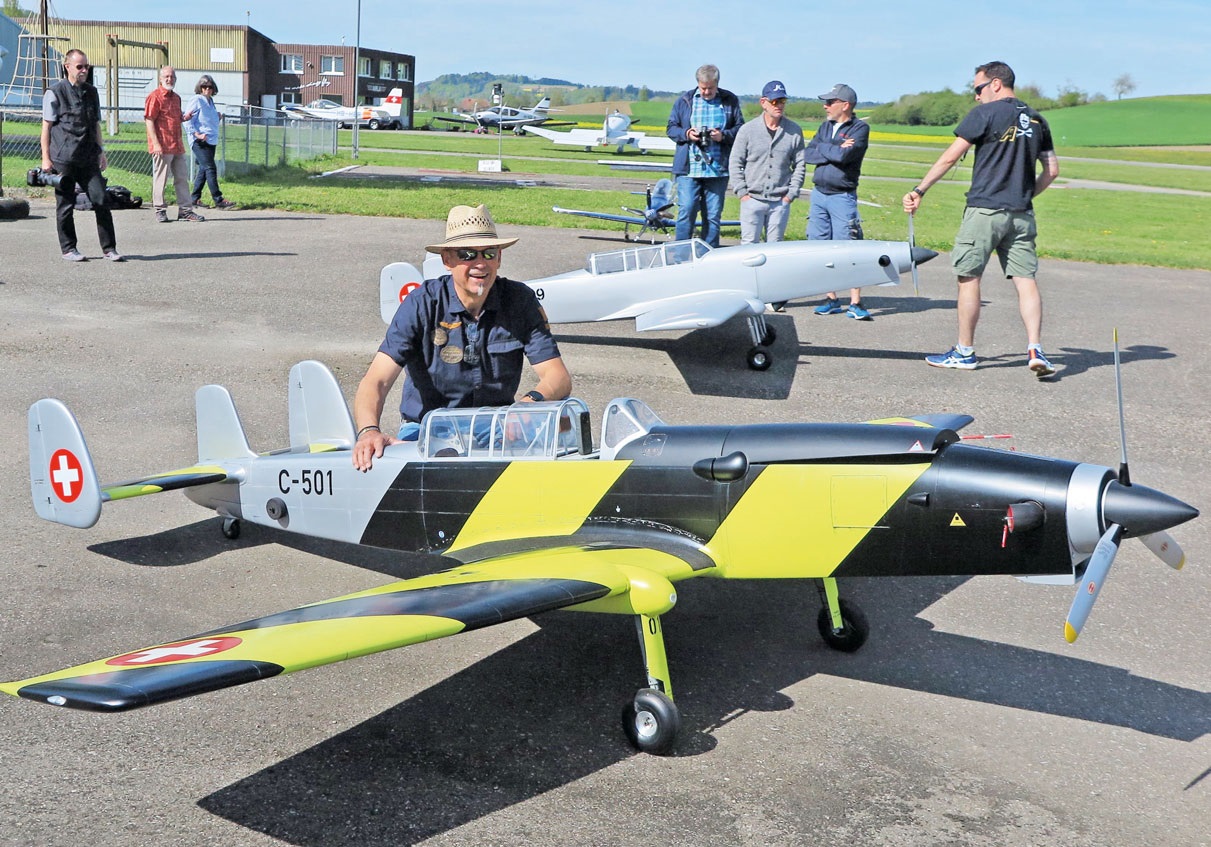
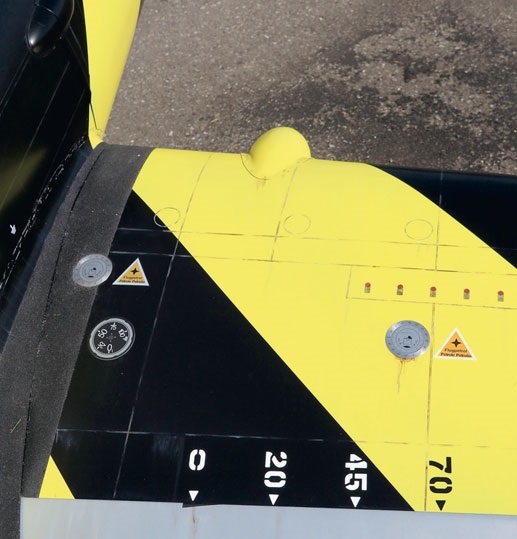
The effort required for the wooden structure was still enormous, but the two showed great dedication and possessed sufficient technical know-how and model-building skills, so that what had taken so long eventually turned out well. The first flights were encouraging. After that, they turned their attention to the details, such as an electrically operated cockpit canopy, and above all, the design required quite a bit more time. The basic pattern of the original—the “flying zebra stripes”—was one thing; the countless details were another. That’s when Marco Zaugg stepped in. He’s a master of the art of weathering. Under his hands, models age so that they look like the originals after 30 years of service. Following the initial flight tests, Zaugg’s dedication led to him taking over the model from Leuenberger, who, having proven that the plane could fly, preferred to turn his attention to other projects.
The originals were the last aircraft designed and built in-house by the Swiss Air Force. Developed during World War II by the Eidgenössische Konstruktionswerkstätte (K+W) in Thun, they were used for reconnaissance flights and ground attack missions. The cantilever biplane—
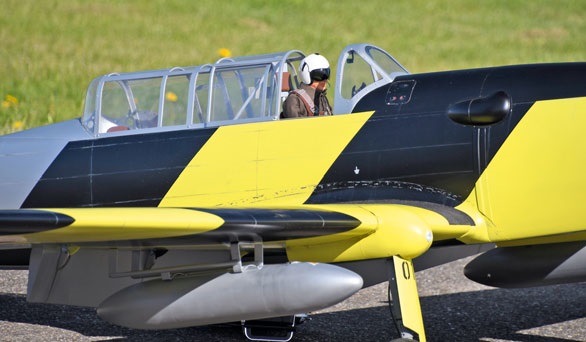
A total of 142 units of the C 3603, a single-seat low-wing aircraft with a twin-tail configuration, were built. They were powered by a Hispano-Suiza 12Y-51 engine. After the war, the C 3603 was used increasingly—and soon exclusively—for target towing. When the Hispano-Suiza engines began to show signs of age, a replacement was sought for this mission. Ultimately, the Department of Defense at the time decided to convert 24 C-3603 aircraft to the C 3605 configuration. The work was extensive, with the focus on a new powerplant. The Lycoming T53 turboprop was selected. Since this engine, with significantly
Although it had more horsepower and was lighter than the Hispano-Suiza, the nose had to be extended by 1.8 m to maintain the same center of gravity. Added to this were an (additional) central vertical stabilizer and the characteristic paint scheme, which was intended to ensure that it could be distinguished from a tow bag during target practice exercises for anti-aircraft units. The first flight took place in August 1968, and the aircraft remained in service with the Swiss
Air Force until 1988. With approximately 1,000 PS, it was the most powerful and fastest C 36; its wingspan was 13.74 m, and its takeoff weight was 3,716 kg.
Today, only a few C 3605s are still airworthy; otherwise, they are popular museum exhibits—and, from time to time, a source of inspiration and a challenge for hardcore model builders.


TEAM MANAGER "THIS" BOSSHARD
 Rodito Nussbaumer

YOU KNOW WHAT I MEAN? 125 YEARS OF THE SWISS AERO CLUB
 Emil Giezendanner

F3A EUROPEAN CHAMPIONSHIPS IN ST-MACAIRE, FRANCE
 Matthias Bosshard

News from HEBU

SUMMER FUN 2026 AT MG USTER
Martin Wunderli
TRY-OUT DAY AT MFV WETTINGEN
Urs Keller
52. 2026 ALPS CUP
Emil Giezendanner
BY YOUTH, FOR YOUTH
Lorena Betschen
ATOM, THE NEW DOUBLE-DECKER FROM CPLR
Matthias Bosshard
CORSAIR F4U – A WARBIRD WITH A MEMORABLE LOOK
Jürgen Rosenberger, Jürgen Prinz
SMALL, MODEL-LIKE SAILBOATS
Res Dauwalder
What's New at Leomotion.com

TWIN TOWN PARTNERSHIP
Wolfgang Voeller
EURO CONTEST GLIDER ACRO TOUR AUSTRIA 2026

INSIGHTS INTO THE HISTORY OF SEAPLANES

34th HAHNENMOOS ALPINE MODEL AIRPLANE CAMP
Res Dauwalder
HORIZON HOBBY/LEMACO NEWS: MICRO OV-10 BRONCO 645 MM BY E-FLITE

COUPE DES ALPES – OBSERVE AND LEARN
Rodito Nussbaumer
PRIDE AND GOOD IDEAS
 Markus Nussbaumer

FREE FLIGHT IN THE MIDDLE OF SUMMER
Urs Muntwyler
THE PC-21 STORY
Emil Giezendanner
WELCOME, NEW MEMBER!
Andrea Bolliger
NEWS FROM HEBU
 Julia Bucher

FROM 0 TO 100
Markus Nussbaumer
MEMORIES
Wolfgang Völler
NOS REGION – A HUB FOR ELECTRIC AVIATION
Emil Giezendanner
Have you almost forgotten about aircraft that take off and land vertically?
Emil Giezendanner
70 YEARS OF THE NIDWALDEN MODEL AIRPLANE CLUB
Martin Barmettler