
Energy and the Environment
The publisher of the journal *Sonnenenergie*—that is, the SSES—has commissioned an author to write a series of articles aimed at a general audience on solar energy technology. Here is the first installment on the topic of batteries, which is important for photovoltaic applications.
Unlike a primary battery (galvanic cell or “disposable battery”), which is depleted after a certain period of time, a secondary battery (rechargeable battery) can be recharged. The so-called “car battery” should therefore be called a “car accumulator.” In what follows, we won’t distinguish very strictly between these two terms; however, it’s clear that our interest lies primarily in rechargeable accumulators, as they are key components of small off-grid solar power plants and solar-powered vehicles.
The unit of measurement for energy (and work) is the “joule.” 1 joule is the amount of work (= energy) contained in a mass of 100 g that has been raised 1 m.
Or: 1 joule is the energy released when a current of 1 A flows for 1 second at a voltage of 1 volt.
Or: If a power of 1 watt is delivered for 1 second, 1 joule of work is done.
1 joule (abbreviated: J) is therefore a fairly small amount of energy. 1,000 J is 1 kJ (“kilojoule”), and 1,000,000 J is 1 MJ (“megajoule”).
The unit of measurement for power is the “watt.” 1 watt is produced when 1 joule of work is done in 1 second.
Or: A current of 1 ampere at a voltage of 1 volt represents an (electrical) power of 1 watt.
The more energy an energy storage device can store in the smallest possible volume (measured in m³) or with the
low mass (measured in kg). “Energy density” expresses the ratio of stored energy to volume or mass (unit of measurement: “J/m³” or “J/kg”).
Similarly, the performance of the storage device can be described using “power density,” which describes the ratio of stored power to volume or mass (unit of measurement: “W/m³” or “W/kg”).
Electrical energy is a high-quality form of energy that can be easily converted into other forms of energy. Storing electrical energy in batteries is extremely convenient, since it can be accessed, so to speak, at the push of a button. However, batteries can store only a relatively small amount of energy relative to their mass or volume. The following comparison illustrates this:
| | Energy
(MJ) | Net
mass
(kg) | Volume
(m³) | Energy/mass
(MJ/kg) | Energy/volume
(MJ/m³) |
|--------------------------------------------------|-----------------|-------------------------|----------------------------|------------------------------|----------------------------------------|
| Bar of chocolate (chem.) | 2.2 | 0.1 | 1.1 × 10⁻⁴ | 22 | 20,000 |
| Gasoline can (chem.) | 730 | 17 | 20 × 10⁻³ | 43 | 37,000 |
| Camping gas canister (chem.) | 140 | 3.0 | 6 × 10⁻³ | 46 | 23,000 |
| Flywheel (high-strength material!) | | | | 1.3 | 1,100 |
| Car battery (electr.) | | | | 0.13 | 360 |
| Charged capacitor (very good dielectric!) | | | | | 2.2 |
| current-carrying coil (superconducting!) | | | | | 80 |
Note: The notation 10⁻⁴ means 0.0001.
The storage of chemical energy obviously allows for the highest energy densities, while the storage of electrical energy in electric fields (in capacitors) or magnetic fields (in coils) allows for even lower energy densities than those possible in rechargeable batteries.
When
use of rechargeable batteries—that the voltage remains consistently high throughout the entire discharge period,
– the internal resistance remains consistently low during the discharge period, so that the discharge current remains constant,
– both the charging and discharging processes may be very short, – the service life—and thus the number of cycles (number of charges/discharges)—is long.
Of course, these very self-serving requirements can only be partially met.
The capacity (or “storage capacity”) of a battery is described using the unit of measurement “ampere-hours” (abbreviated as Ah). This product of current and time is essentially the amount of charge the battery can hold. Put simply, 10 Ah means that the battery can supply a current
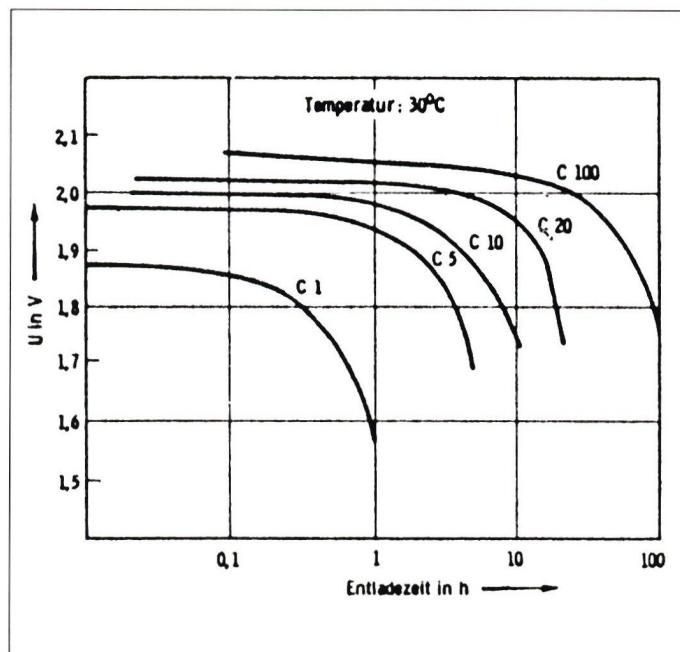
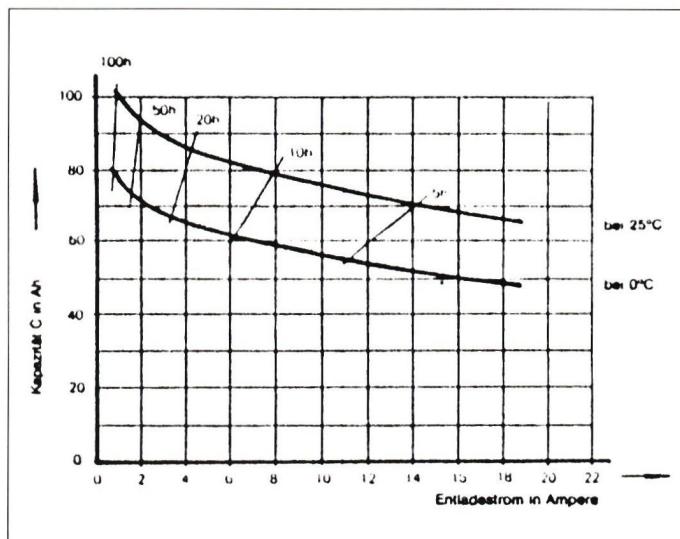
of 10 A can be drawn from the battery for 1 hour, or a current of 1 A can be drawn for 10 hours. However, the relationships are not as simple as they initially appear here. Figures 1 and 2 show that capacity depends heavily on the discharge current.
The discharge current and the duration of the discharge directly influence the depth of discharge. This refers to the percentage of the rated capacity to which a battery
battery is discharged. There are photovoltaic batteries that should only be regularly discharged below 50% in exceptional cases. The depth of discharge has a very strong influence on the battery’s service life: If a battery is repeatedly discharged to a low level, it will have a shorter service life than if it is only ever discharged slightly.
Even an unused battery discharges, albeit quite slowly; this is referred to as self-discharge. The self-discharge rate depends heavily on the battery type, the design, and, as shown in Diagram 3, the temperature. Self-discharge must be continuously compensated for with a small charging current.
In the following, we will examine batteries that are suitable for storing electrical energy in electric vehicles or off-grid solar systems. Such applications are typically characterized by a high number of charge-discharge cycles; under certain conditions, standard batteries can wear out in as little as one month when used in solar systems.
– A lead-acid battery (e.g., a car battery) uses the following reaction:
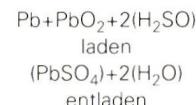
Let’s take a closer look at this process, which is also representative of the other types:
During charging, a portion of the lead plates becomes coated with lead dioxide (PbO₂). This is the oxidation of the anode (= positive terminal of the battery). This process means that electrons are removed from the anode. At the same time, the cathode (= negative terminal of the battery) receives electrons, converting lead sulfate (PbSO₄) into pure lead. This is the reduction of the cathode. Both processes result in an increase in the proportion of sulfate ions in the battery acid (=
diluted sulfuric acid), the concentration of sulfate ions increases, meaning the density of the acid rises ( $>1.28 \text{ g/cm}^3$ ).
During discharge, the process runs in reverse: the negative terminal releases electrons, and the positive terminal accepts electrons. At the negative terminal, pure lead is converted to lead sulfate (oxidation of the cathode); at the positive terminal, lead dioxide ( $\text{PbO}_2$ ) is also converted to lead sulfate (reduction of the anode). Both processes remove sulfate ions from the battery acid; its density decreases ( $>1.15 \text{ g/cm}^3$ ).
Characteristics: 2.1-volt cell; energy density $1.3 \cdot 10^5 \text{ joules/kg}$ ; service life of approximately 1,000 cycles; power density 20 (continuous) to 100 (peak) watts/kg. The lead-acid battery is relatively inexpensive but does not have a long service life; it is not cycle-stable and has a high self-discharge rate. This is a major disadvantage, especially when used in electric vehicles.
Lead-acid batteries are available in open or sealed forms:
- Open-type: require minimal maintenance, are available with capacities ranging from 10 to 2,000 Ah; can be charged with high efficiency.
- Sealed: Can be operated in any position; completely maintenance-free; capacities range from 0.8 to 110 Ah.
– The nickel-cadmium battery is based on the following reaction:
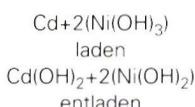
Characteristics: 1.2-volt cell. Because it contains the heavy metal cadmium, this type is expensive; disposal and recycling are problematic. However, its service life is longer than that of a lead-acid battery. Open and sealed versions are also available:
- open: very long service life; still operational even at temperatures as low as $-40$ degrees Celsius; capacities ranging from 10 to 1,250 Ah.
- Sealed: completely maintenance-free; 100 percent discharge possible; voltages up to 110 V are possible in series connection; capacities ranging from 0.5 to 15 Ah.
The following types are mentioned only briefly because they are not widely used:
- Nickel-iron battery (sometimes used in racing solar cars)
- Silver-zinc battery (very expensive!)
- Sodium-sulfur high-temperature cell
- Lithium-sulfur high-temperature cell
The problem with high-temperature cells lies in the need for a safe and leak-proof enclosure for the molten sulfur, which is highly corrosive. Additionally, high-temperature cells usually require an auxiliary battery to start them.
When discussing batteries, a distinction is made between two types of efficiency: The Ah efficiency indicates the ratio of the charge that can be drawn from the battery to the charge supplied to the battery during charging. This efficiency is typically around 0.9 (or 90 percent).
The Wh efficiency is the ratio of energy drawn to energy supplied. This value is always lower than the Ah efficiency and is approximately 0.8 (or 80 percent). Batteries in solar systems, in particular, are repeatedly discharged and recharged. Charging must be monitored by a charge controller, because a discharged battery draws a current from a voltage source (e.g., a solar generator) that gradually weakens until its voltage approaches the supply voltage. If the voltage source now increases its voltage, the battery can continue to draw current. Eventually, it will be fully charged. If the supply voltage is still above the battery’s cut-off voltage at this point, the battery begins to gas: oxygen, hydrogen, and oxyhydrogen gas are produced. A sealed battery now develops considerable internal pressure, which can lead to it bursting. The regulator must now ensure that only as much current is supplied as is necessary to compensate for self-discharge (so-called trickle charge). Conversely, certain regulators monitor the depth of discharge and, if necessary, cut off the current (so-called deep-discharge protection). Of course, depending on their electronic complexity, regulators can do much more. When switching to trickle charging, some controllers simply dissipate the current supplied by the solar generator into
Discharge capacity C as a function of discharge current
for the Varta Solar 82000 battery.
Voltage curve for various discharge currents. The effective capacity can be calculated using “discharge time – discharge current.”
Some monitor a single battery, while others can monitor multiple batteries according to specified priorities and charge them sequentially.
The state of charge is monitored by voltage monitors, which are often combined with charge controllers. Their function is to indicate the charge/discharge status, but also
the “battery capacity,” allowing one to estimate the amount of stored energy.
The use of rechargeable batteries in solar power systems requires careful planning: The batteries must be compatible with the solar—
Self-discharge of unused batteries, depending on the storage period. I = A600 solar battery, II = standard lead-acid battery.
Generators must be properly matched. It is also definitely worth planning for a good control and monitoring system in addition to these two basic components. Only then can optimal service life and high reliability of the entire system be ensured.
Currently, the lead-acid battery is still the most widely used type for the applications primarily considered here. The nickel-cadmium battery is already much less common.
The disadvantages of the lead-acid battery are well known; however, it will likely be
a very long time before a genuine alternative to the lead-acid battery is available on the market.
Dieter Kuhn, certified physicist, 8057 Zurich
A. Stork: “Das private E-Werk,” VTL Publishing, Hirschau, 1990, approx. Fr. 10.-; U. Muntwyler: “Practical Applications of Solar Cells,” Franzis-Verlag, Munich, 1990, about Fr. 15.-; W. Hagemann (ed.): “Lead-Acid Batteries,” Lehrmittelverlag W. Hagemann, Düsseldorf (project transparency).
From “Sonnenenergie” 3/91


TEAM MANAGER "THIS" BOSSHARD
 Rodito Nussbaumer

ATOM, THE NEW DOUBLE-DECKER FROM CPLR
 Matthias Bosshard

INSIGHTS INTO THE HISTORY OF SEAPLANES

CORSAIR F4U – A WARBIRD WITH A MEMORABLE LOOK
Jürgen Rosenberger, Jürgen Prinz
SUMMER FUN 2026 AT MG USTER
Martin Wunderli
F3A EUROPEAN CHAMPIONSHIPS IN ST-MACAIRE, FRANCE
Matthias Bosshard
What's New at Leomotion.com

HORIZON HOBBY/LEMACO NEWS: MICRO OV-10 BRONCO 645 MM BY E-FLITE

PRIDE AND GOOD IDEAS
 Markus Nussbaumer

News from HEBU

YOU KNOW WHAT I MEAN? 125 YEARS OF THE SWISS AERO CLUB
 Emil Giezendanner

34th HAHNENMOOS ALPINE MODEL AIRPLANE CAMP
Res Dauwalder
SMALL, MODEL-LIKE SAILBOATS
Res Dauwalder
TRY-OUT DAY AT MFV WETTINGEN
Urs Keller
52. 2026 ALPS CUP
Emil Giezendanner
TWIN TOWN PARTNERSHIP
Wolfgang Voeller
EURO CONTEST GLIDER ACRO TOUR AUSTRIA 2026

BY YOUTH, FOR YOUTH
Lorena Betschen
WELCOME, NEW MEMBER!
Andrea Bolliger
FREE FLIGHT IN THE MIDDLE OF SUMMER
Urs Muntwyler
THE PC-21 STORY
Emil Giezendanner
COUPE DES ALPES – OBSERVE AND LEARN
Rodito Nussbaumer
NEWS FROM HEBU
 Julia Bucher

FROM 0 TO 100
Markus Nussbaumer
NOS REGION – A HUB FOR ELECTRIC AVIATION
Emil Giezendanner
MEMORIES
Wolfgang Völler
Have you almost forgotten about aircraft that take off and land vertically?
Emil Giezendanner
70 YEARS OF THE NIDWALDEN MODEL AIRPLANE CLUB
Martin Barmettler