
The Ross-Twin 60
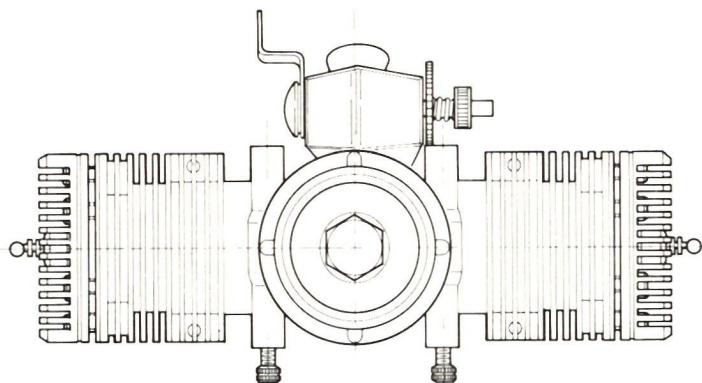
With the Ross Twin, model aircraft enthusiasts finally have a boxer engine with glow ignition. You might wonder why all this effort is necessary. Well, the fact is that, due to the laws of physics—which still apply—a single-cylinder engine cannot be balanced.
Vibrations are therefore unavoidable and, at the high RPMs common today, reach an extremely damaging intensity. The situation is different with the boxer engine, which can be largely balanced and consequently produces hardly any vibrations at all; it may therefore come as a surprise that boxer engines were not manufactured sooner.
There was certainly no shortage of attempts in this regard, but the buzz around the various prototypes presented always died down quickly. Presumably, it was both the high manufacturing costs and technical challenges—especially the difficulty of achieving an identical fuel-air mixture in both cylinders under all operating conditions—that acted as such a hindrance. It thus apparently fell to the genius and perseverance of Louis Ross, Vice President of Northfield Precision Instrument Corp. in Long Island, New York, to bring a boxer engine for model airplanes to production readiness during a period of underutilization.
This engine is now a collector’s item produced in small batches, a fact that is evident even from a distance simply by its appearance. It is available in the so-called standard version or, for an additional charge, in a black anodized version, which improves heat dissipation. It features a rear-mounted cylindrical rotary valve and is typically equipped with the much-praised Perry carburetor. Two mufflers are included, and these are not only quiet but also serve as effective oil separators based on the cyclone principle.
Over the course of half a year, the following practical experience was gained: Starting is trouble-free. It is sufficient to connect just one spark plug to the starter battery and, once the engine has started, to briefly fire the other one. If both spark plugs are fired at the same time, the engine starts immediately—this serves as a warning. After a break-in period of about 15 flights, the full-throttle response was silky smooth and even, though we flew somewhat conservatively as a precaution. The carburetor settings for full-throttle performance are uncritical, as are those for idle. With an 11 x 7 wooden propeller, the engine reliably maintained 2,400 RPM at a standstill, which is quite a sensation for a boxer engine with unheated spark plugs. The response to throttle input is spontaneous and smooth, reminiscent of an electric motor. Flights took place from August through December using self-synthesized fuel, whose recipe—previously kept strictly secret—consists of 7–10% nitromethane, 20% Castrol M, methanol, and a dash of Glo-Life. The measured maximum RPMs are slightly lower than those of a Webra 61 under the same conditions, which in itself is certainly not a major issue, since the Ross-Twin was not specifically developed for use in RCMM World Championships.
So how much does all this fun cost? The motor plus two mufflers: $125 plus $33 equals $158—or about 500 Swiss francs. It’s certainly not one of the cheapest. But it’s actually two motors in one; viewed that way, and given the flawless workmanship and exemplary choice of materials, the price is justified, and anyone who wants to treat themselves—and, above all, their RC system—will just have to shell out the cash. And for certain applications, the Boxer is the obvious choice thanks to its low-vibration operation: the model in question, for example, was used in a model equipped with a movie camera, which yielded remarkable results.
It’s worth noting that these mufflers with oil separators are also available in a larger version for standard 10 cm³ engines, though a corresponding adapter must be used depending on the engine type. Such mufflers have been used on the Webra, Veco, and HP .61 models, and in my humble opinion, they are currently the quietest on the market. No clear drop in performance compared to the respective original mufflers could be detected. On the other hand, a handkerchief is all you need to clean the model, since only a small amount of fine oil escapes from the exhaust. Long live convenience—even in RC sports! (AU!) H. St.


News from HEBU

TEAM MANAGER "THIS" BOSSHARD
 Rodito Nussbaumer

SUMMER FUN 2026 AT MG USTER
Martin Wunderli
SMALL, MODEL-LIKE SAILBOATS
Res Dauwalder
TRY-OUT DAY AT MFV WETTINGEN
Urs Keller
What's New at Leomotion.com

52. 2026 ALPS CUP
 Emil Giezendanner

ATOM, THE NEW DOUBLE-DECKER FROM CPLR
 Matthias Bosshard

INSIGHTS INTO THE HISTORY OF SEAPLANES

YOU KNOW WHAT I MEAN? 125 YEARS OF THE SWISS AERO CLUB
Emil Giezendanner
34th HAHNENMOOS ALPINE MODEL AIRPLANE CAMP
Res Dauwalder
CORSAIR F4U – A WARBIRD WITH A MEMORABLE LOOK
Jürgen Rosenberger, Jürgen Prinz
F3A EUROPEAN CHAMPIONSHIPS IN ST-MACAIRE, FRANCE
Matthias Bosshard
HORIZON HOBBY/LEMACO NEWS: MICRO OV-10 BRONCO 645 MM BY E-FLITE

PRIDE AND GOOD IDEAS
 Markus Nussbaumer

BY YOUTH, FOR YOUTH
Lorena Betschen
FREE FLIGHT IN THE MIDDLE OF SUMMER
Urs Muntwyler
THE PC-21 STORY
Emil Giezendanner
TWIN TOWN PARTNERSHIP
Wolfgang Voeller
EURO CONTEST GLIDER ACRO TOUR AUSTRIA 2026

WELCOME, NEW MEMBER!
Andrea Bolliger
COUPE DES ALPES – OBSERVE AND LEARN
Rodito Nussbaumer
NEWS FROM HEBU
 Julia Bucher

FROM 0 TO 100
Markus Nussbaumer
MEMORIES
Wolfgang Völler
NOS REGION – A HUB FOR ELECTRIC AVIATION
Emil Giezendanner
Have you almost forgotten about aircraft that take off and land vertically?
Emil Giezendanner
70 YEARS OF THE NIDWALDEN MODEL AIRPLANE CLUB
Martin Barmettler