
Build Report and First Flight of the ASW-17 from FMS
Winter is slowly but surely approaching, and I’ve been wanting to get a new plane for the winter season. Since I’m not quite ready with my Triple Thermic yet—and since this wooden plane is clearly meant to be a “fair-weather plane” for me—I headed to my model shop’s wonderland to look for an alternative.
- Foam shell (resistant to moisture and snow, easy to clean and repair).
- Glider with electric thermal.
- Wingspan +/- 2500 mm.
- Good low-speed flight characteristics.
- As few cables as possible that need to be plugged in during launch preparations.
- As little build time as possible, since I needed something to fly (I can still work on my Triple Thermic).
- A spare 6-channel receiver should suffice.
- If possible, an EC3 connector on the ESC.
After a brief discussion, I made up my mind: it would be the ASW-17 from FMS.
I immediately liked the plane a lot with all its features and details, so I didn’t have to think twice. Especially since the price, at Fr. 339, was under my budget. An almost ready-to-fly model with flaps, QR, HR, SR, and motor. All servos, as well as the ESC and motor, were already installed and wired. This model met (almost) all of my requirements. The only thing needed on the ESC side was an “XT-60 to EC3” connector adapter—so I didn’t even have to solder anything.
For the LiPo, I bought an ETOP 4S/2600; I didn’t have this size in my “collection” yet. This allowed me to set the required center of gravity just right. In principle, it would also be possible to use a 3S LiPo, though that would naturally result in compromises in terms of speed and climb performance. However, since this would likely be a disadvantage even when just flying around, I decided to go with 4S.
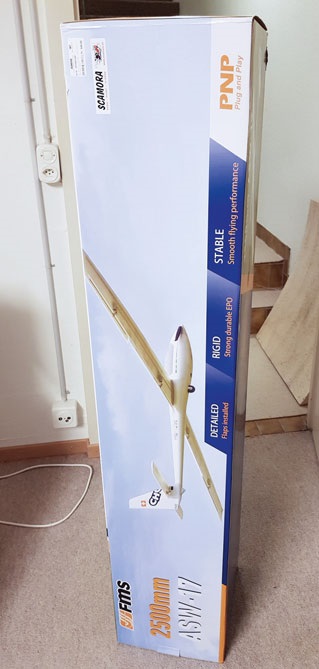
The individual parts are neatly stowed away in the giant box, and I’m hoping the box can also be used to transport the plane. Well, unfortunately, only partially. Since the plane sticks out the back with the elevator and rudder attached, the back of the box would have to be cut out. The box would also need to be adjusted around the fuselage.
“Would have to,” because this still needs to be done. But for a “temporary” solution, it works fine even without the cutouts.
As for “building” the glider, there isn’t much to write about (as I’d hoped). The manual is eleven pages long, of which just under three pages deal with the actual construction. The rest consists of safety regulations, flight basics, troubleshooting, and programming instructions for the controller (though it comes pre-programmed from the factory).
- So:
- Install the rudder, “click”
- Install the elevator, “click”
- Install the elevator and rudder control linkages
- Screw in the wing connectors
- Slide on the wing halves, “double-click”
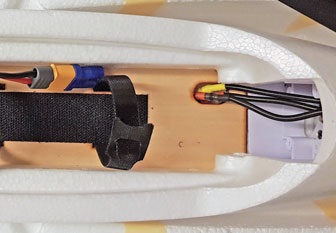
To install the receiver, I also needed a cable tie. I usually secure receivers with Tesa Powerstripes. However, since the surface of the battery board is treated, this solution doesn’t really hold. But thanks to the cutouts in the battery board, I was able to implement the solution with the additional cable tie without much effort. I routed one of the antennas out of the top of the fuselage. Thanks to the foam, this was very easy to do without any adhesive.
Yeah, that’s pretty much all there is to report on the build.
The size works out very well; though, in the basement, it would be possible to build even slightly larger models... The ESC is stowed in the belly, under the battery tray. Thanks to the arrangement of the ventilation slats, it’s well cooled. After the first landing, a lot of dirt and grass had already accumulated in the fuselage. Now I’m worried that it will fill up with snow during a snow landing—we’ll see…
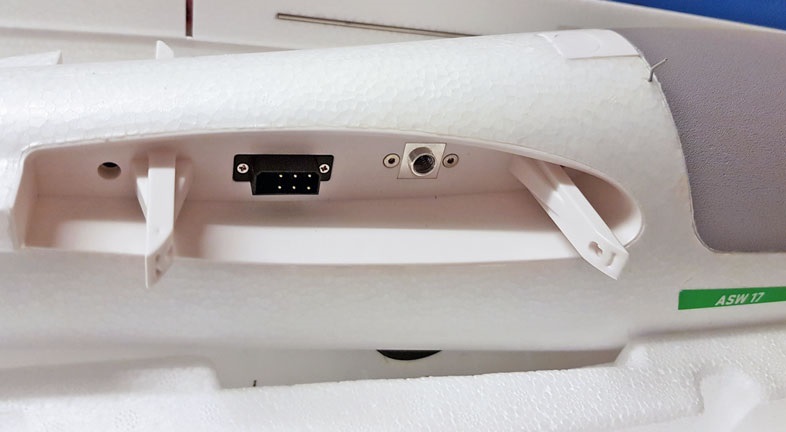
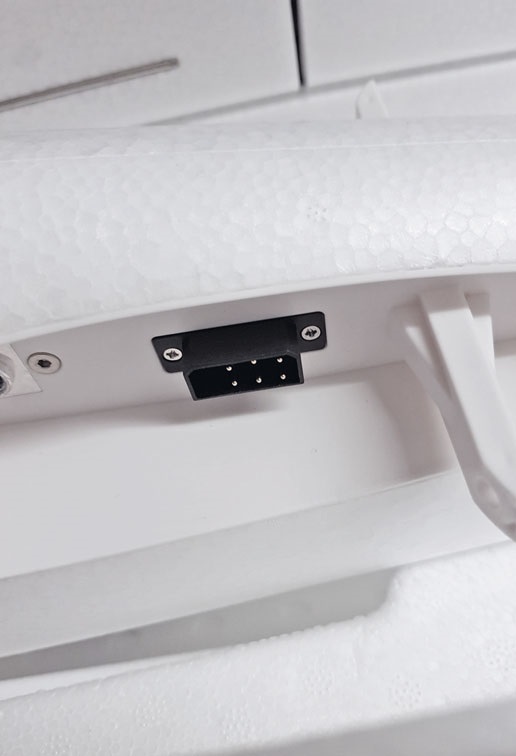
The first test hover on the center-of-gravity scale. I set it to 70 mm (70–80 mm according to the instructions). Six channels are sufficient, since the flap servos aren’t installed symmetrically and can therefore be connected via a single cable. The wings are attached using a screwless “quick-release” system, and the signal transmission for the two aileron servos each is also handled to my satisfaction via a plug-in system—no fiddling with cables before takeoff. There’s enough space under the canopy for the battery and, later on, possibly some telemetry equipment as well. I kept the electronics on this plane fairly simple. If I ever feel like adding more later, that can easily be done.
- After the hand launch, the ASW climbed quite steeply and had to be manually controlled at first.
- With sufficient initial altitude, I began trimming it down—and not just a little.
- It also took just a few trim clicks to level it out.
- Even though I now have a neutral flight attitude,
- When I open the throttle, the glider lifts off quite a bit again. I still need to test whether a little more depth is possible for normal flight. I have the feeling the glider is a bit tail-heavy.
- The normal travel of all the control surfaces is too limited for my taste. Here, I’ve set them to maximum travel (which is still slightly greater than specified in the manual).
- If the ASW stalls, it dives over one wingtip but can be recovered easily.
- The braking effect of the flaps is good. It’s so good that I can probably do without flap deflections entirely during landing. But even without using the flaps, it’s possible to fly quite slowly.
- When the model has the flaps fully extended, it responds rather sluggishly to control inputs.
- Reset the elevator trim to neutral and readjust the control linkage.
- Adjust flap settings: reduce for thermals and landing.
- Test the recovery behavior after entering a stall—is the EWD OK?
- Let the glider run a little longer to achieve better control response.
- Don’t approach the landing too slowly. The uphill landing site requires some speed.
- Attempt a landing without flaps, and without slipstream as well.
After a few days, we headed back to the airfield—this time to put the lessons learned from the first flight into practice.
- You don't really need the flaps for landing; you can slow down enough and land without any stress even without them.
- I’ve adjusted the flap settings because the maximum deflection is too strong and makes the plane quite difficult to control. Now two settings are programmed: one with light deflection and one with medium deflection, each with a slight amount of elevator added. Unfortunately, the manual doesn’t provide any information on this.
- According to the manual, the gentle flare after the initial approach indicates a correct EWD.
- The EWD measured with the GliderThrow: approximately 2.3 degrees.
- As for the ventilation grille on the underside of the fuselage (controller), my fears have unfortunately been confirmed: The ventilation grille must be cleared after every landing because it fills up with grass and dirt.
- Let’s see if I can find a good solution for that.
- I had set the motor timer to 4 minutes according to the instructions: After 4 minutes of motor runtime and 30 minutes of flight, the LiPo checker still showed 26% charge and just under 3.8 V voltage on the unloaded cells.
- Based on these values, I changed the motor timer to 3.5 minutes, hoping that a little more than 30% reserve will remain afterward and the cells won’t be overtaxed.
A clubmate has since purchased the same model and flipped the ventilation grille on the underside of the fuselage so that the slats don’t act like propeller blades.
I did the same thing. All you have to do is remove a small tab from the grille, and it works. The benefit was immediately apparent after the next landing: only a few drops of water had found their way into the fuselage, but no more dirt.
Hoping that the controller will still be sufficiently cooled this way, I’ll leave it like this for now.
After these positive test flights, I’m really looking forward to the upcoming fall/winter season. I think the ASW is exactly the right, uncomplicated electric glider for me to enjoy a few carefree hours of flying.


TEAM MANAGER "THIS" BOSSHARD
 Rodito Nussbaumer

YOU KNOW WHAT I MEAN? 125 YEARS OF THE SWISS AERO CLUB
 Emil Giezendanner

F3A EUROPEAN CHAMPIONSHIPS IN ST-MACAIRE, FRANCE
 Matthias Bosshard

News from HEBU

SUMMER FUN 2026 AT MG USTER
Martin Wunderli
TRY-OUT DAY AT MFV WETTINGEN
Urs Keller
52. 2026 ALPS CUP
Emil Giezendanner
BY YOUTH, FOR YOUTH
Lorena Betschen
ATOM, THE NEW DOUBLE-DECKER FROM CPLR
Matthias Bosshard
CORSAIR F4U – A WARBIRD WITH A MEMORABLE LOOK
Jürgen Rosenberger, Jürgen Prinz
SMALL, MODEL-LIKE SAILBOATS
Res Dauwalder
What's New at Leomotion.com

TWIN TOWN PARTNERSHIP
Wolfgang Voeller
EURO CONTEST GLIDER ACRO TOUR AUSTRIA 2026

INSIGHTS INTO THE HISTORY OF SEAPLANES

34th HAHNENMOOS ALPINE MODEL AIRPLANE CAMP
Res Dauwalder
HORIZON HOBBY/LEMACO NEWS: MICRO OV-10 BRONCO 645 MM BY E-FLITE

COUPE DES ALPES – OBSERVE AND LEARN
Rodito Nussbaumer
PRIDE AND GOOD IDEAS
 Markus Nussbaumer

FREE FLIGHT IN THE MIDDLE OF SUMMER
Urs Muntwyler
THE PC-21 STORY
Emil Giezendanner
WELCOME, NEW MEMBER!
Andrea Bolliger
NEWS FROM HEBU
 Julia Bucher

FROM 0 TO 100
Markus Nussbaumer
MEMORIES
Wolfgang Völler
NOS REGION – A HUB FOR ELECTRIC AVIATION
Emil Giezendanner
Have you almost forgotten about aircraft that take off and land vertically?
Emil Giezendanner
70 YEARS OF THE NIDWALDEN MODEL AIRPLANE CLUB
Martin Barmettler