
The Royal Flying Doctor Services in Switzerland
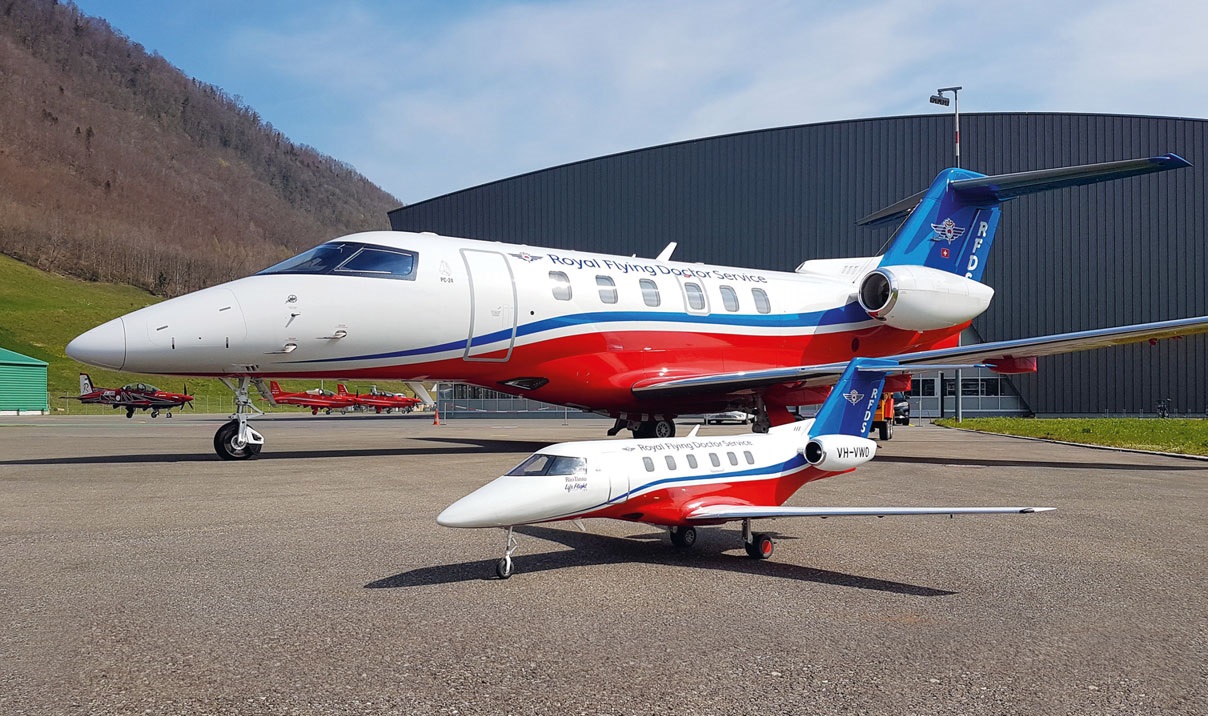
As a big fan of Pilatus aircraft, I was able to get my hands on serial number 001 of the Keiro (Kurt Eich) Semi Scale PC-24 model kit in 1:8 scale in December 2018.
It quickly became clear that we would build the model using iron-on transfer film, based on the design of the Royal Flying Doctor Services, which operates in Australia. The model has a wingspan of 2.14 meters and is 2.09 meters long. In addition to Unilight Scale lighting with a total of 12 high-power LEDs, it features a Benedini sound system with the original PC-24 engine sound. The fuselage is based on a box-shaped framework made of poplar plywood, covered with 2-mm balsa. This is where we first noticed the high precision of fit among the 400 milled parts. The nacelle mounting and the vertical stabilizer are integrated directly into the fuselage structure. The landing gear mechanism is the reliable ER-30eVo from Electron; the main landing gear legs with twin wheels and spring-loaded swing arms are from Keiro, and the nose landing gear leg is from Eurokit. The required thrust is provided by two 69-mm Wemotec EVO Mini fans powered by Hacker E40s 2.5D motors, controlled by two YGE 90 ESCs and a 6S 5800 mAh LiPo battery.
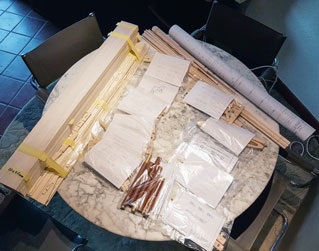
The two fully-planked wing halves are constructed using a conventional rib structure. For the landing flaps, the fuselage-wing junction, and the horizontal stabilizer, we deviated from the construction plans in order to make the model even more faithful to the original. The landing flaps were split into two sections, the fuselage-wing junction was significantly rounded, and on the horizontal stabilizer, we replicated the “nose,” which houses the rudder counterweight in the original. A total of ten Midi-sized Futaba servos were installed, six of them in the wing. The Futaba receiver system is powered by a 2S LiPo battery via a Jeti power supply. All other power consumers are powered by a total of three Castle Creations BEC 2.0 units due to the varying supply voltages and current ratings. Kurt Eich’s prototype weighs 5.7 kg ready to fly. Our model, with the additional servos, lighting, and the Benedini sound system, weighs just over 7 kg, which is still well within the acceptable range. This was confirmed during the successful maiden flight. The model flies very smoothly, and its flight characteristics are simply unique. As expected, the two-piece landing flaps and the lighting system look very realistic in flight. Depending on the equipment and design, you should allow 6–12 months for construction and already have some model-building experience.


TEAM MANAGER "THIS" BOSSHARD
 Rodito Nussbaumer

YOU KNOW WHAT I MEAN? 125 YEARS OF THE SWISS AERO CLUB
 Emil Giezendanner

F3A EUROPEAN CHAMPIONSHIPS IN ST-MACAIRE, FRANCE
 Matthias Bosshard

News from HEBU

SUMMER FUN 2026 AT MG USTER
Martin Wunderli
TRY-OUT DAY AT MFV WETTINGEN
Urs Keller
52. 2026 ALPS CUP
Emil Giezendanner
BY YOUTH, FOR YOUTH
Lorena Betschen
ATOM, THE NEW DOUBLE-DECKER FROM CPLR
Matthias Bosshard
CORSAIR F4U – A WARBIRD WITH A MEMORABLE LOOK
Jürgen Rosenberger, Jürgen Prinz
SMALL, MODEL-LIKE SAILBOATS
Res Dauwalder
What's New at Leomotion.com

TWIN TOWN PARTNERSHIP
Wolfgang Voeller
EURO CONTEST GLIDER ACRO TOUR AUSTRIA 2026

INSIGHTS INTO THE HISTORY OF SEAPLANES

34th HAHNENMOOS ALPINE MODEL AIRPLANE CAMP
Res Dauwalder
WELCOME, NEW MEMBER!
Andrea Bolliger
HORIZON HOBBY/LEMACO NEWS: MICRO OV-10 BRONCO 645 MM BY E-FLITE

COUPE DES ALPES – OBSERVE AND LEARN
Rodito Nussbaumer
PRIDE AND GOOD IDEAS
 Markus Nussbaumer

FREE FLIGHT IN THE MIDDLE OF SUMMER
Urs Muntwyler
THE PC-21 STORY
Emil Giezendanner
NEWS FROM HEBU
 Julia Bucher

FROM 0 TO 100
Markus Nussbaumer
MEMORIES
Wolfgang Völler
NOS REGION – A HUB FOR ELECTRIC AVIATION
Emil Giezendanner
Have you almost forgotten about aircraft that take off and land vertically?
Emil Giezendanner
70 YEARS OF THE NIDWALDEN MODEL AIRPLANE CLUB
Martin Barmettler