
Model Airplane Trailer
In issue No. 4/2023 of the magazine “Modellflugsport,” Bernd Vonbank describes a model airplane trailer. With an empty weight of 380 kilograms, such a trailer is too heavy for me. I only want to transport a glider model with a wingspan of up to about three meters. For that, I’m looking for a bicycle trailer weighing no more than 10 to 15 kilograms.
There are tons of bike trailers out there. But none that are suitable for my purpose. So I’ll build one myself—at least the body. This raises the question of whether the model airplane should be transported horizontally or vertically. Vertically, I think, because I originally planned to build a wooden bike bag, with the wings and fuselage standing vertically in two wooden crates on either side of the bike’s rear wheel. My wife advises me to build a bike trailer—which signals her acceptance of yet another vehicle in our garage.
At my bike shop, I find a trailer that’s suitable for my needs: small and lightweight. I would have preferred wheels with larger spokes, but you can’t have everything. It doesn’t have suspension, so I’ll place the model airplane I’m transporting on a piece of foam. The trailer consists of a metal tube frame to which the wheels and the drawbar are attached. A collapsible red plastic crate rests loosely on the frame. So I “just” need to build a taller wooden box that I can place in the tubular frame in place of the plastic box. This will make the bike trailer multifunctional. I’ll use the included plastic box to transport items to the recycling center—and the wooden box to carry model airplanes to the airfield.
I’ve given some thought to the height of the structure: the higher it is, the better protected the model will be. But I want to be able to reach the bottom of the trailer from above with one hand. The result is a front and rear wall of different heights. The trailer structure, made of poplar plywood, is quick to assemble. To secure the gliders inside the box, I use round wooden rods with rubber bands stretched across them—similar to how wings are attached with rubber rings on simple model airplanes. A low partition is built into the bottom of the box so that, for example, a heavy high-launch device cannot damage the fragile model airplane during transport.
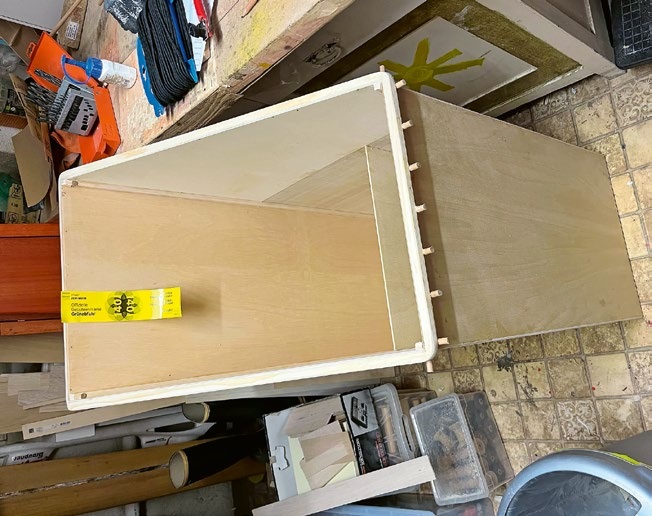
On my first test ride through Zofingen’s old town, every pedestrian turned to look at me, because the noise from my trailer was considerably louder than that of a wheeled suitcase. The wooden box acts as a perfect sound box on the bumpy cobblestones. Soundproofing is incredibly simple: I just stretch a foam sheet between the metal tube frame and the wooden structure using rubber straps attached to the metal frame. It works perfectly. I decide to skip the “moose test” (an evasive maneuver to avoid a suddenly appearing obstacle); the center of gravity doesn’t seem to be as high as it appears at first glance. When loading the trailer, it’s important to make sure the weight is distributed toward the bottom.
To avoid confusing it with a green recycling bin, I paint the wooden crate a bright red. Loaded with my yellow Standard Airfish glider model, the trailer reminds my adult daughter of a full McDonald’s french fries container.
The first trip to the airfield, about five kilometers away, goes perfectly. However, my physical condition is barely up to the challenge of the roughly 50-meter climb. I feel the weight of the trailer and find myself out of breath. Another realization is that I can no longer turn my head 180 degrees. But I want to see what’s happening behind me in the open trailer. I need a rearview mirror—there are some clever bike rearview mirrors available today.
After my first few trips, I expand the trailer by adding a wooden box mounted on the outside to serve as a toolbox.
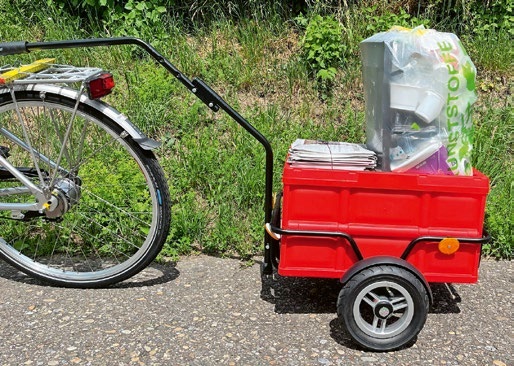
I’m happy with my bike trailer—though I still lack years of experience. My first—and so far only—trip to the Zofingen Flying Club’s model airfield was too much for my fitness level. I couldn’t cover the 15.7-kilometer route with 306 meters of elevation gain in the 47 minutes indicated by Google Maps. In some sections, I had to get off and laboriously push or pull the bike and trailer on foot. That’s why I’m currently using my bike trailer only for short distances of up to five kilometers. I think an e-bike could extend my range.


News from HEBU

TEAM MANAGER "THIS" BOSSHARD
 Rodito Nussbaumer

YOU KNOW WHAT I MEAN? 125 YEARS OF THE SWISS AERO CLUB
 Emil Giezendanner

F3A EUROPEAN CHAMPIONSHIPS IN ST-MACAIRE, FRANCE
 Matthias Bosshard

52. 2026 ALPS CUP
Emil Giezendanner
PRIDE AND GOOD IDEAS
 Markus Nussbaumer

ATOM, THE NEW DOUBLE-DECKER FROM CPLR
Matthias Bosshard
CORSAIR F4U – A WARBIRD WITH A MEMORABLE LOOK
Jürgen Rosenberger, Jürgen Prinz
SUMMER FUN 2026 AT MG USTER
Martin Wunderli
TRY-OUT DAY AT MFV WETTINGEN
Urs Keller
TWIN TOWN PARTNERSHIP
Wolfgang Voeller
BY YOUTH, FOR YOUTH
Lorena Betschen
SMALL, MODEL-LIKE SAILBOATS
Res Dauwalder
What's New at Leomotion.com

HORIZON HOBBY/LEMACO NEWS: MICRO OV-10 BRONCO 645 MM BY E-FLITE

COUPE DES ALPES – OBSERVE AND LEARN
Rodito Nussbaumer
EURO CONTEST GLIDER ACRO TOUR AUSTRIA 2026

INSIGHTS INTO THE HISTORY OF SEAPLANES

34th HAHNENMOOS ALPINE MODEL AIRPLANE CAMP
Res Dauwalder
WELCOME, NEW MEMBER!
Andrea Bolliger
FREE FLIGHT IN THE MIDDLE OF SUMMER
Urs Muntwyler
THE PC-21 STORY
Emil Giezendanner
NEWS FROM HEBU
 Julia Bucher

FROM 0 TO 100
Markus Nussbaumer
MEMORIES
Wolfgang Völler
NOS REGION – A HUB FOR ELECTRIC AVIATION
Emil Giezendanner
Have you almost forgotten about aircraft that take off and land vertically?
Emil Giezendanner
DO YOU KNOW WHAT I MEAN IN THE LAND OF SMILES?
Emil Giezendanner