
Certification of the Val-de-Ruz Model Aircraft Club (GAM-VRAM)
After successfully passing the land consolidation review (2009–2011) and having its existence confirmed, as well as its membership in the FSAM (MFS 4/2012), the club faced a new challenge on January 1, 2013, when the merger of the fifteen municipalities of Val-de-Ruz took effect under the single name of the Municipality of Val-de-Ruz. The agreement reached approximately thirty years earlier with the municipality of Engollon became null and void. To ensure the club’s long-term viability, the board felt it necessary to have its field recognized by the new municipal authorities.
The first step in what would become a lengthy process lasting nearly five years was taken on November 21, 2013, during a meeting between the Val-de-Ruz Municipal Council and a delegation from the committee. The discussion focused on the club’s presentation and history, as well as its desire to be officially recognized by the municipal authorities. The reception was cordial, and the council listened attentively. Following up on this meeting, on February 17, 2014, the Municipal Council adopted a resolution regarding model aircraft flying in Val-de-Ruz, stipulating that a maximum of two sites related to model aircraft flying are authorized within the municipal boundaries of Val-de-Ruz. The letter sent to us by the Municipal Council states: “We are pleased to inform you that your property has been selected as one of these sites.” However, compliance with regulations is required, and a complete application must be submitted to the Municipal Council by May 31, 2014. This application will be submitted to the relevant cantonal authorities, and an agreement will be drawn up between the
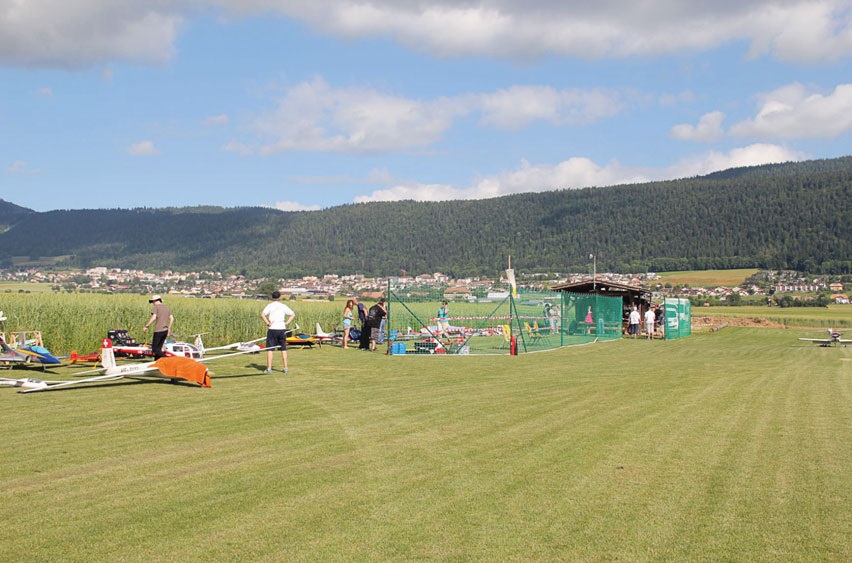
VRAM and the Municipality of Val-de-Ruz, provided a favorable recommendation is issued.
The application must include the following documents: an official site plan; written agreements from the landowner and immediate neighbors; the club’s bylaws; rules for use of the site; a noise impact study; a map of the airspace to be used (flight sectors); safety measures in place for both airspace and the ground; a parking plan for model aircraft enthusiasts’ vehicles; and proof of the club’s liability insurance.
In late June 2014, the application was submitted to the municipal office. The most significant part of the application—and also the most expensive—was the noise impact study. An independent firm was commissioned to conduct it. We had to wait for suitable weather conditions to carry out the noise measurements (hence the delay in submitting the
application). Three aircraft were selected: the Extra 330C, the Jet Flash, and the Jet Boomerang.
Measurements are taken on the ground in accordance with FSAM guidelines and in flight along a route defined based on measurement points placed according to the terrain and the proximity of surrounding residences—all as part of a lengthy and complex procedure. In fact, despite an initial positive conclusion, the cantonal authority later requested more precise calculations, which led to a second report in October 2014 and a favorable final report in December 2014.
At the same time, our application was submitted to the cantonal authorities in July 2014... and the wait began—a long and drawn-out process that finally came to an end in June 2016 with a favorable cantonal preliminary decision. This was a first step toward satisfaction, but not yet a victory. In fact, since the property
is located in an agricultural zone, so it requires a rezoning with a building permit and a public hearing!
Armed with courage and determination, we went through the necessary procedures, filled out the forms, provided the required documentation, and responded to various requests. Ultimately, three objections, representing seven people, were filed. New statements of position and various justifications followed, and on December 4, 2017, the cantonal authorities issued a favorable preliminary decision on the change of land use, forwarding the reasoning to the objectors for their comments.
Are we close to the finish line? Not quite! We must wait for the opponents to state their position and for the formal decision of the
State Councilor in charge of the Department of Territorial Development and the Environment. On January 15, 2018, the canton considered the case closed, and on June 18, 2018, the objections were withdrawn and the rezoning approved. A victory? Let’s wait a little longer. The Val-de-Ruz Municipal Council confirmed the change of land use, though it will not take effect until the deadline for appealing the Neuchâtel State’s decision has passed. Finally, with the deadline having passed without any objections, the VRAM was certified in September 2018. But why not a more specific date? Simply because the municipality must notify us of the certification in writing, which has not yet been done.
- The VRAM is the first model aircraft club in Neuchâtel to pass the certification process.
- The cantonal authorities had no idea or reference point regarding the level of activity expected of such a club. Initially, they assumed the club’s activity would be comparable to that of a civilian airfield: 8 hours a day, seven days a week.
- We had to explain and make the case that the comparison was inaccurate and that factors such as weather and members’ work schedules needed to be taken into account.
- These clarifications were crucial for determining flight schedules and assessing noise impacts.
- Foresight and open-mindedness. In a process like this, it’s not about defending our activities at all costs. We must be open to the arguments of opponents and cantonal authorities and identify where preventive compromises can be reached to anticipate and avoid overly restrictive decisions—particularly regarding flight days and times.
- During this process, it is worth noting the very positive attitudes of the municipal authorities of Val-de-Ruz and the canton of Neuchâtel. It is likely
that our conciliatory approach—without, however, compromising our objectives—has played a part in this.
- Also worth noting is the role played by the FSAM, which fully deserves the support of the clubs.
- The guidelines for the use of model aircraft and the operation of model aircraft fields served as a valuable working basis and were regarded as credible by the cantonal authorities.
- The financial support granted following the noise study helped us significantly in covering its relatively high cost.
*Alain Spitznagel*


News from HEBU

TEAM MANAGER "THIS" BOSSHARD
 Rodito Nussbaumer

SUMMER FUN 2026 AT MG USTER
Martin Wunderli
BY YOUTH, FOR YOUTH
Lorena Betschen
SMALL, MODEL-LIKE SAILBOATS
Res Dauwalder
TRY-OUT DAY AT MFV WETTINGEN
Urs Keller
What's New at Leomotion.com

52. 2026 ALPS CUP
 Emil Giezendanner

ATOM, THE NEW DOUBLE-DECKER FROM CPLR
 Matthias Bosshard

INSIGHTS INTO THE HISTORY OF SEAPLANES

YOU KNOW WHAT I MEAN? 125 YEARS OF THE SWISS AERO CLUB
Emil Giezendanner
34th HAHNENMOOS ALPINE MODEL AIRPLANE CAMP
Res Dauwalder
CORSAIR F4U – A WARBIRD WITH A MEMORABLE LOOK
Jürgen Rosenberger, Jürgen Prinz
F3A EUROPEAN CHAMPIONSHIPS IN ST-MACAIRE, FRANCE
Matthias Bosshard
HORIZON HOBBY/LEMACO NEWS: MICRO OV-10 BRONCO 645 MM BY E-FLITE

PRIDE AND GOOD IDEAS
 Markus Nussbaumer

EURO CONTEST GLIDER ACRO TOUR AUSTRIA 2026

FREE FLIGHT IN THE MIDDLE OF SUMMER
Urs Muntwyler
THE PC-21 STORY
Emil Giezendanner
TWIN TOWN PARTNERSHIP
Wolfgang Voeller
WELCOME, NEW MEMBER!
Andrea Bolliger
COUPE DES ALPES – OBSERVE AND LEARN
Rodito Nussbaumer
NEWS FROM HEBU
 Julia Bucher

FROM 0 TO 100
Markus Nussbaumer
MEMORIES
Wolfgang Völler
NOS REGION – A HUB FOR ELECTRIC AVIATION
Emil Giezendanner
Have you almost forgotten about aircraft that take off and land vertically?
Emil Giezendanner
70 YEARS OF THE NIDWALDEN MODEL AIRPLANE CLUB
Martin Barmettler