
Changes to the RC Categories
For the year 1974, the changes to the RC categories described below will be introduced on a provisional basis. At the end of 1974, the RC Commission will then draw up the final regulations based on the experience gained.
All Swiss championships will be held this year according to these new rules and programs—while the regions themselves can decide whether their championships this year will be held according to the old or the new rules. However, holding a regional qualifier under the old format seems to make little sense, since the pilots who qualify there will then have to fly the new programs at the national competition.
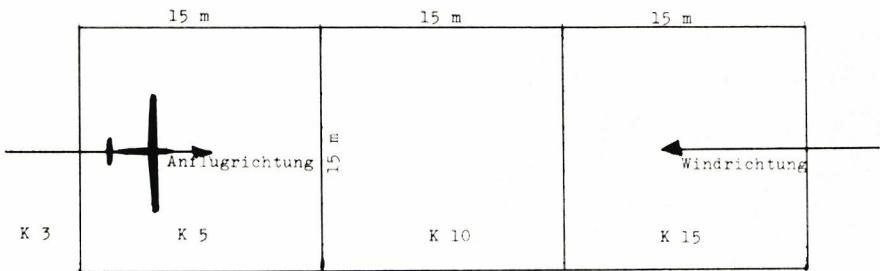
The Landing
In both gliding categories, the landing takes place within a 45-by-15-meter landing rectangle, which is divided into three 15-meter squares. The pilot receives the highest score (or the highest coefficient) if his model comes to a stop in the last of the three squares. The decisive factor for the target landing is the model’s coming to a complete stop, with the location of the model’s nose being evaluated.
In both categories, the landing is scored as zero if any of the following applies:
- Breakage or loss of a part
- A landing where the model lands on its tail
- Approach over a long side of the rectangle
- The model overturning
- No changes except:
- Unlocking the pilot's location
- Conversion of the landing circle to a landing rectangle
| 1. High Start | K 3 |
| 2. Cloverleaf (starting on the left) | K 12 |
| 3. Left Renversement | K 12 |
| 4. One loop | K 6 |
| 5. Rectangular approach | K 8 |
| 6. Landing (5-second straight approach) | |
| in the last field | K 10 |
| in the middle field | K 7 |
| in the first field | K 5 |
| outside (on the slope axis) | K 3 |
In the powered flight categories (formerly RCM and RCMM), there will no longer be any distinction based on the aircraft type. All functions and features (ailerons, retractable landing gear, landing flaps, adjustable wing geometry) are permitted.
Nevertheless, the commission has retained the division into two categories, primarily to promote the next generation of pilots, but also to offer multi-channel pilots who do not train extensively an opportunity to compete, even as the FA1 category becomes increasingly challenging.
Maximum flight time: 8 minutes, including 3 minutes of pre-takeoff preparation
For each flyby in front of the judges, it is recommended to perform the next maneuver, with the exception of the trim flight after takeoff and the landing preparation after the spin. (This is a recommendation.)
| 1. Start (from a standstill) | K 10 |
| 2. Two loops performed | K 5 |
| 3. Inverted flight (approx. 5 sec.) | K 10 |
| 4. Left roll | K 10 |
| 5. Two looping maneuvers | K 10 |
| 6. Double Immelmann | K 15 |
| 7. Two horizontal rolls | K 10 |
| 8. Three rolls | K 10 |
| 9. Rectangular plot | K 10 |
| 10. Landing | |
| Circle, 15 m diameter | K 15 |
| 30 m diameter | K 10 |
| outside | K 5 |
Maximum flight time: 10 minutes, including 3 minutes of pre-takeoff preparation. Timing begins exactly 1 minute after the call.
Each pass in front of the judges is also counted as a maneuver here, with the exception of the trim flight after takeoff and the landing preparation after the spin.
| 1. Start | K 10 |
| 2. Figure “M” | K 15 |
| 3. Cuban Eight | K 10 |
| 4. Double Immelmann | K 10 |
| 5. Slow Roll | K 15 |
| 6. Three pushed-through loops (from inverted flight) | K 10 |
| 7. Four-point roll | K 15 |
| 8. Three towed loops | K 10 |
| 9. Eight-point roll | K 15 |
| 10. Lying eight (1 1/4 loop, pushed + 1 1/4 loop, pulled) | K 10 |
| 11. Three horizontal rolls | K 15 |
| 12. Cylinder | K 15 |
| 13. Figure-8 roll (upright figure-8 with 2 half rolls) | K 10 |
| 14. Three rolls | K 10 |
| 15. Rectangular Landing | K 10 |
| 16. Landing | |
| Circle, 15 m diameter | K 15 |
| 30 m diameter | K 10 |
| outside | K 5 |


TEAM MANAGER "THIS" BOSSHARD
 Rodito Nussbaumer

ATOM, THE NEW DOUBLE-DECKER FROM CPLR
 Matthias Bosshard

INSIGHTS INTO THE HISTORY OF SEAPLANES

CORSAIR F4U – A WARBIRD WITH A MEMORABLE LOOK
Jürgen Rosenberger, Jürgen Prinz
SUMMER FUN 2026 AT MG USTER
Martin Wunderli
F3A EUROPEAN CHAMPIONSHIPS IN ST-MACAIRE, FRANCE
Matthias Bosshard
What's New at Leomotion.com

HORIZON HOBBY/LEMACO NEWS: MICRO OV-10 BRONCO 645 MM BY E-FLITE

PRIDE AND GOOD IDEAS
 Markus Nussbaumer

News from HEBU

YOU KNOW WHAT I MEAN? 125 YEARS OF THE SWISS AERO CLUB
 Emil Giezendanner

34th HAHNENMOOS ALPINE MODEL AIRPLANE CAMP
Res Dauwalder
SMALL, MODEL-LIKE SAILBOATS
Res Dauwalder
TRY-OUT DAY AT MFV WETTINGEN
Urs Keller
52. 2026 ALPS CUP
Emil Giezendanner
TWIN TOWN PARTNERSHIP
Wolfgang Voeller
EURO CONTEST GLIDER ACRO TOUR AUSTRIA 2026

BY YOUTH, FOR YOUTH
Lorena Betschen
WELCOME, NEW MEMBER!
Andrea Bolliger
FREE FLIGHT IN THE MIDDLE OF SUMMER
Urs Muntwyler
THE PC-21 STORY
Emil Giezendanner
COUPE DES ALPES – OBSERVE AND LEARN
Rodito Nussbaumer
NEWS FROM HEBU
 Julia Bucher

FROM 0 TO 100
Markus Nussbaumer
NOS REGION – A HUB FOR ELECTRIC AVIATION
Emil Giezendanner
MEMORIES
Wolfgang Völler
Have you almost forgotten about aircraft that take off and land vertically?
Emil Giezendanner
70 YEARS OF THE NIDWALDEN MODEL AIRPLANE CLUB
Martin Barmettler