
Chargers and Model Building—The Never-Ending Story
A discharged battery is by no means useless. It can still serve as a paperweight. To supply energy, however, it must first be charged. That’s why a rechargeable battery is also referred to as a secondary battery. Charging is a bit like refueling, only far more complicated and—as is well known in this era of emerging electric mobility—usually more time-consuming. That’s why the right charging technology has been an issue ever since rechargeable batteries were invented.
Humans are unreliable when it comes to managing charging processes, especially when they have to perform repetitive, routine tasks. They get distracted too easily. Monitoring a charging process and—importantly—ending it in a timely manner requires unwavering attention; it’s a declaration of war on any kind of creative intelligence.
The first rechargeable batteries suitable for model-making were made of lead: heavy as lead, but still reasonably fault-tolerant because they could be opened from the top. If you forgot them on the charger, you could later remedy the situation by topping them off with distilled water. Things became more difficult when the desire arose to operate them in any orientation. Now they had to be sealed. Among the first truly gas-tight secondary systems were the Rulag* batteries, which is why they were already being advertised as “dry batteries.”
* Dr. Rudolph Mohr, Taschen-
lampen Gesellschaft
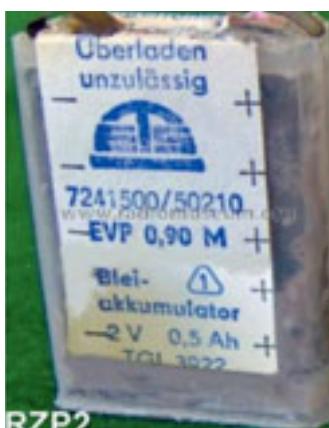
This battery went on to have a quite remarkable military career as a torpedo propulsion battery. In the 1950s, it also found its way into the recreational sector (as a heating battery for portable radios and two-way radios, and for model aircraft propulsion systems).
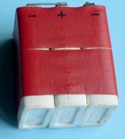
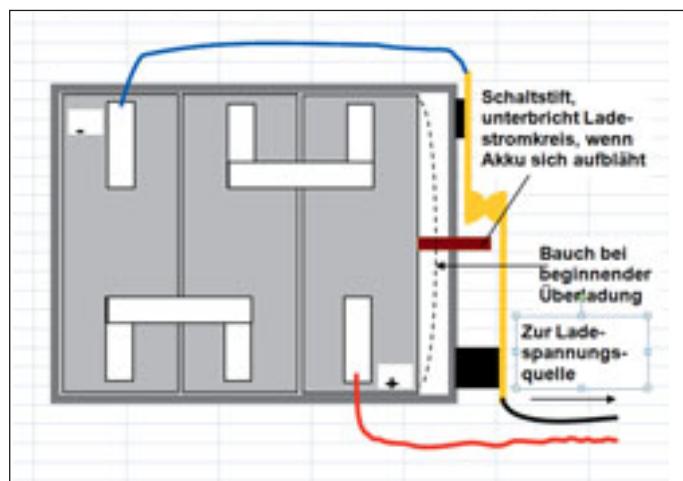
It was likely model builders who developed the first effective battery charger with an automatic shut-off feature. They took advantage of the fact that the cells, encased in soft plastic, would swell when overcharging began.
If only it were still that simple today! But this was likely the birth of the automatic charger.
Lead (Pb) batteries are still considered low-maintenance. For a long time, limiting the charging current was of secondary importance here, since the batteries’ “toll tolerance” (e.g., automotive starter batteries) far exceeded the charger’s capacity to supply current. That changed with the introduction of “smart” lead-acid cells. Sealed Pb batteries using gel or mat technology already feature built-in electrochemical overcharge protection. In this process, oxygen is generated at the positive terminal and then reabsorbed at the negative terminal. However, this only works at charging currents below 0.3 C, thereby ruling out all time-saving fast-charging options.
Until the early 1980s, so-called DEAC batteries with a rated capacity of 250–500 mAh were the standard power sources for receivers. These NiCd batteries were considered reliable and low-maintenance. They were generally charged “overnight” at currents of no more than 0.1 C. Since there were no criteria for determining the state of charge of these button cells with sufficient accuracy, the charging time was based on the user’s sleep schedule or their sense of how long the charging would take. Attentive hobbyists were rewarded with a longer service life (for the batteries). When, in the late 1970s, fast-charging NiCd batteries—designed for use in power tools—began to slowly replace the button cells, the charging scene picked up pace. These so-called NiCd sintered cells could now be charged via a resistive cable at 2–4 °C—that is, in less than an hour. The only question was always: When is enough? With this type of battery, the cell voltage didn’t provide a clear criterion, since its level was influenced by factors such as charging current, temperature, pre-treatment, and aging. Control freaks repurposed their moms’ kitchen alarm clocks to signal the end of the calculated charging time. It usually went wrong. But you can learn from your mistakes! Because NiCd batteries charged for too long became noticeably warm—and in extreme cases, hot. Checking the charge by placing a hand on the battery—a method still fraught with human error—was soon replaced by thermal switches or temperature sensors with switching modules. The automatic charger was born—for the second time. The problem was that the temperature sensor actually had to be in direct contact with the battery.
A later challenge: With the subsequent generation of NiMH batteries, slight heating began even during the charging process, so the cut-off temperature had to be set relatively high—which was only beneficial to “battery health” to a limited extent.
Around the same time, it was also recognized that the voltage curve of NiCd batteries could provide an indication of when the battery was fully charged, because the heat generated during overcharging caused the charging voltage to drop again. This was relatively easy to evaluate electronically. This discovery was dubbed the “Detla-Peak method.”
It also worked reasonably reliably with the subsequent NiMH batteries. Since the peak is less pronounced in those batteries, the measurement sensitivity must be slightly higher. However, this type of full-charge detection is always associated with a brief period of overcharging, which the new generation of NiMH cells seemed to tolerate far less. The charging process becomes gentler on the battery if charging stops as soon as the voltage curve reaches its inflection point. The term “Inflex” has become established for this gentle charging method, which results in only a few percent loss of capacity.
The emergence of lithium-ion cells in early 2000 marked a turning point. At first, uncertainty spread because the new stars in the battery world were considered capricious and were all too willing to prove it in the hands of inexperienced model aircraft pilots. Fire extinguishers were in high demand. But soon the community learned to handle them and came to appreciate the outstanding performance of the new generation of batteries. Initially rated as having low capacity, the popular C-rate—soon to become the decisive selling point—skyrocketed within a few years. Electric flight really took off, thanks in part to new motor technology. But just as one problem was solved, a new one soon arose. Energy demands grew—the market needed new chargers. From then on, they came more and more frequently from the Far East, much to the chagrin of established Western companies.
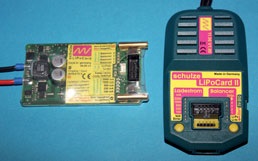
Stationary chargers used to rely on a conventional power transformer. That was fine as long as the charging currents remained in the milliamp range. Transforming higher currents using the 50-hertz technology of that time resulted in bulky, heavy, and expensive devices. Today, the so-called switching power supply dominates the market. With the help of modern power electronics (see box for the switching principle), power levels exceeding one kilowatt can be transmitted through compact enclosures with minimal losses.
The 12-V starter battery was well known as a mobile power source. With 6–7 NiCd cells, this was still acceptable. A standard automotive Bilux bulb served as the current-limiting resistor. With a higher number of cells, the solution was to divide the battery into small packs. Then the DC-to-DC converter was developed to enable the charging of batteries with more than 7 cells “in one piece.” These devices chop the DC voltage at a high frequency so that it can then be transferred to a different voltage level with relatively small inductors and minimal losses. Converters that generate higher voltages (e.g., 50 V) from lower voltages (e.g., 12 V) are called step-up converters. If the voltage needs to be reduced, a step-down converter is used based on the same principle. In most cases, both systems are combined to enable charging of batteries of various sizes, ranging from, for example, 1 to 12 cells. With such converters—which, incidentally, operate at efficiencies around 90%—the input and output voltages can be flexibly adjusted to meet specific needs. This also applies to the input supply voltage. It can—and in fact must—vary over a wide range, because with charging powers in the kilowatt range, it makes little sense to supply the converter with only 12 V. With current levels in the three-digit ampere range, the supply cables would soon turn into red-hot wires. Manufacturers therefore recommend using voltage sources of up to 48 V. Power supplies built directly into the charger housing are usually designed to be less powerful than separate switching power supplies.
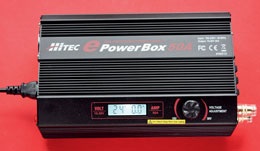
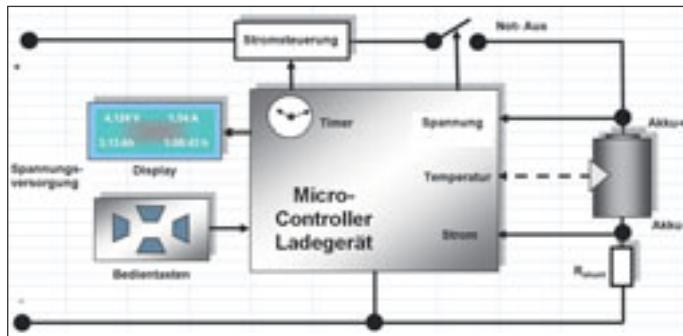
Multifunctionality—that is, the ability to charge all common battery types (Pb, NiCd, NiMH, possibly NiZn, LiFe, Lilon, LiPo, LiHV)—is now considered a must for model chargers. Due to the wide variety of different charging programs, these devices cannot function entirely without human intervention. The task of a truly automatic charger would be to identify the connected battery in terms of type (cell technology), number of cells, and cell size. This is not yet possible. In this regard, the electronics rely on the user’s input. In some areas, however, modern chargers are already capable of making suggestions that the user can then confirm or correct. In turn, the device checks the user’s input for plausibility. Charging current limitation already works best. This is achieved by measuring the internal resistance of the connected battery. Autonomous detection of the number of cells is also only possible to a limited extent, since battery voltage depends not only on the number of cells but also on the current state of charge. With LiPo batteries, this works—provided no balancer cable is connected—for up to about four cells. Universal chargers, as are currently common in model making, require the aforementioned inputs but then derive everything they need to determine the state of charge of the connected battery from the values of charging voltage, charging current, and charging time. For NiXX cells, additional temperature monitoring would certainly be helpful, although this feature is often omitted due to the need for an external temperature sensor. In all cases, a microprocessor handles the integration of these parameters. Most chargers are operated using the standard four buttons. However, it has become apparent that single-button operation (a scroll wheel with a click function) can lead to more convenient solutions.
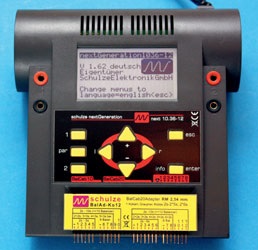
The display assists with menu navigation and provides information about current operations. The electronics actually control only the charging current, based on the other measured parameters.
For voltage-sensitive LiXX batteries, individual cell monitoring is recommended, even though battery cells have become increasingly better—that is, more uniform—in recent years, supplemented by a balancer that compensates for any remaining differences as completely as possible during the final phase of charging. This also places the requirement on the balancer to be able to operate with adequate currents. For a long time, 0.3 A was considered sufficient. The increase in achievable charging currents into the double-digit ampere range makes an adjustment to 1 A per channel seem appropriate.
“Just charge it to full, please!” has long since ceased to be sufficient when it comes to charging. A charger must first check whether the connected battery is in a chargeable state (e.g., via the lithium precharge program). Sometimes there is a need to discharge the battery or to bring it into a storable state via a storage program. So-called
Maintenance or conditioning programs from the NiXX era still enjoy a certain degree of popularity, even though, at best, they are merely “useless” for the majority of today’s batteries. So-called “restore” programs, which are designed to “revive” previously damaged batteries, should also be viewed with skepticism. While this is not a questionable endeavor—even with lithium batteries—the user manual must not suggest that such processes can be carried out safely without human supervision.
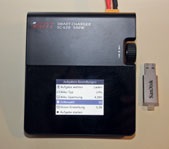
Entertainment is always in demand. Talking and song-playing chargers are already among us. Modern charger displays have evolved into veritable chatterboxes. They display current and charging time, capacity charged or discharged, all cell values, voltage and its trend, the cell’s position within the battery pack, as well as extreme and differential values. Model airplane enthusiasts also appreciate being informed about the internal resistance of their batteries. In principle, a microprocessor can evaluate, correlate, and display all this data and store it on any storage medium for later use. Bluetooth connections to a cell phone promise mobility while the battery is charging. Anyone who wishes can view and analyze the charging process on a PC either in real time or later. The practical value of such features is sometimes debated. Temperature control of the built-in fan, on the other hand, is undisputedly considered a stress reliever. Today, no one objects to an additional USB port that provides 5 V for charging, for example, a smartphone.
The availability of a sufficient number of memory slots—in which the charging parameters of frequently used batteries can be saved and retrieved as needed—can be considered a convenience and a safety enhancement. This eliminates the need to re-enter these parameters—a task that is always prone to errors (a routine problem)—when the device is used again. The proven BID (Battery IDentification) chip system, originally introduced by Robbe, served this purpose. For example, based on stored charging histories, it is possible to estimate the performance development of batteries and trace past treatment errors.
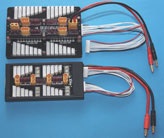
If you want to charge multiple batteries at the same time, a multi-charger is a good option, but more recently you can also use a para-board (parallel charging board). In the latter case, of course, simultaneous charging is limited to batteries with the same number of cells. Decoupling resistors between the individual cell terminals keep the equalization currents within reasonable limits.
Model chargers form a class-based society. The “economy class” consists of chargers capable of charging lithium batteries up to a maximum of 3–4s. These belong to the beginner or “toy” sector. Anyone who wants to get seriously into electric flight is better off with “Economy Class.” This category supports LiPos up to 6s (or 15 NiXX or 10 Pb cells). The maximum voltage that the built-in voltage converters must generate for this purpose is approximately 26 V. Within this voltage range, manufacturers can rely on inexpensive semiconductor components (the situation is quite similar with speed controllers). The specified charging currents can reach as high as 20 A. But be careful: these figures are subject to performance limitations. A 150-watt (W) charger can only deliver $150\text{ W}/26\text{ V} \approx 6\text{ A}$ at the maximum number of cells. Devices capable of handling LiPos with a capacity of 8–10s fall into the “Economy Plus” category. It’s worth taking a look at the power output offered; 300–500 W is considered adequate.
“Business Class” models usually take the predictable route of offering a pair of charging outputs rated at 6–8s. The output voltage remains below 35 V, which doesn’t exactly cause component costs to skyrocket. A drawback here is that battery packs with more than the specified number of cells must be split during charging.
For “First Class” chargers, cost considerations are initially secondary. This is entirely justified by the required components as well as the charge capacity. The maximum voltage at the charging output is limited to 60 V DC by the European Low Voltage Directive. This allows 14s LiPo batteries to be charged to full capacity. Consequently, the charging power of such devices must be measured in kilowatts (kW).
A prime example of this class of devices is the Pulsar 3 (+) from pp-rc. This “Rolex” among chargers utilizes, in part, a modified charging technology designed to meet professional standards. For NiXX batteries, you can choose between Reflex charging and the gentle Inflex full-charge detection. Lithium batteries can also be charged using Reflex pulses. Thanks to pulse charging technology, the batteries reach their final charge voltage more quickly, which has a decidedly positive effect on their lifespan. However, this requires a highly accurate, self-calibrating internal measurement system. The balancing system does not operate with a fixed current value but rather in an analog manner, allowing even batteries with significant cell voltage differences to be balanced. Yes, and all of that alone would certainly be worth the price for enthusiasts.


News from HEBU

HORIZON HOBBY/LEMACO NEWS: MICRO OV-10 BRONCO 645 MM BY E-FLITE

PRIDE AND GOOD IDEAS
 Markus Nussbaumer

TEAM MANAGER "THIS" BOSSHARD
 Rodito Nussbaumer

YOU KNOW WHAT I MEAN? 125 YEARS OF THE SWISS AERO CLUB
 Emil Giezendanner

F3A EUROPEAN CHAMPIONSHIPS IN ST-MACAIRE, FRANCE
 Matthias Bosshard

ATOM, THE NEW DOUBLE-DECKER FROM CPLR
Matthias Bosshard
SUMMER FUN 2026 AT MG USTER
Martin Wunderli
What's New at Leomotion.com

52. 2026 ALPS CUP
Emil Giezendanner
TWIN TOWN PARTNERSHIP
Wolfgang Voeller
34th HAHNENMOOS ALPINE MODEL AIRPLANE CAMP
Res Dauwalder
CORSAIR F4U – A WARBIRD WITH A MEMORABLE LOOK
Jürgen Rosenberger, Jürgen Prinz
SMALL, MODEL-LIKE SAILBOATS
Res Dauwalder
TRY-OUT DAY AT MFV WETTINGEN
Urs Keller
WELCOME, NEW MEMBER!
Andrea Bolliger
FREE FLIGHT IN THE MIDDLE OF SUMMER
Urs Muntwyler
COUPE DES ALPES – OBSERVE AND LEARN
Rodito Nussbaumer
EURO CONTEST GLIDER ACRO TOUR AUSTRIA 2026

BY YOUTH, FOR YOUTH
Lorena Betschen
INSIGHTS INTO THE HISTORY OF SEAPLANES

THE PC-21 STORY
Emil Giezendanner
NEWS FROM HEBU
 Julia Bucher

FROM 0 TO 100
Markus Nussbaumer
MEMORIES
Wolfgang Völler
NOS REGION – A HUB FOR ELECTRIC AVIATION
Emil Giezendanner
DO YOU KNOW WHAT I MEAN IN THE LAND OF SMILES?
Emil Giezendanner
Have you almost forgotten about aircraft that take off and land vertically?
Emil Giezendanner