
Position of a free-flight model in turbulent atmosphere
These considerations are based on observations of the behavior of slope gliders during the model-aircraft camps in Verbier (1944–1950) and up to the present. The only difference is that the Verbier models did not have compass-guided control. In contrast, we have developed models with excellent course stability in turbulent conditions, thanks to an optimal distribution of wing area and the high placement of the ballast (lead) in the nose of the aircraft.
The most recent flights took place at the 2020 Swiss Championship in Wikartswil (BE), at the regional competition in Hottwil on September 12, 2021, and, most notably, on September 11, 2022, during the national team selection competition in Gansingen. It was very hot that day, and it had rained the day before. Each flight alternated between fairly abrupt periods of climb and descent. Four competitors achieved a total of 500 points (3 flights of 240 seconds and 2 of 300 seconds). The flights were spectacular, with the models diving to very low altitudes either before or after climbing to more than 50 m above the starting point. And on several occasions, the models were pitched up 20–25° for 20 to 30 seconds.
It wasn’t until 2021 that I realized we had never discussed this phenomenon. In fact, we were glued to our binoculars, and each competitor hurried to retrieve their model for the next flight. But this time, I wasn’t a competitor. Why mention slope models (F1E)?
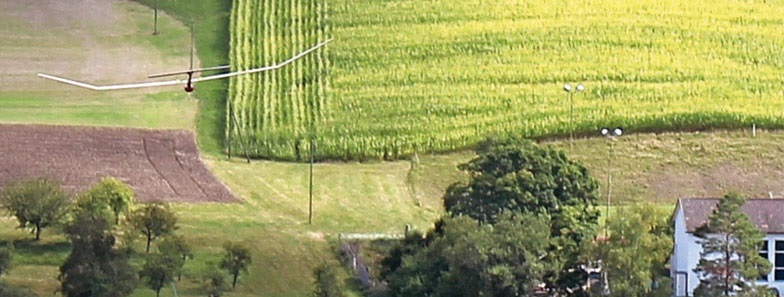
The gliders (F1A, B, C) are flying above us and circling. From the ground, it’s hard to notice anything out of the ordinary.
Slope-launch models take off from our level and fly away, becoming visible higher up and, more importantly, lower down than us. Furthermore, at least a large portion of the flight is in a straight line. This allows us to observe their behavior in turbulent conditions.
In principle, a model flies at a slight downward angle (~7%). In thermals, it should maintain this position, just as it does during a descent.
However, we sometimes observe that the model consistently pitches up for several tens of seconds (Fig. 1) in updrafts and pitches down in downdrafts. In slope soaring, when the model enters a downdraft, it can be seen from behind pitching down at an angle of ~20°,
sometimes parallel to the slope (Fig. 2) but without ever hitting it.
Ascending air is a vertical current that rises from the bottom to the top. In fact, it is a bubble of air that rises for a few minutes (not very long—if you take off right after a 300-second peak, you’re likely to fly for less than 120 seconds). The updraft stops when the heated air has been replaced by cooler air. It resumes when the favorable surface (e.g., dry, dark), having absorbed heat for a few minutes, reheats the air.
Downdrafts replace the volume of heated air that rises with cooler air.
The model entering the downdraft passes through one (or
a succession of several) vortices and is subjected to a pitching moment.
What is surprising is that the observed dive generally lasts 10–20 s and that the model loses a great deal of altitude.
If there were no network of vortices, the glider would be subjected to a pitching torque for only ~0.25 seconds, when the wing and then the tail enter the downdraft. In this case, the glider should immediately return to its normal glide angle.
A nose-down flight is nothing special. Any airplane is stable in a nose-down attitude but will stall if it pitches up.
In normal gliding flight, the wings’ lift, thanks to speed,
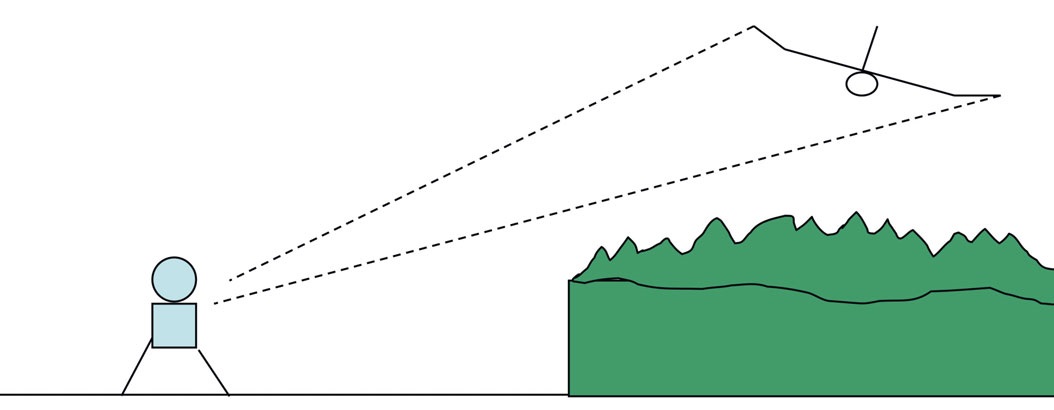
is equal to the glider’s weight. Drag “consumes” altitude. For a glider with a glide ratio of 15, it loses 1 meter of altitude for every 15 meters it travels. In an updraft, the model pitches up without entering a pump, which is surprising during straight-line flight (Fig. 2). Of course, a model turning—which is shaken as it enters the pump—tightens its turn.
The angle of the competitors’ and timekeepers’ binoculars is at least 20° for a duration of more than 20 seconds. How can the glider continue to climb at such an angle without stalling? Therefore, the nose-up glider continues to fly at ~5 m/s. If the glider’s speed were to decrease, lift would cease and the glider would stall.
We’re flying from a clearing to the west. The east wind is blowing at a speed of ~7 m/s. We need to go a little faster to land on the plain. There are a lot of Maxi models (300s).
Everything is normal for a model flying directly into the wind. My model is drifting slightly to starboard. What’s not normal is its constant bank to starboard. It’s losing thermal lift, and I spend too much time looking for it to make any more flights. I then observe other flights and notice that the other models, which are drifting to starboard, are also banked. This bank angle can reach ~20°. The models are very stable in this position.
With this bank angle, the lift area decreases to 94%. A model set to 8.0 m/s accelerates to ~8.25 m/s. Is the rudder turned? Why is it banking like this?
I don't recall observing this phenomenon on any other occasions besides in Winkartswil on the west slope in 2020 during the Swiss Championship. The wind was blowing from the northeast. The gliders, as they banked
drifting southward flew over a forest, usually at an altitude of 20–40 m above the trees.
The models flying directly into the wind were flying perpendicular to the vortices created by the differences in speed between the various layers of air and were therefore not affected. The layers of air well above the forest had a speed of ~7 m/s.
Our models have a significant dihedral angle, ~10% of the wingspan. If the model tilts by 11.3°, the projected area of the lowered wing increases by ~6%, and that of the raised wing decreases by ~7.7%. Therefore, a certain amount of torque is required to keep the model tilted in a stable manner.
I see no other explanation than the asymmetric impact of vortices on the model.
Let’s consider a model with a starboard offset. Its programmed flight path makes a certain angle with the wind direction. The vortices are practically perpendicular to the wind direction. Each vortex first “strikes” the port wing on the underside (especially the wingtip for a model with multiple dihedrals) and then, ~0.07 s later, the upper surface of the starboard wing (causing the flight path to deviate from the current wind direction). The strong turbulence and energy of the vortex increase the lift at the port wing tip and decrease that at the starboard wing tip (or the port wing and then the starboard wing for a single-V dihedral) and keep the glider’s bank angle virtually constant. But there might be a simpler explanation. The slope that causes dynamic lift is not an inclined plane that the wind strikes in the direction of its steepest incline. Fig. 4 shows the glider tilted according to the shape of the hill.
Vortices form between two airflows
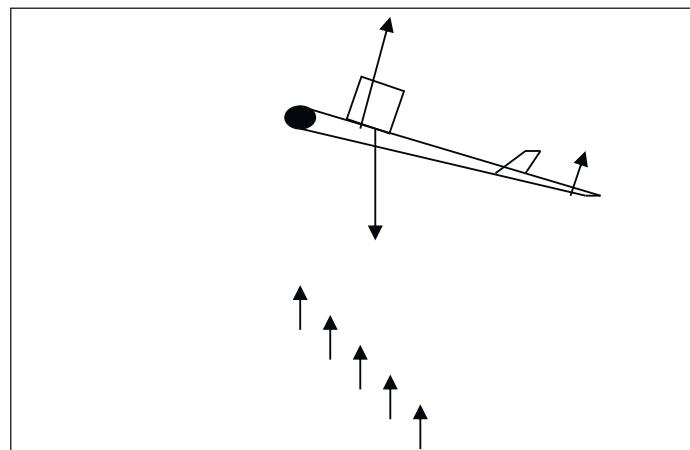
moving in opposite directions or at different speeds. The greater the difference in speed, the stronger the vortices. A vortex is a rotating cylinder whose radius increases as the difference in speed increases. The axis of the vortices is perpendicular to the direction of the flows. The direction of rotation of the vortices is determined by the direction of the two air currents.
To begin with, we assume that both flows are vertical, which is the case with light winds. Updrafts and downdrafts are therefore vertical flows.
However, there are also horizontal or oblique flows when “replacement” air is drawn in.
“It is the asymmetry that creates the phenomenon1.”
Suppose we have a horizontal plain 20 m in diameter that is uniformly irradiated. There is no wind. The thermal bubble will be a “sausage” 20 m in diameter that will rise while maintaining its shape. The vortices will be horizontal tori 20 m in diameter.
In reality, there is wind, which is irregular because thermal movements are discontinuous.
Radiation depends on the nature of the ground. Therefore, the vortices will be discontinuous and not
necessarily horizontal. Let’s move on to dynamic vortices, with a fairly steady wind. To obtain horizontal vortices, a flat slope would be needed, ending in a well-rounded horizontal crest, with the ridge properly oriented in the direction of the wind. In addition, the nature of the ground would need to be homogeneous.
In fact, we have a hill where part of the surface is pasture and the rest is forest.
The vortices are discontinuous and may have a certain inclination.
These observations generally apply only to slope-gliders flying relatively close to the ground, in rugged terrain, in strong winds, or during thermal activity. Gently sloping terrain should not be subject to such influences. Other categories of models or aircraft are not affected.
However, if by chance these lines were read by an aerologist or other aerodynamicist—that is, by someone familiar with atmospheric airflow—their comments would be welcome.
Maurice Bodmer
1 Conclusion of a physics course taught by a UNIL/EPUL professor in 1947 (final lecture before retirement).


TEAM MANAGER "THIS" BOSSHARD
 Rodito Nussbaumer

SUMMER FUN 2026 AT MG USTER
Martin Wunderli
52. 2026 ALPS CUP
 Emil Giezendanner

ATOM, THE NEW DOUBLE-DECKER FROM CPLR
 Matthias Bosshard

INSIGHTS INTO THE HISTORY OF SEAPLANES

34th HAHNENMOOS ALPINE MODEL AIRPLANE CAMP
Res Dauwalder
CORSAIR F4U – A WARBIRD WITH A MEMORABLE LOOK
Jürgen Rosenberger, Jürgen Prinz
SMALL, MODEL-LIKE SAILBOATS
Res Dauwalder
F3A EUROPEAN CHAMPIONSHIPS IN ST-MACAIRE, FRANCE
Matthias Bosshard
What's New at Leomotion.com

HORIZON HOBBY/LEMACO NEWS: MICRO OV-10 BRONCO 645 MM BY E-FLITE

PRIDE AND GOOD IDEAS
 Markus Nussbaumer

News from HEBU

BY YOUTH, FOR YOUTH
Lorena Betschen
YOU KNOW WHAT I MEAN? 125 YEARS OF THE SWISS AERO CLUB
Emil Giezendanner
TRY-OUT DAY AT MFV WETTINGEN
Urs Keller
FREE FLIGHT IN THE MIDDLE OF SUMMER
Urs Muntwyler
THE PC-21 STORY
Emil Giezendanner
TWIN TOWN PARTNERSHIP
Wolfgang Voeller
EURO CONTEST GLIDER ACRO TOUR AUSTRIA 2026

WELCOME, NEW MEMBER!
Andrea Bolliger
COUPE DES ALPES – OBSERVE AND LEARN
Rodito Nussbaumer
NEWS FROM HEBU
 Julia Bucher

FROM 0 TO 100
Markus Nussbaumer
MEMORIES
Wolfgang Völler
NOS REGION – A HUB FOR ELECTRIC AVIATION
Emil Giezendanner
Have you almost forgotten about aircraft that take off and land vertically?
Emil Giezendanner
70 YEARS OF THE NIDWALDEN MODEL AIRPLANE CLUB
Martin Barmettler