
Challenge: F-35B Lightning II on a 1:5 scale
Arnold (Noldi) Meier spent no less than seven years building this impressive model. Now it stands in full size, beautifully painted, on the runway at Dübendorf Airfield. Since the optimal center of gravity hasn’t yet been precisely determined, pilot and friend Julius Jezerniczky cautiously performed a short hop as a test. Of course, we’re all eagerly awaiting the maiden flight.
“The manufacturer is the famous American company Lockheed Martin, which produces three different variants of the F-35. I was so fascinated by this jet that, as an experienced model builder, I decided—given its complexity and appeal—to build the Type B, that is, the vertical takeoff and landing variant. Since the vertical takeoff and landing variant requires special and complex control technology for the demanding maneuvers involved in vertical takeoff and landing, I decided to build the model structurally for Version B, but to equip it with the propulsion system for Version A—that is, a fixed turbine—for the initial flight tests and to gain experience.”
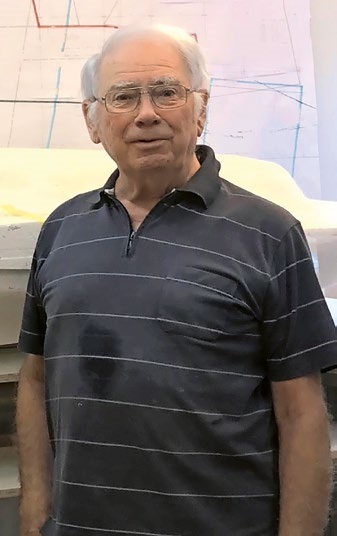
Throughout the entire construction period, Noldi kept me up to date with photos and brief comments. There was no secrecy or attempts to keep anything under wraps. He’s simply a pro who has already made a name for himself with many beautiful large-scale models. His Jumbo and the PC 24 have practically become staples at all kinds of air shows. For several years now, he’s been supported by Julius Jezerniczky. Without this jet pilot—who has extensive experience with gas turbines—this nearly one-of-a-kind large-scale project would hardly have been brought to a successful (provisional) conclusion. The entire paint scheme and design were among the most labor-intensive aspects of the project. In addition to technical advice and support, transportation and storage were indispensable. Another expert helper in the construction of large-scale models was Tom Escher. The use of honeycomb material as a support medium in the vacuum process is said to be largely attributable to him. In general, I would like to point out once again that such large-scale projects are best tackled by smaller teams. However, this approach requires a fair amount of teamwork. Lone wolves are better off avoiding it.
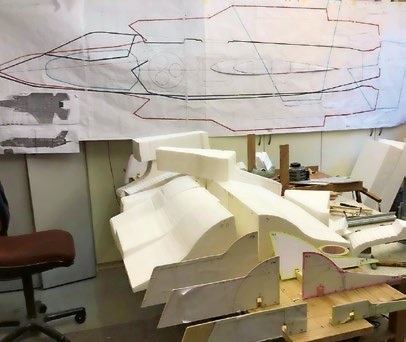
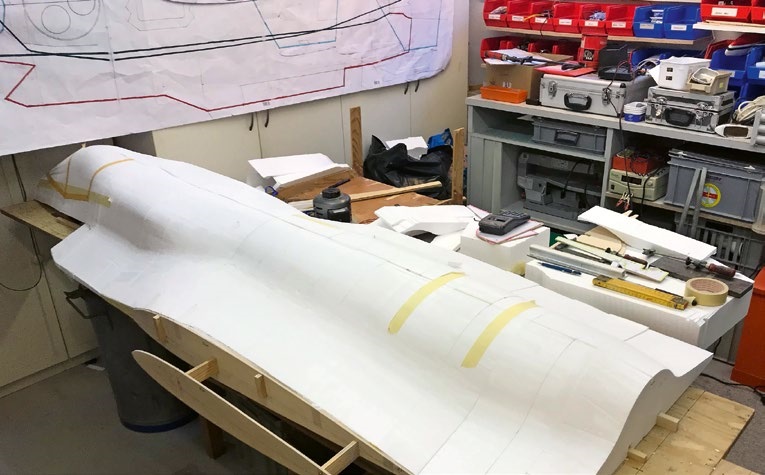
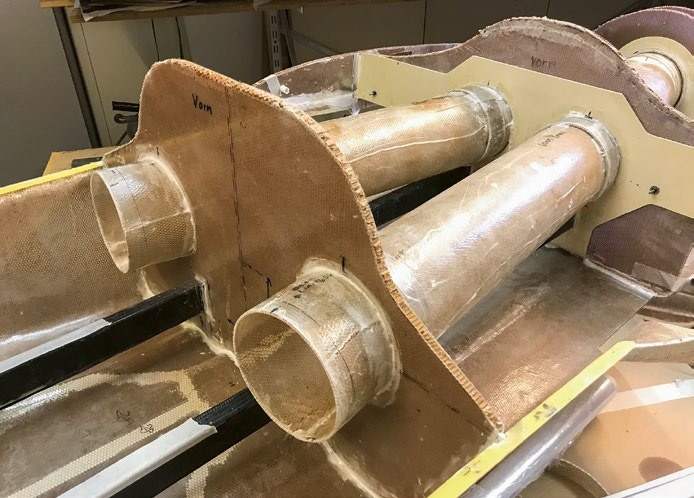
Noldi writes: “When I began planning in 2017, very few documents—such as drawings—were available, so I decided to design the model entirely from scratch on the drawing board. Two plastic models available at the time, along with an A4 drawing showing the dimensions for length, wingspan, and height, were my only sources of information; from these, I then calculated a scale of 1:5. The fuselage consists of two longitudinal halves made of 3-mm honeycomb panels, which were molded from a styrofoam master model. Carbon-fiber reinforcements were also added. I built the wings, tailplane, and horizontal stabilizer using my tried-and-true construction method: Styrofoam coated with fiberglass cloth and reinforced with插管.”
| Scale: | 1:5 |
| Wingspan: | 229 cm |
| Length: | 312 cm |
| Height: | 95 cm |
| Weight: | 37.5 kg |
| Drive: | Dossenbach Projoy turbine (25 kg) |
| An additional 5 impellers are required for VTOL operation. | |
| Fuel tank: | 4,900 ml, 100 ml Hooper |
| Construction material: | Glass-filled Styrofoam, carbon fiber-reinforced plastic, CFRP honeycomb panels |
| Kit: | Construction time: 6 years, 1,500 hours |
| Builder/Designer: | Arnold “Noldi” Meier |
| Paint job, propulsion: | Julius Jezerniczky |
- Tailerons, rudder, landing flaps
- 8 thrust flaps, swivel nozzle with lift actuator, 21 servos, and 2 linear motors
- 26 channels, Core-Powerbox Systems Royal
The invitation took me a little by surprise, but I was also thrilled. The whole event was organized by NOS board member Nello Nero. Understandably, the excitement was palpable when Julius opened the side panel of his impressive trailer and the F-35 emerged in all its impressive grandeur. Noldi sat quietly in his chair, focused on the proceedings. Then the model was placed on the ground—or rather, on two supports—before the landing gear was extended. With expert precision, Julius assembled the model. From then on, he proceeded strictly step by step according to the checklists. Functional checks—a Powerbox Royal SRS supplies the RC system with 7.4 V—the landing gear is powered separately. The engine started up without a hitch. Taxiing tests followed. Pilot Julius wanted to test the takeoff behavior with several accelerated runs. As a spectator, I could easily imagine the model spinning out—which is exactly what happened. The plane actually took off and hovered in the air for a brief moment, though not very stably, before touching down again on the runway. For the pilot, the situation was clear. The center of gravity must be shifted forward by adding weight—something no designer likes to do.
After that brief attempt at takeoff, I found my voice again. I must have forgotten to breathe. What’s next? That was my question to the builder/designer, Noldi Meier. The model is sure to fly great. What about vertical takeoff and landing (VTOL)? That’s going to take some work, says Noldi. He plans to achieve this with five electric impellers. However, he adds self-critically that the model will become even heavier—and let’s not forget the batteries! His son, a computer scientist, will write the software for it. The whole thing is a typical drone problem. The “Trikooper” project reminds me of a high school senior thesis by two students. Not exactly a trivial solution.
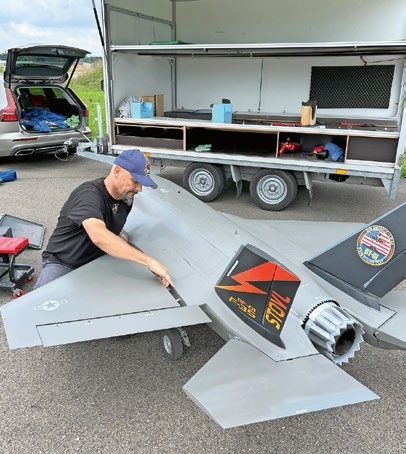
As I write these lines, Noldi and his helpers are waiting for the maiden flight. Maiden flights of homemade aircraft are always particularly challenging—even for experienced builders. Of course, it would be a wonderful gift and a great source of satisfaction for the builder if Noldi could witness a spectacular demonstration of his F-35 in Hausen. Pilot Julius Jezerniczky notes that he’ll need to complete a larger number of flights before he can ensure sufficient safety. For him, safety takes precedence over spectacle and self-promotion—a mature attitude befitting a professional. The editorial team wishes him the best of luck and thanks him for his support.


News from HEBU

TEAM MANAGER "THIS" BOSSHARD
 Rodito Nussbaumer

SUMMER FUN 2026 AT MG USTER
Martin Wunderli
BY YOUTH, FOR YOUTH
Lorena Betschen
SMALL, MODEL-LIKE SAILBOATS
Res Dauwalder
TRY-OUT DAY AT MFV WETTINGEN
Urs Keller
What's New at Leomotion.com

52. 2026 ALPS CUP
 Emil Giezendanner

ATOM, THE NEW DOUBLE-DECKER FROM CPLR
 Matthias Bosshard

INSIGHTS INTO THE HISTORY OF SEAPLANES

YOU KNOW WHAT I MEAN? 125 YEARS OF THE SWISS AERO CLUB
Emil Giezendanner
34th HAHNENMOOS ALPINE MODEL AIRPLANE CAMP
Res Dauwalder
CORSAIR F4U – A WARBIRD WITH A MEMORABLE LOOK
Jürgen Rosenberger, Jürgen Prinz
F3A EUROPEAN CHAMPIONSHIPS IN ST-MACAIRE, FRANCE
Matthias Bosshard
HORIZON HOBBY/LEMACO NEWS: MICRO OV-10 BRONCO 645 MM BY E-FLITE

PRIDE AND GOOD IDEAS
 Markus Nussbaumer

EURO CONTEST GLIDER ACRO TOUR AUSTRIA 2026

FREE FLIGHT IN THE MIDDLE OF SUMMER
Urs Muntwyler
THE PC-21 STORY
Emil Giezendanner
TWIN TOWN PARTNERSHIP
Wolfgang Voeller
WELCOME, NEW MEMBER!
Andrea Bolliger
COUPE DES ALPES – OBSERVE AND LEARN
Rodito Nussbaumer
NEWS FROM HEBU
 Julia Bucher

FROM 0 TO 100
Markus Nussbaumer
MEMORIES
Wolfgang Völler
NOS REGION – A HUB FOR ELECTRIC AVIATION
Emil Giezendanner
Have you almost forgotten about aircraft that take off and land vertically?
Emil Giezendanner
70 YEARS OF THE NIDWALDEN MODEL AIRPLANE CLUB
Martin Barmettler