
Dassault Mirage IIIS Ueli Amacker and Reto Senn
An Old Love Is Rekindled
In the 1990s, I received my first Swiss Air Force Mirage IIIS (unfinished airframe), developed by my colleague Meinrad Gyr. We competed as a four-plane squadron under the name “MirageTeam Schweiz” at various events. The Mirage was built to a 1:7 scale and was powered by a Byron impeller with a Rossi motor. At the time, I built a second Mirage, which, over the years—equipped first with a JPX gas turbine and later with a Jet Cat P-60—spent many wonderful hours in the air.
My love for this model has always been—and still is—strong. Unfortunately, however, there are no Mirage III model kits available for purchase in a reasonable size. That’s when I had the brilliant idea to contact one of the best model builders specializing in wooden models: Ueli Amacker—he even builds the impellers for his models himself. His models are primarily replicas of Swiss Air Force aircraft. But so far, he hadn’t built any turbine-powered models. At first, Ueli came up with every good excuse why it wouldn’t be possible to build the Mirage at a 1:5 scale. The fact that a turbine would have to be installed also gave Ueli all sorts of headaches. On top of that, the model had to be small enough for transport. So the fuselage had to be separable, and the wings and vertical stabilizer had to be removable. After a few phone calls, my powers of persuasion paid off, and Ueli agreed.
In order to design and build the model with reasonable accuracy, I had to get a three-view drawing of it at the scale of the replica. Once again, my friend—the one who can make the impossible possible—was the one who could make it happen. Urs Mayländer, a longtime member of the Swiss national team (Jet Scale Team).
After four months, I was able to pick up the raw model—made entirely of balsa and plywood—from Ueli. Now it was time for me to get back to my model-building roots. When was the last time I’d worked with
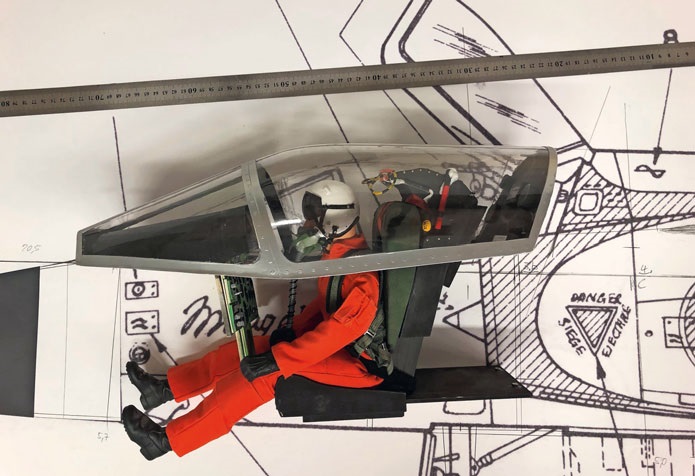
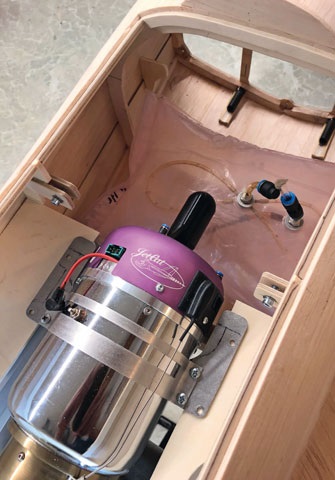
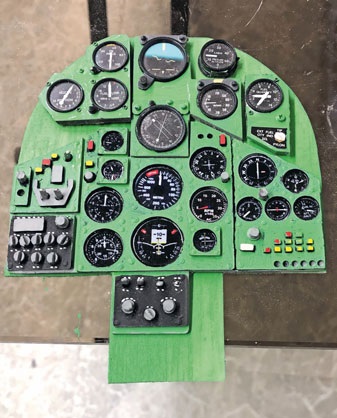
balsa wood? It had been years. My hobby room got pretty dusty, and I went through packs of tissues—I was sneezing that much. Finally, I could start applying the fiberglass cloth. Just as I’d learned back in the day, I used epoxy resin, which I thinned slightly for easier application. It’s always good to have friends with different skills. So, without further ado, an AT-16 landing gear was modified to fit perfectly into a Mirage as the main landing gear. It was important to me that the front view looked “Mirage-like.” Compared to the original plan, the turbine (a Jet Cat P-180NX) had to be moved significantly forward. In the end, I only needed to add a small amount of lead to the nose. The question was how to give the model a scale-like appearance without too much effort. Without further ado, I cut out covers and sheet metal seams from thin adhesive film. I simply simulated the screw placements using a leather punch before applying the film. I then inserted screws into the finished model.
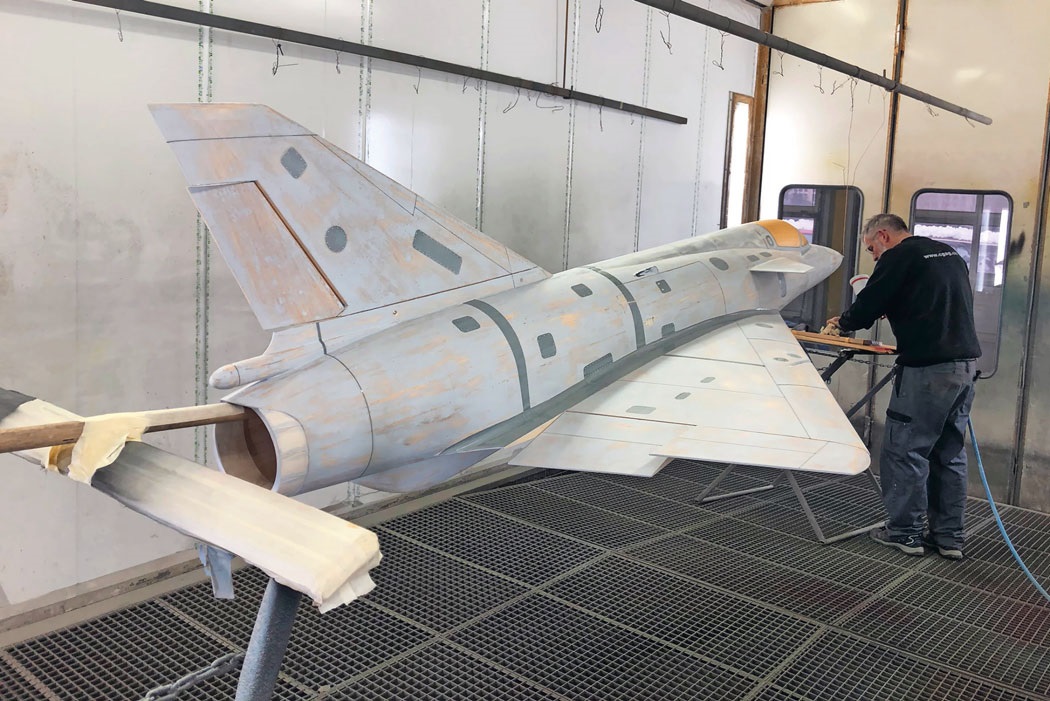
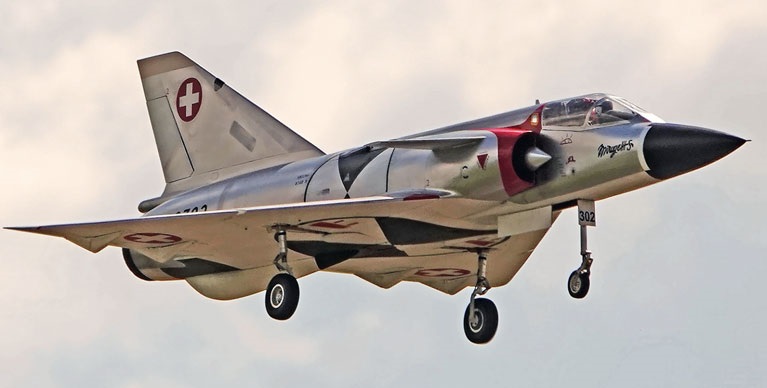
After careful consideration, I decided the model should look exactly like my first Mirage. The version that was used by the GRD (now Armasuisse) as a test aircraft. I found a decal set online for a 1:72 scale model. Once again, one of my friends (Ralle Schneider from Tailormade Decals) made the impossible possible and scaled up all the masking templates to a 1:5 scale. My friend Oliver Kölla, who paints many of my models, found a paint called “polished aluminum.” It was a huge undertaking in terms of the paint scheme. But Oli wanted to try something new. The result was great, though I had to age the model in various places; otherwise, parts of it would have been so shiny they’d practically fly through the air, making it almost impossible to control. For the receiver side, I relied entirely on Powerbox equipment. The final result is impressive. A fantastic airplane with a takeoff weight of just 18.7 kg. Thank you, Ueli Amacker, for this dream
Ueli Amacker, builder of the Mirage IIIS.
Then, in the spring of 2021, the big moment arrived: the maiden flight. For years, I had only flown planes with landing flaps and the like. Yes, it’s quite simple: lower the landing gear, extend the landing flaps, and the plane glides in smoothly. I still remembered from my early days flying the Mirage that it was important to raise the nose during the final turn before touchdown and then apply throttle as you approach. One uncertainty remained: whether the Mirage was angled up enough to take off properly. I consulted with Ueli and a few other Mirage pilots. According to them, I’d done everything right.
So, a range test, final checks of the controls and engine, and the briefing with my son, who was there to assist me. What to do if the engine cuts out, when to extend the landing gear, flight objectives such as trim, slip behavior, etc. Nothing stood in the way of the maiden flight. I positioned myself halfway down the runway so that I
I could tell when the nose wheel got light, with the goal of taking off as far ahead of me as possible. I pulled back fully right from the start, opened the throttle wide, and off we went. After about 60 meters, the nose got light and the plane lifted off gently. Only moderate trim adjustments were needed. The spotter always does this so my hands can stay on the stick. Unusually for a first flight, I had a good feel for the plane, and I was able to perform an inverted flight (center of gravity test) as well as a few rolls. Before I knew it, the timer beeped for landing. A clean landing turn as always, and I was on final approach.
Adi’s instructions were matter-of-fact. Before I knew it, I was back on the ground. Wow, what an airplane! The next few flights were then devoted to adjusting the control surfaces and the gyro. The amazing thing about the Mirage is that it can’t stall. All it does is head toward the ground at a high angle of attack and a high rate of descent. Just open the throttle, and everything’s back to normal. Of course, Adi—as well as his friend Andreas—had to fly the Mirage, because I was interested in hearing the pros’ feedback. Both were absolutely thrilled after their respective flights.
The Mirage now has about 30 flights under its belt. I regularly inspect the airframe to make sure all the wooden joints are still securely glued and all components are in working order. I do this with all my models. This is standard practice for aircraft designed to carry people. Our models are subjected to the same forces, and the components are put through their paces as well. So, from a safety standpoint, it makes sense to perform this inspection. We all want to keep enjoying our hobby for a long time to come.
Ueli has now delivered the third “large Mirage III” and has forbidden me from writing that he’s still accepting orders, because he’s had enough of this model—he wants to focus on some more manageable model airplanes. Let’s wait and see if anyone manages to talk Ueli into doing something unexpected again.
| Scale: | 1:5 |
| Wingspan: | 160 cm |
| Length: | 290 cm |
| Weight: | 18.7 kg takeoff weight / 15 kg empty weight |
| Equipment: | Pioneer Powerbox with iGyro Sat, Powerbox receiver, and batteries |
| Remote control: | Powerbox Core |
| Turbine: | JetCat P-180NX |
| Fuel Tank: | Jens Pohle fuel bag (fuelbag.de) |
The Triengen Air Show on September 4—brilliantly organized by the MG Schöftland—finally gave me the chance, after a long wait, to capture the Mirage IIIS on camera. This collaborative project by Ueli Amacker and Reto Senn had been on my wish list for a long time. My club colleague Ueli had told me some time ago that he’d finally been persuaded to build a turbine-powered Mirage. The intricately painted Mirage truly sparkled in the sky above Triengen. It was well worth the wait!
*Markus Nussbaumer*


News from HEBU

TEAM MANAGER "THIS" BOSSHARD
 Rodito Nussbaumer

YOU KNOW WHAT I MEAN? 125 YEARS OF THE SWISS AERO CLUB
 Emil Giezendanner

F3A EUROPEAN CHAMPIONSHIPS IN ST-MACAIRE, FRANCE
 Matthias Bosshard

52. 2026 ALPS CUP
Emil Giezendanner
PRIDE AND GOOD IDEAS
 Markus Nussbaumer

CORSAIR F4U – A WARBIRD WITH A MEMORABLE LOOK
Jürgen Rosenberger, Jürgen Prinz
SUMMER FUN 2026 AT MG USTER
Martin Wunderli
TRY-OUT DAY AT MFV WETTINGEN
Urs Keller
BY YOUTH, FOR YOUTH
Lorena Betschen
ATOM, THE NEW DOUBLE-DECKER FROM CPLR
Matthias Bosshard
SMALL, MODEL-LIKE SAILBOATS
Res Dauwalder
What's New at Leomotion.com

HORIZON HOBBY/LEMACO NEWS: MICRO OV-10 BRONCO 645 MM BY E-FLITE

COUPE DES ALPES – OBSERVE AND LEARN
Rodito Nussbaumer
TWIN TOWN PARTNERSHIP
Wolfgang Voeller
EURO CONTEST GLIDER ACRO TOUR AUSTRIA 2026

INSIGHTS INTO THE HISTORY OF SEAPLANES

34th HAHNENMOOS ALPINE MODEL AIRPLANE CAMP
Res Dauwalder
WELCOME, NEW MEMBER!
Andrea Bolliger
FREE FLIGHT IN THE MIDDLE OF SUMMER
Urs Muntwyler
THE PC-21 STORY
Emil Giezendanner
NEWS FROM HEBU
 Julia Bucher

FROM 0 TO 100
Markus Nussbaumer
MEMORIES
Wolfgang Völler
NOS REGION – A HUB FOR ELECTRIC AVIATION
Emil Giezendanner
Have you almost forgotten about aircraft that take off and land vertically?
Emil Giezendanner
DO YOU KNOW WHAT I MEAN IN THE LAND OF SMILES?
Emil Giezendanner