
RC Gliding Today
Developments and Challenges in Modern Competitive Model Flying (F3B), as Illustrated by the Experiences and Thoughts of Our World Championship Participants Hans Stoll, Gerhard Läderach, and Ruedi Binkert
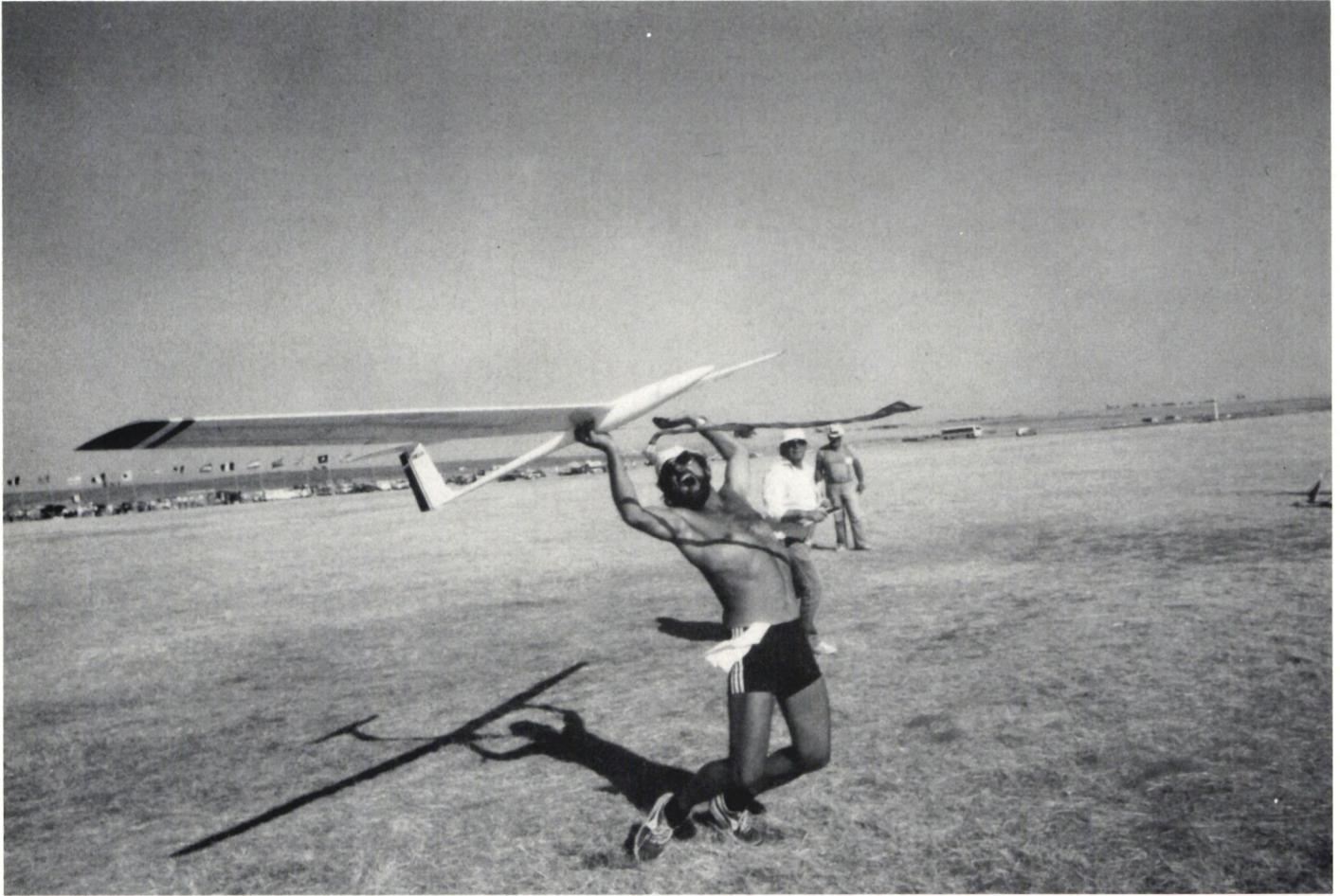
It was located about 23 km from the hotel on the outskirts of Sacramento. Over the course of the World Championships, the ground beneath the short, sparse grass turned into a desert-like airfield with rock-hard, dusty soil. The dry grass lying around posed a constant high risk of fire. The dimensions of the site—800 x 570 m—fully met the requirements for an F3B competition. Costs were evidently cut on the team tents, which provided shade; each tent measured 3 x 3 m and was arranged in a long row. Each team tried to get more protection from the scorching sun using canvas sheets and poles. After the first few days, the team camps looked as if Bedouins were living in the desert. The food at the field was good, as it was brought in from the city every day. A small kiosk was available for refreshments, but it had to close as early as five in the afternoon due to a lack of supplies. If the teams hadn’t organized themselves, they would have been left high and dry for almost the entire day.
In my opinion, the level of organization at the airfield was probably comparable to that of a regional competition. To illustrate the problems, I’d like to cite frequency monitoring as just one example. Toward the end of the open practice week, the “clothespin” system was introduced, which worked quite well. For the World Championships, we had obtained all the 53 MHz channels, since we were advised not to fly on 40 MHz in the U.S. Using our small monitoring receiver, we checked our frequency, but aside from some faint music—which didn’t bother us—everything seemed to be fine. I took off, flew for a few seconds, and suddenly the model nosedived into a tailspin. What had happened? I was able to recover the model immediately. The same thing happened two more times in a row before I could land the model safely.
Ruedi and Geri, however, had no problems, even though they were flying on the same frequency. A model airplane enthusiast from Sacramento generously made his well-equipped workshop with measuring instruments available to us, for which I’d like to thank him again here. TM
and Heinz Schläpfer put my remote control through a thorough check. No fault could be found. A battery test revealed a slightly elevated final charge voltage (a phenomenon caused by battery aging). Could this have been the cause? Well, this was remedied by turning on the transmitter during the drive to the airfield.
During the official practice session, each team was allotted 15 minutes. We decided to complete two speed flights each. I was the first to launch and managed a clean flight under nine seconds. During the landing approach, about 50 meters away from me, the model crashed onto the rock-hard ground from a height of one meter. The transmitter was immediately turned off, and the agreed-upon launch signal was given to Ruedi. When I reached the model, I saw that the fuselage had burst open and one elevator was broken. In the meantime, Ruedi took off and also delivered an outstanding flight under nine seconds. After the speed flight, he pulled his model up and was already flying straight ahead in a stable flight pattern to prepare for landing. Suddenly, his model began a forced loop and crashed to the ground from a height of 50 meters. Result: Total loss! The frequency monitoring team informed us that no interference was detectable and asked us to check the analyzer display ourselves. At that moment, we were glad to have Heinz with us. As an electronics technician by trade, he was the right person to take a closer look at the frequency monitoring system. No signals whatsoever—other than background noise—could be detected on the expensive device, even though the Swedes were conducting their official training less than a hundred meters away! All attempts to readjust and check the equipment were to no avail. The receiver was too insensitive. Heinz recommended that the organizers check the analyzer’s antenna. Once again, it turned out that they had cut corners in the wrong place. Even the best and most expensive equipment is useless if it’s connected to cheap department-store antennas with built-in short circuits.
There were other prime examples of frequency control blunders. For instance, the organizers managed to have two competitors fly—or rather, crash—at the same time on the same frequency. Ruedi, too, was sent to the starting line twice on the same frequency as a fellow competitor. Only close attention during flight control checks (the yaw control was exhibiting slight jerks) prevented further crashes. I’m a big fan of the simple but reliable clothespin system.
I’d like to describe a typical day here—interspersed with a few thoughts—as a snapshot of the World Cup week.
Wake-up call at 5:00 a.m. at the first-class hotel (we didn’t skimp on this). At 6:00 a.m., the whole team met for breakfast in the dining room after the models had been packed into the transport crates and stowed in the cars. After breakfast at 6:30 a.m., we set off in two station wagons packed to the brim (9 models, a winch, toolboxes, coolers, and 10 people). At 7:30 a.m., we began assembling the models—not an easy task with spectators surrounding us. We used the transport crates to set up a small barrier so that the curious onlookers wouldn’t be standing right in the middle of the models. It was very important to cover the models because, first, there was a terrible amount of dust, and second, the strong sunlight caused surface temperatures to reach up to 60 °C. This resulted in a large temperature difference between the top and bottom surfaces of the wings, and we had to expect the wings to warp. We then went over the day’s launch order with the TM, while the high-launch team checked the winches and the high-launch rope. The nylon silk was kept moist at all times. This was a very important and tried-and-true detail in this intense heat combined with low humidity. Thanks to this measure, we had virtually no problems with the high-launch winch. Putting on our launch numbers, applying sunscreen, and putting on sunglasses and hats were the next steps, and then we were ready for launch. But anyone who thought we were finally off to a start was once again mistaken, as waiting was a defining feature of the World Championship. The Canadians, with their rocket launches, brought some excitement to the daily routine. Using a 36-volt winch and a braided cord (clothesline), the models were catapulted to a height of about 80 meters and then hoisted to normal launch altitudes of 150 to 180 meters with the help of the large winch. As impressive as such a launch may seem, this launch method is also dangerous. During a high launch, the deflection device was ripped out of the ground and flew 60 meters through the air. The long-awaited explosion of a model then truly revealed yet another source of danger. After the wings were literally torn to shreds at a height of 60 meters, the fuselage flew uncontrollably across the entire course and crashed at baseline B.
Ernst Maderthanner had a very important role, having taken on the responsibility for the team’s physical well-being. Everyone always eagerly awaited Ernst’s return from his shopping trips with coolers filled with tomatoes, grapefruits, and mineral water. With temperatures reaching up to 42 °C, a huge amount of liquid was consumed, and Ernst had to restock several times a day.
Our high-launch team members, Heinz and Ernst, put in a tremendous effort. They dragged the high-launch winches up to 400 meters to the launch site and back nine times a day, checked the high-launch ropes for damage and length, and kept the ropes constantly wet. We pilots had a support team at our side that many teams could only dream of. We’d like to take this opportunity to thank them once again from the bottom of our hearts. People like this are hard to find; they deserve to have their efforts properly recognized. They’re always there when you need them, helping out, running around, and even digging into their own wallets—and in the end, it’s the pilot who gets rewarded. The helpers walk away with nothing but a “thank you.” Every active F3B pilot should take a moment to consider whether he could even participate in a competition without his helpers.
F3B flying is a true team sport, and that’s why the helpers should also be rewarded accordingly. However, it will likely be years before the helpers—in addition to the pilot and the team manager—are given the recognition they deserve; as long as, at a World Championship, none of the remaining participants—other than those in 1st through 3rd place—receive any recognition; indeed, not even the rankings from 4th place onward are announced, and to make matters worse, the official rankings aren’t even available.
But back to the day’s schedule. The long day at the airfield ended between 7:00 and 8:00 p.m. with packing up the models. After the drive back to the hotel, there was just enough time to clean the models and take a shower. Then, at 9:30 p.m., we had dinner, and by 10:00 p.m., everyone was glad to get the most urgent tasks for the next day done and be in bed by 11:00 p.m.
Hans Stoll
| 1. Holley | USA | 100.0% |
| 11. Läderach | CH | 94.5% |
| 18. Binkert | CH | 91.1% |
| 27. Stoll | CH | 84.4% |
In my analysis of the 1981 World Championships, I would like to focus primarily on the distinctive features of the models used by the top pilots.
The first thing I noticed was that there were no sensational new designs, such as the one introduced by the Italian Pagliano at the 1979 World Championships with his “Allure” model featuring a fuselage-less design. Kit models were also practically never used, or only with major modifications. All the top-performing F3B gliders were original designs that had been developed and refined over a long period of time. If one were to construct an average model based on those placed in the top ten, it would look something like this: wingspan 2.8 m, wing area approx. 55 dm², weight without payload 1.9–2 kg, equipped with ailerons, rudder, and elevator, air brakes and possibly flaps, with a lead payload of up to 1 kg for speed flying. The wing constructions used were predominantly either plastic wings built from a negative mold or conventionally built wings covered with fiberglass fabric and coated with epoxy resin, resulting in a high-quality surface finish.
All variations of aerodynamic braking devices were used, ranging from the standard Schemp-Hirth flap to an opening rudder. To slow the model down on the ground, dangerous objects such as saw teeth milled from aluminum and steel spikes several centimeters long were attached to the bottom of the fuselage.
Almost without exception, detachable high-launch hooks were used; these came in a wide variety of designs and functioned reliably.
The high-launch technique using a high-launch winch was the only method employed, and it must be noted that much higher initial altitudes can be achieved using a winch. This leads to the exclusive use of this launch method and thus greatly increases the workload for competitors and organizers.
Notable were the efforts of numerous pilots to increase the speed range of their models in level flight by using technical devices such as flaps or a remotely adjustable center of gravity. Flaps were also used to increase lift during the initial climb phase, thereby reducing the amount of line that needed to be reeled in by the winch and consequently raising the initial altitude upon release.
In conclusion, I would like to note that the models flown by top pilots have become very similar in terms of aerodynamic cleanliness and construction precision, and that the limits set by the F3B rules are being reached more and more often by an increasing number of pilots.
Gerhard Läderach
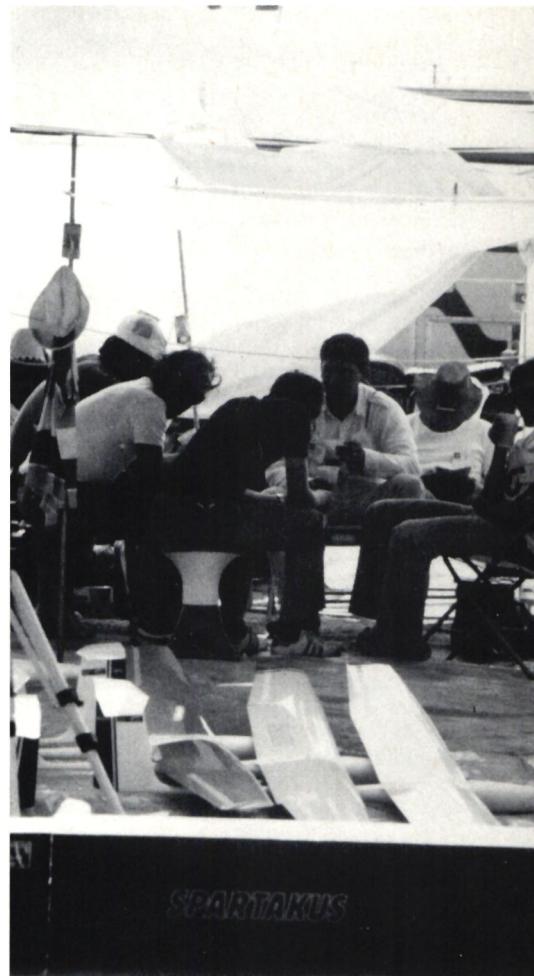
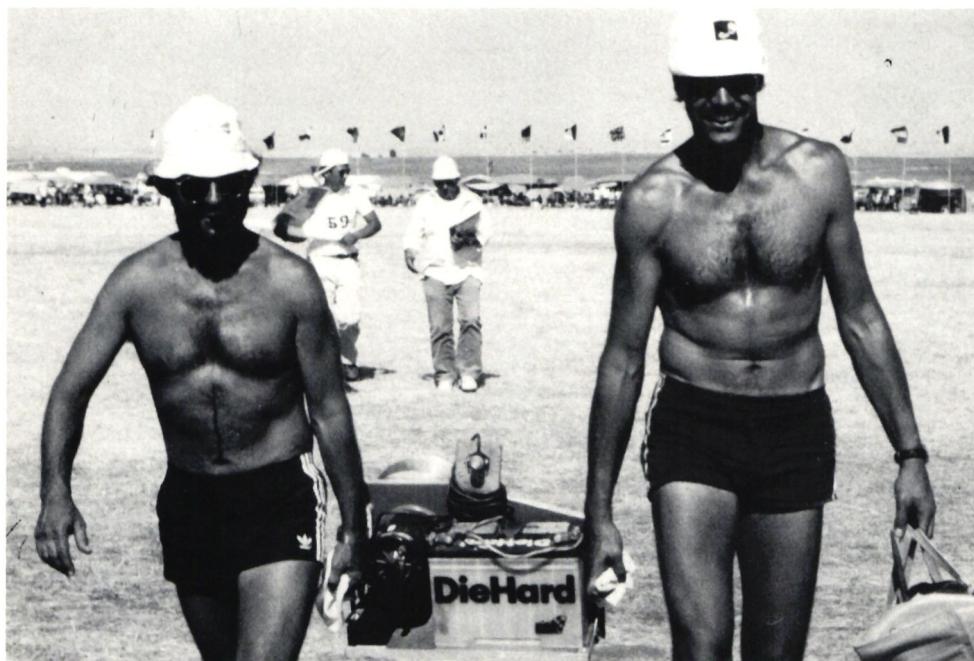
The high-launch team of Heinz Schläpfer and Ernst Harlacher, using the winch, on their way to the launch site.
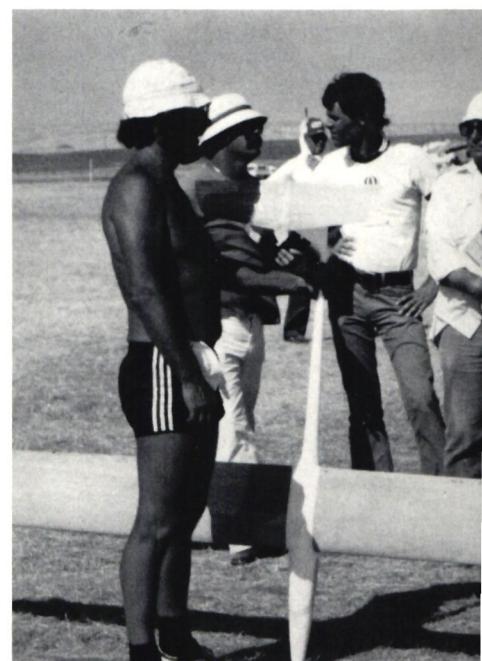
Geri Läderach before the start signal. In the middle is team leader H. R. Schläpfer.
Now that Geri Läderach and Hans Stoll have commented on the external conditions of the 3rd World Championship in the F3B category—and it should be noted right away that the importance of flight equipment, infrastructure, and the very practical living conditions during a championship should by no means be underestimated— I would like to add a few thoughts on the topic of “competition philosophy.” By this I mean the more subtle expectations, hopes, and fears that every pilot, every team leader, and indeed every volunteer brings with them—and from which the motivation and “fighting spirit” of each individual largely stem. Such expectations, hopes, and fears remain implicit primarily because, during the hectic preparation period—and even more so during the competition itself—there is often room only for the “absolute essentials.” People are fully occupied with building and training.
Hardly anyone doubts that both—building and training—are necessary if one wants to pursue competitive model aviation even somewhat seriously. So, first comes building. In this regard, with four completely identical models each, we certainly didn’t need to worry too much. Even after losing two of our models during official practice (one total loss and one broken fuselage), caused by the initially completely absent frequency control—which was also clearly overwhelmed on multiple occasions during the course of the subsequent competition—we certainly still had more flying equipment at our disposal than most other teams. We could also be quite confident when it came to infrastructure. Both our high-launch team and the vital supply of fluids left nothing to be desired. I don’t know how many kilograms of tomatoes and how many liters of mineral water our entire team consumed during those few days. Nor do I know how often our high-launch team carried the heavy kites—sometimes quite far out into the sun-scorched terrain—and back again in the sweltering heat. I’d just like to take this opportunity to once again express my heartfelt thanks—to Heinz Schläpfer, Ernst Harlacher, and Ernst Maderthanner. Undoubtedly, the extensive preparatory work and dedication of our team manager, Hans-Ruedi Schläpfer, and his family also deserve our recognition and gratitude.
But now the inevitable question arises: If everything was so perfectly organized and went so smoothly, shouldn’t this have led to better results? Even so, an 11th-place finish (Geri Läderach), an 18th-place finish (Ruedi Binkert), and a 27th-place finish place (Hans Stoll) at a World Championship with 66 competitors are by no means bad results—and even though our 6th-place finish in the team standings is certainly nothing to be ashamed of—we must honestly admit: We all expected more. And it is precisely this expectation—this pressure to perform, which we had largely imposed on ourselves but which obviously existed from other quarters as well—that, in my opinion, has had disastrous consequences. We pilots made mistakes that really shouldn’t have happened. Our team manager, Hans-Ruedi Schläpfer, also made mistakes that really shouldn’t have happened. – Lack of training? – Stress? – Certainly that, too. But I do believe that, aside from our undoubtedly inadequate familiarity with our model, one other aspect in particular was seriously neglected: namely, the joy—I’d even go so far as to say: the fun of the competition. Even a World Championship and the preparations for it should take place in an atmosphere where this very aspect of our challenging, beautiful, and versatile hobby isn’t neglected. I hope that in the future, I and everyone else will have more time for this. And I believe that this joy in the activity—for the activity’s sake—is one of the most essential prerequisites for success as well.
Ruedi Binkert
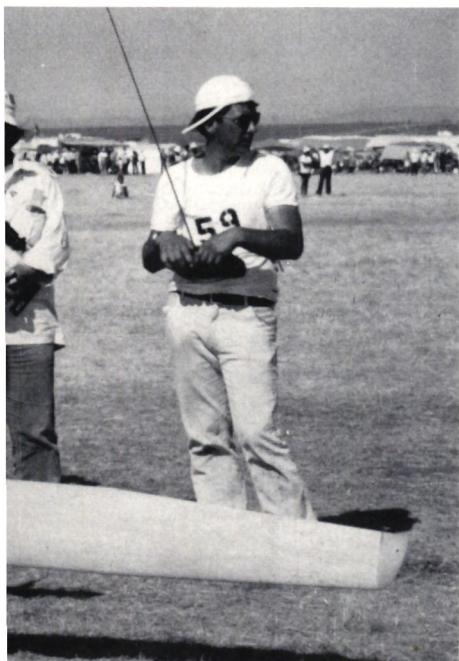
Ruedi Binkert and Hans Stoll dusting off the model.


News from HEBU

TEAM MANAGER "THIS" BOSSHARD
 Rodito Nussbaumer

SUMMER FUN 2026 AT MG USTER
Martin Wunderli
SMALL, MODEL-LIKE SAILBOATS
Res Dauwalder
TRY-OUT DAY AT MFV WETTINGEN
Urs Keller
What's New at Leomotion.com

52. 2026 ALPS CUP
 Emil Giezendanner

BY YOUTH, FOR YOUTH
Lorena Betschen
ATOM, THE NEW DOUBLE-DECKER FROM CPLR
 Matthias Bosshard

INSIGHTS INTO THE HISTORY OF SEAPLANES

YOU KNOW WHAT I MEAN? 125 YEARS OF THE SWISS AERO CLUB
Emil Giezendanner
34th HAHNENMOOS ALPINE MODEL AIRPLANE CAMP
Res Dauwalder
CORSAIR F4U – A WARBIRD WITH A MEMORABLE LOOK
Jürgen Rosenberger, Jürgen Prinz
F3A EUROPEAN CHAMPIONSHIPS IN ST-MACAIRE, FRANCE
Matthias Bosshard
HORIZON HOBBY/LEMACO NEWS: MICRO OV-10 BRONCO 645 MM BY E-FLITE

PRIDE AND GOOD IDEAS
 Markus Nussbaumer

EURO CONTEST GLIDER ACRO TOUR AUSTRIA 2026

FREE FLIGHT IN THE MIDDLE OF SUMMER
Urs Muntwyler
THE PC-21 STORY
Emil Giezendanner
TWIN TOWN PARTNERSHIP
Wolfgang Voeller
WELCOME, NEW MEMBER!
Andrea Bolliger
COUPE DES ALPES – OBSERVE AND LEARN
Rodito Nussbaumer
NEWS FROM HEBU
 Julia Bucher

FROM 0 TO 100
Markus Nussbaumer
MEMORIES
Wolfgang Völler
NOS REGION – A HUB FOR ELECTRIC AVIATION
Emil Giezendanner
Have you almost forgotten about aircraft that take off and land vertically?
Emil Giezendanner
70 YEARS OF THE NIDWALDEN MODEL AIRPLANE CLUB
Martin Barmettler