
The E-Flite Ultra Micro 4-Site
E-Flite stands out for its high-quality, miniature models. Following the Blade MSR mini helicopter, here is an adorable little biplane designed for aerobatics and 3D flying—the Ultra Micro 4-Site—which weighs 35 g fully equipped. This little aircraft incorporates the key features of E-Flite’s micro designs, namely: a coreless brushed motor, 4 linear microservos (1 for elevator, 1 for rudder, and 2 for ailerons), and a 2.4 GHz receiver. The entire system is powered by a 3.3 V, 150 mAh LiPo battery.
The model comes fully assembled in a polystyrene box that protects it during shipping. The model is securely packed, and this box will obviously be very useful later on for taking it to the field or the indoor flying arena. It is a biplane whose structure is made of a material similar to Depron. Both wings have a symmetrical airfoil; the leading edge is rounded, then the airfoil is flat and tapers toward the trailing edge. The fuselage consists of two intersecting panels, with an openwork reinforcement that ensures good torsional rigidity. The two wings are joined by two large panels, which contribute to side-slip stability. Also included are two glue-on air brakes, which allow for aerobatics at a constant speed. Note that flight time is reduced when using them. The tail surfaces and control surfaces are well-proportioned, suggesting they will be effective. As mentioned at the beginning, there is one servo per aileron (or more precisely, one for the upper wing aileron and one for the lower wing aileron) to ensure a quick response. The wings are connected to each other (!) by a 0.5 mm diameter carbon crossbar. The landing gear consists of 1 mm diameter carbon rods and is equipped with Depron wheel fairings. The control rods are made of 1 mm diameter carbon rods, fitted with a bent cap that also serves as an adjustment element for the control surface’s neutral position. The ailerons are connected to each other by a 0.5 mm diameter carbon rod. The tiny 8.5 mm diameter coreless motor drives a 130 mm × 70 mm propeller via a gear reduction ratio of approximately 1:4. A thorough inspection of the glue joints led to the receiver block being reattached to the fuselage, along with a control rod guide. This gluing was done using Sader’s Fortissimo adhesive. To fly the model, you’ll need a 3.3 V 150 mAh battery, a charger (for example, the battery and charger from the Blade MSR), and a DSM2-compatible transmitter—none of which are included in the kit. Overall, the model looks great in its yellow and red livery, and I have to admit I was a bit taken with that aspect.
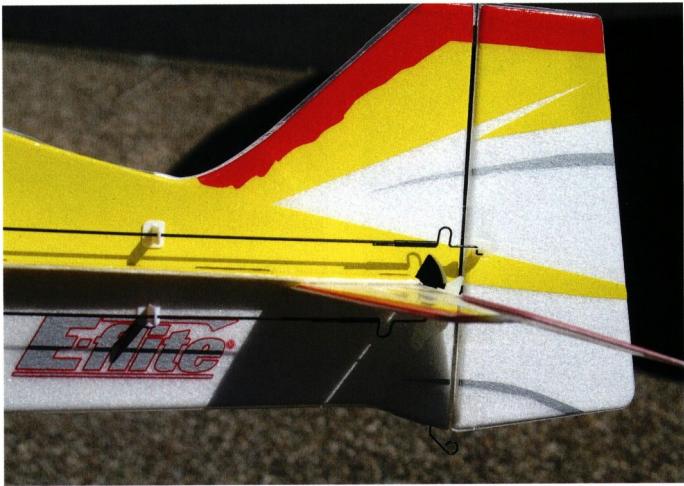
ensures good torsional rigidity. The two wings are joined by two large surfaces, which contribute to side-slip flight. The kit also includes two glue-on air brakes, which allow for aerobatics at a constant speed. Note that flight time is reduced in this case. The tail surfaces and control surfaces are well-proportioned, which suggests they will be effective. As mentioned at the beginning, there is a clamp—
| Wingspan: | 387 mm |
| Length: | 445 mm |
| Wing area: | 6.2 dm² as measured (note: the value in the manual is incorrect) |
| Weight with 150 mAh batteries: | 35 g |
| Wing loading: | 6 g/dm² |
| Motor: | 8.5 mm diameter coreless brushed motor |
| Propeller: | 130 mm × 70 mm |
| Receiver: | 2.4 GHz AR6400L, DSM2-compatible |
| Servos: | 4 × SPMAS 2000 L linear servos |
| Observed flight time: | approximately 4–5 min. with 150 mAh batteries |
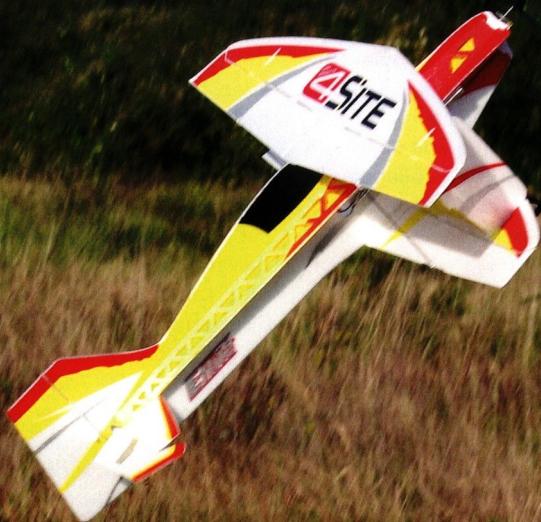
A model that looks great, with a luminous design that stands out clearly against the sky.
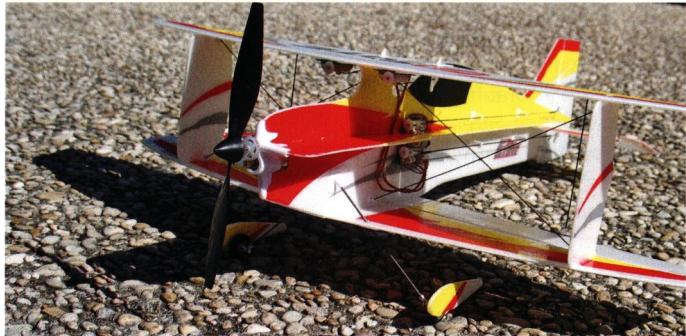
The wheel fairings are made of Depron. The small wheels require a flat surface to take off.
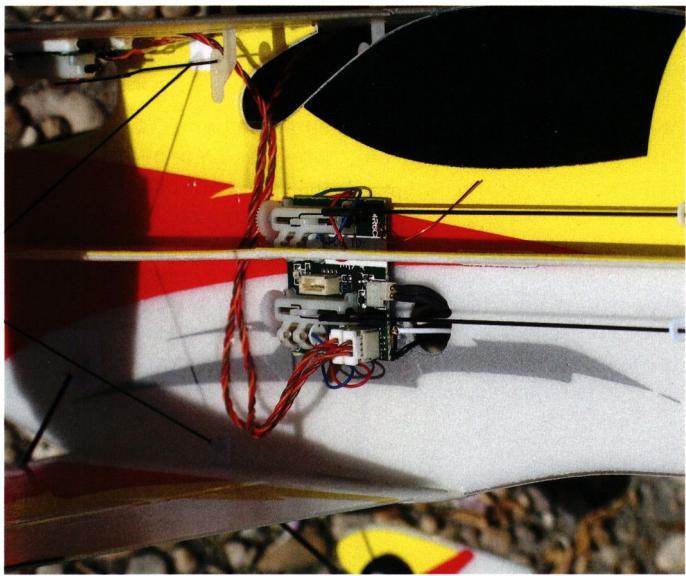
The tiny 2.4 GHz receiver houses two linear servos and the speed controller.
The model is compatible with Specktrum DSM2 technology, and as such, the transmitter for the Blade MSR mini helicopter can theoretically be used to fly the model. The manual advises against this, however, because it is not possible to set up exponential control with this transmitter. I tried it outdoors anyway on a calm day: It is indeed strongly discouraged, as the model is very jerky, even with reduced control travel. You’ll need a compatible transmitter such as the Spektrum DX6i (note that the DX6 is not compatible), or the DX7/DX7se. The first step is “binding,” a standard procedure for 2.4 GHz systems, which involves pairing the receiver and transmitter.
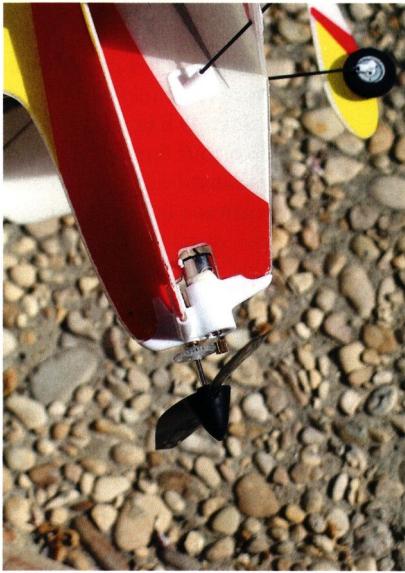
The propulsion unit is a coreless brushed motor equipped with a gearbox.
| Controls: | Dual rate 65%, expo 50%, travel +/-24 mm |
| Elevator: | Dual rate 60%, expo 50%, travel +/-16 mm |
| Ailerons: | Dual rate 60%, expo 40%, travel +9 mm |
The center of gravity is set 40 mm from the leading edge, as recommended in the manual, but can be moved back slightly to improve hover stability.
The instructions recommend a space measuring 7.5 m by 15 m with a minimum height of 2.5 m. For my part, I started by testing it out in my living room, which is much smaller (4 × 5 m) and cluttered with all sorts of objects. It’s possible to fly it in hover mode, but I have to admit that several attempts ended up in the fireplace or on the couch—which just goes to show how sturdy this little aircraft is, thanks to its low weight. On YouTube, you’ll find videos of pilots flying in their living rooms, which showcase this micro-aircraft’s capabilities—and my own limitations at the same time!
Test flights continued outdoors in calm weather.
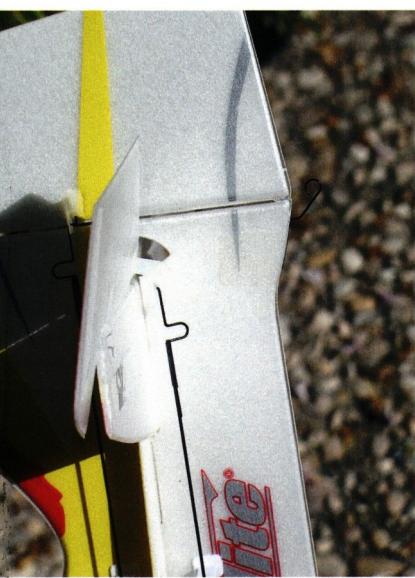
One of the two aileron linear servos.
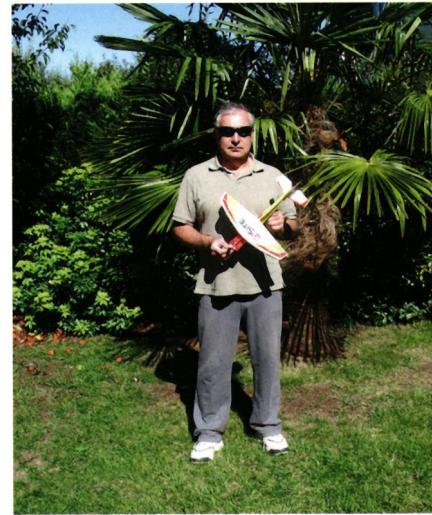
The author and his little pet.
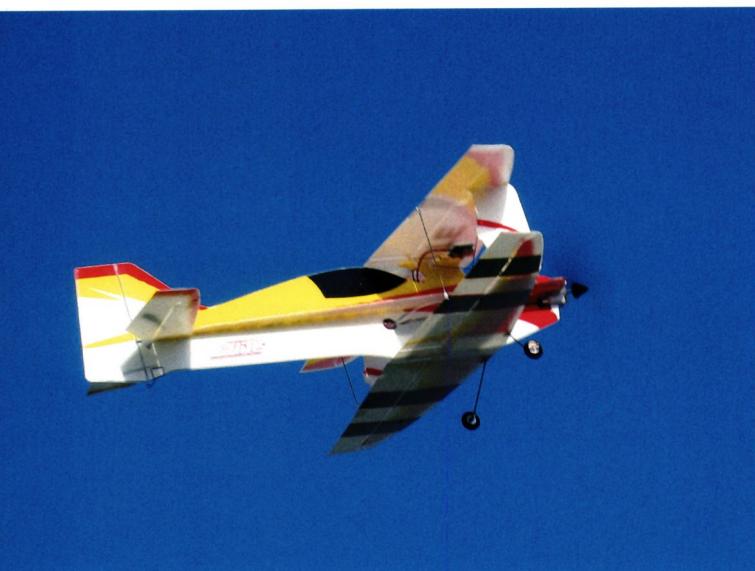
Given the model’s small size, it must be launched by hand, as it cannot take off from a grass runway. It’s very easy to do this by holding it by the top of the fuselage and releasing it while applying full throttle at a 45° angle upward.
One of the first things that stands out is the precision of the controls; the model is very stable on its flight path. Initiating a turn absolutely requires 3-axis control; otherwise, it will bank, and despite input on the elevator, it will turn very little. A touch of rudder is necessary; it’s an extremely effective control surface that must be used with care.
In classic aerobatics, everything comes off easily: rolls, loops, and inversions (which are quite enjoyable). Flying inverted is just a formality; you need to push the controls very little, which confirms afterward that the center of gravity (CG) position recommended in the manual is correct. In inverted flight, you’ll also need to control all three axes to execute a textbook turn. You can perform square loops and inverted loops—the model stays well-centered. The release is quick and recovers just as easily. Edge flight is really easy, as is the edge loop. It’s a real treat to see how such a small machine can perform such precise aerobatics. As for hovering, I find the motor power to be just enough—you practically have to go full throttle to stay vertical—and that power is only available for the first two minutes (I’m used to hovering at 50% throttle on my 3D planes). It’s a bit of a hassle when you find yourself in a tricky situation. When the wind picks up to 5–10 km/h, you can still have fun, but you have to fight to make headway, because, as everyone knows, biplanes are slow. The battery provides about 4–5 minutes of flight time, and it’s a good idea to have a few spares on hand—given their low cost (€5)—to get the most out of it.
In conclusion, this model is intended for pilots with some experience; it is not recommended for beginners. It has undeniable aerobatic capabilities, and despite its small size, it remains very precise to fly. The icing on the cake is that it has a look that’s sure to turn heads at the airfield. ■
*Serge Encaoua*


TEAM MANAGER "THIS" BOSSHARD
 Rodito Nussbaumer

YOU KNOW WHAT I MEAN? 125 YEARS OF THE SWISS AERO CLUB
 Emil Giezendanner

F3A EUROPEAN CHAMPIONSHIPS IN ST-MACAIRE, FRANCE
 Matthias Bosshard

News from HEBU

SUMMER FUN 2026 AT MG USTER
Martin Wunderli
TRY-OUT DAY AT MFV WETTINGEN
Urs Keller
52. 2026 ALPS CUP
Emil Giezendanner
BY YOUTH, FOR YOUTH
Lorena Betschen
ATOM, THE NEW DOUBLE-DECKER FROM CPLR
Matthias Bosshard
CORSAIR F4U – A WARBIRD WITH A MEMORABLE LOOK
Jürgen Rosenberger, Jürgen Prinz
SMALL, MODEL-LIKE SAILBOATS
Res Dauwalder
What's New at Leomotion.com

TWIN TOWN PARTNERSHIP
Wolfgang Voeller
EURO CONTEST GLIDER ACRO TOUR AUSTRIA 2026

INSIGHTS INTO THE HISTORY OF SEAPLANES

34th HAHNENMOOS ALPINE MODEL AIRPLANE CAMP
Res Dauwalder
HORIZON HOBBY/LEMACO NEWS: MICRO OV-10 BRONCO 645 MM BY E-FLITE

COUPE DES ALPES – OBSERVE AND LEARN
Rodito Nussbaumer
PRIDE AND GOOD IDEAS
 Markus Nussbaumer

FREE FLIGHT IN THE MIDDLE OF SUMMER
Urs Muntwyler
THE PC-21 STORY
Emil Giezendanner
WELCOME, NEW MEMBER!
Andrea Bolliger
NEWS FROM HEBU
 Julia Bucher

FROM 0 TO 100
Markus Nussbaumer
MEMORIES
Wolfgang Völler
NOS REGION – A HUB FOR ELECTRIC AVIATION
Emil Giezendanner
Have you almost forgotten about aircraft that take off and land vertically?
Emil Giezendanner
70 YEARS OF THE NIDWALDEN MODEL AIRPLANE CLUB
Martin Barmettler