
It has to be light and fly
Peter (Pete) Ziegler
September 2019, MG Bern Vintage Model Aircraft Day: Christian Ott and I are there as participants. Testing and flying our rubber-powered models. We’re chatting with our friends about everything under the sun and new projects. Chris is interested in building a C-36. Someday. I’ve thought about it myself, too—but not the “flying crosswalk,” rather the piston-engine version.
A few days later, I received an email from Chris with a link to a website for a model club in the U.S. A manufacturer there is offering a “Short Kit” for the C-3603! So-called “Short Kits” consist solely of printed or laser-cut balsa wood strips with ribs, frames, small parts, and a construction plan. All other materials that are normally included in a model kit—such as assembly instructions, skin material, strips, cowls, wheels, covering paper, etc.—are missing here. It is therefore up to each modeler to decide where and how to obtain these items.
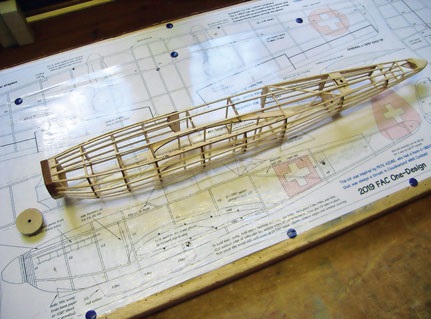
The 2019 Fall Meeting of the gummimotor.ch group: Among many other topics, the C-36 was also on the agenda. Roman Gröner proposed a “Coo-kup.” By the end of the day, the group planning to build a C-36 had grown to six people. In the days that followed, Chris contacted the manufacturer and ordered the kits. At the Spring 2020 meeting, two days before the COVID-19 lockdown, the kits were handed over to those who had ordered them, and construction of the models could begin. For decades, its silhouette could be seen in the sky and its engines (piston engine and later turbine) could be heard. This model is well documented in the books by Hans Prisi and Georg Hoch. The museum in Dübendorf is also a good source for research. And, as is common today, the www. So, at some point, six C-36 models with different paint schemes will take to the skies! The models are built using classic wooden model-making techniques, just as we “old-timers” have been accustomed to for years, and yet everyone will build and customize their model according to their personal preferences. Roman describes the start of his build as follows: “As with most of my projects, I started with the fuselage for the C-36. One side is currently on the workbench, waiting to be freed from the pins. The nice thing about the laser-cut parts is that they fit together very precisely. However, they always have these dark edges that show through unattractively under a light-colored covering. I don’t see much of a problem with the fuselage, but it could be an issue with the vertical stabilizer, since the part number is burned into the wood. Depending on how deep the number is burned in, it may or may not be possible to sand it off... If necessary, I’ll laminate the two rudders instead of using the original parts. I’ll assemble both for now and see how it goes...”
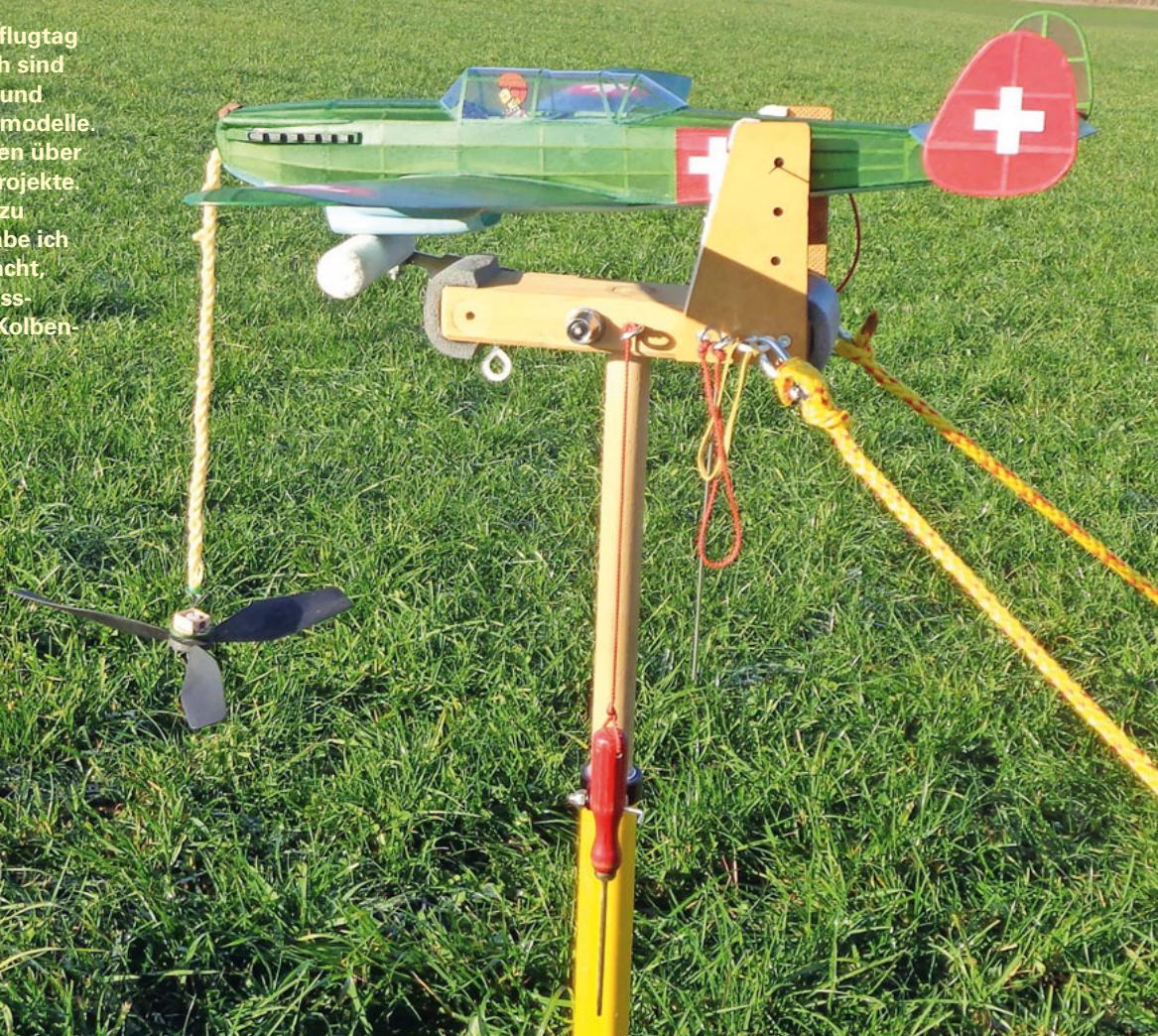
Like Roman, Chris also started with the fuselage; I built the rear wing and the two vertical stabilizers first. Chris then made tremendous progress on the build, and the airframe of his model was soon taking shape on the workbench. A shell that’s quite impressive. We discussed the detailing through constant communication via email and phone. In-person meetings weren’t possible for a long time due to the pandemic and its restrictions. And simply building according to the plans wasn’t our goal. So we modified the forward fuselage accordingly based on our documentation. Chris equipped his model with scale-accurate, retractable landing gear and a propeller for display purposes—parts that are removed during flight operations. Both of them built the large, easily visible cockpit and placed pilots (Lt. Oskar and Lt. Schluffi) in the front seat.
And what are the others up to? Roman didn’t get past the start of construction. Work commitments slowed him down. Andreas Koch, Fredi Genther, and Peter Hunn haven’t even started yet.
This didn’t stop Chris and Pete from continuing to build their models. Both have now completed the airframes on their models and are ready for covering. And so the models were covered: Chris used fabric, while Pete used paper. Both models were painted in the September 1944 scheme, known as the “neutrality paint scheme.” While Chris took care of the cockpit canopies and vacuum-formed them neatly, I focused on the lettering and national insignia so that we could stay as close as possible to the real thing. We created three decal sheets, which were printed on a laser printer onto white and clear decal film. For the painting, we used Tamiya paints, which are already very thin, and thinned them further so that they would still provide good coverage. While Chris only sketched the control surfaces and a few maintenance hatches, I additionally sketched sheet metal seams and ventilation slots using a fine, waterproof marker.
Our progress apparently convinced Andreas Koch to start building his own model. True to his philosophy—“It has to be light and fly!”—he began building his C-36. While we use two-bladed plastic propellers, Andreas is building a three-bladed wooden propeller right from the start. Chris Ott and Pete Ziegler are now set to conduct their first trim and test flights, but these had to be carried out individually rather than together, as planned. Blame it on COVID...
| Wingspan: | 640 mm |
| Length: | 458 mm |
| Weight: | approx. 50 g (Andreas) to 95 g (Pete, Chris) |
| Propulsion: | 2–4 Loop FAI Rubber Tan Super Sport 1/8" |
| Scale: | approx. 1:20 |
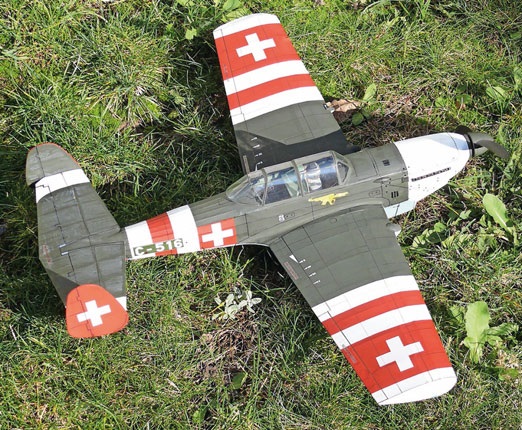
On November 8, 2020, the EKW C-3603 C-516 took to the skies for the first time at the MG Solothurn model airfield. And it flies! Chris’s model followed a few days later (November 21, 2020) in Wolfwil, and Andreas’? On November 27, 2020, the third EKW C-3603 took to the blue autumn sky above the Huttwilerberg in Huttwil. Andreas covered his model only with colored paper and omitted any additional paint to keep the weight as low as possible. As a result, the model achieves flight times of up to 90 seconds.
You can watch the model in flight at https://www.youtube.com/watch?v=G5305qMlpR8. Now everyone is hoping that the models that are already finished—and those still to come—can soon be flown at a joint gathering. In the meantime, however, two members have left the project.
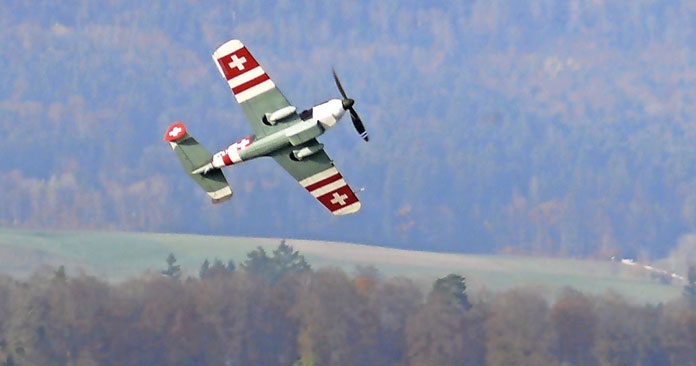
Finally! Last Saturday (July 24, 2021), we held our first rubber-powered model car meet after the previous events were canceled due to COVID. Despite the less-than-ideal weather forecast, we were all looking forward to the event. We hadn’t seen each other in a long time; there was plenty to discuss, discover, and chat about. Plus, it was our first meetup of the summer. We usually hold our meetups in the spring and fall. But this time we had the chance to hold it in the summer, since SG Olten was at their gliding camp and we were once again welcomed as guests at their home airfield. We’d like to take this opportunity to extend a heartfelt thank you to the organizers at SG Olten! After all, the weather wasn’t all that bad. We had it all… it rained several times a day, but we also had sunny windows for our flights. And the model exhibition was set up in the clubhouse: rubber-powered and CO2-powered models—about 30 in total—which, with eleven participants, made for a impressive fleet. In addition, all three completed EKW C-3603 models from our build-along were on display together. Not only could they be seen, but they could also be admired in flight—and all three are indeed flying. A thunderstorm then brought flying operations to a close, but we still enjoyed some camaraderie in the clubhouse before everyone slowly made their way home—satisfied, with many impressions and ideas, and looking forward to the next gathering.
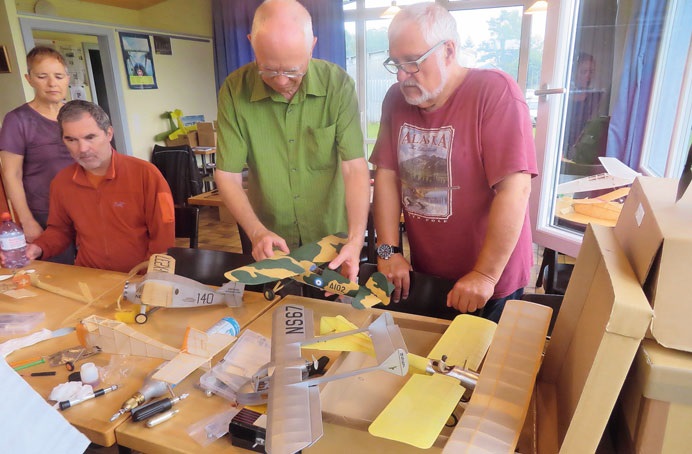
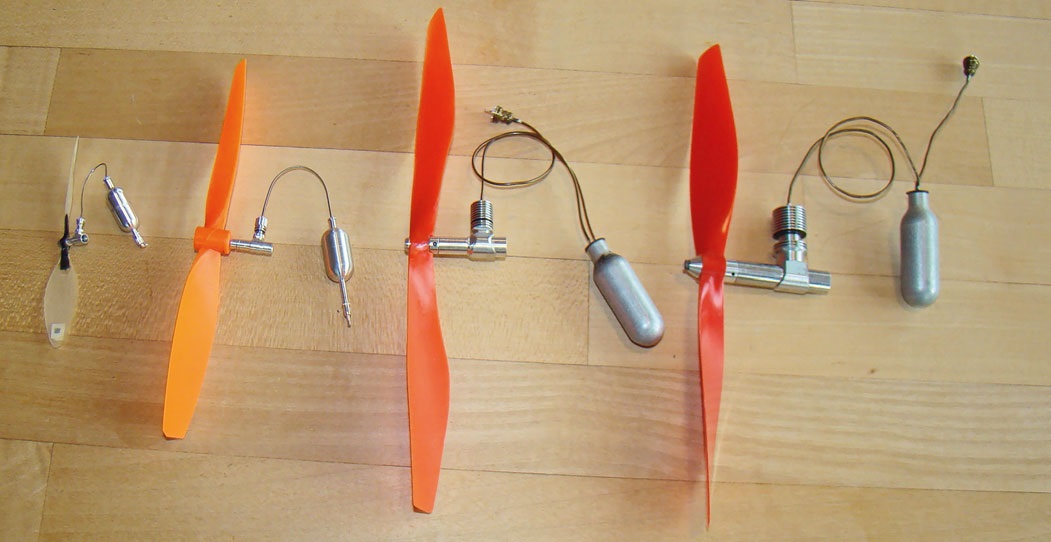
CO2 models are a common sight at our meetings. Their design and construction are similar to those of rubber-powered models, except that they are powered by a CO2 motor rather than rubber bands. This is an old—but increasingly forgotten—method of propulsion for free-flying models.
In the photo, models are being prepared. René Butty (seated) is an expert in this category. The models shown here were built by him and Georgios Kandylakis.
| Wingspan: | 640 mm |
| Length: | 458 mm |
| Weight: | approx. 50 g (Andreas) to 95 g (Pete, Chris) |
| Propulsion: | 2–4 Loop FAI Rubber Tan Super Sport 1/8" |
| Scale: | approx. 1:20 |


TEAM MANAGER "THIS" BOSSHARD
 Rodito Nussbaumer

SUMMER FUN 2026 AT MG USTER
Martin Wunderli
52. 2026 ALPS CUP
 Emil Giezendanner

ATOM, THE NEW DOUBLE-DECKER FROM CPLR
 Matthias Bosshard

INSIGHTS INTO THE HISTORY OF SEAPLANES

34th HAHNENMOOS ALPINE MODEL AIRPLANE CAMP
Res Dauwalder
CORSAIR F4U – A WARBIRD WITH A MEMORABLE LOOK
Jürgen Rosenberger, Jürgen Prinz
SMALL, MODEL-LIKE SAILBOATS
Res Dauwalder
F3A EUROPEAN CHAMPIONSHIPS IN ST-MACAIRE, FRANCE
Matthias Bosshard
What's New at Leomotion.com

HORIZON HOBBY/LEMACO NEWS: MICRO OV-10 BRONCO 645 MM BY E-FLITE

PRIDE AND GOOD IDEAS
 Markus Nussbaumer

News from HEBU

BY YOUTH, FOR YOUTH
Lorena Betschen
YOU KNOW WHAT I MEAN? 125 YEARS OF THE SWISS AERO CLUB
Emil Giezendanner
TRY-OUT DAY AT MFV WETTINGEN
Urs Keller
FREE FLIGHT IN THE MIDDLE OF SUMMER
Urs Muntwyler
THE PC-21 STORY
Emil Giezendanner
TWIN TOWN PARTNERSHIP
Wolfgang Voeller
EURO CONTEST GLIDER ACRO TOUR AUSTRIA 2026

WELCOME, NEW MEMBER!
Andrea Bolliger
COUPE DES ALPES – OBSERVE AND LEARN
Rodito Nussbaumer
NEWS FROM HEBU
 Julia Bucher

FROM 0 TO 100
Markus Nussbaumer
MEMORIES
Wolfgang Völler
NOS REGION – A HUB FOR ELECTRIC AVIATION
Emil Giezendanner
Have you almost forgotten about aircraft that take off and land vertically?
Emil Giezendanner
70 YEARS OF THE NIDWALDEN MODEL AIRPLANE CLUB
Martin Barmettler