
Peanuts in Action
As a follow-up to my article in *Modellflugsport* 1/81, I will now describe my experiences and adventures with these small models at major competitions.
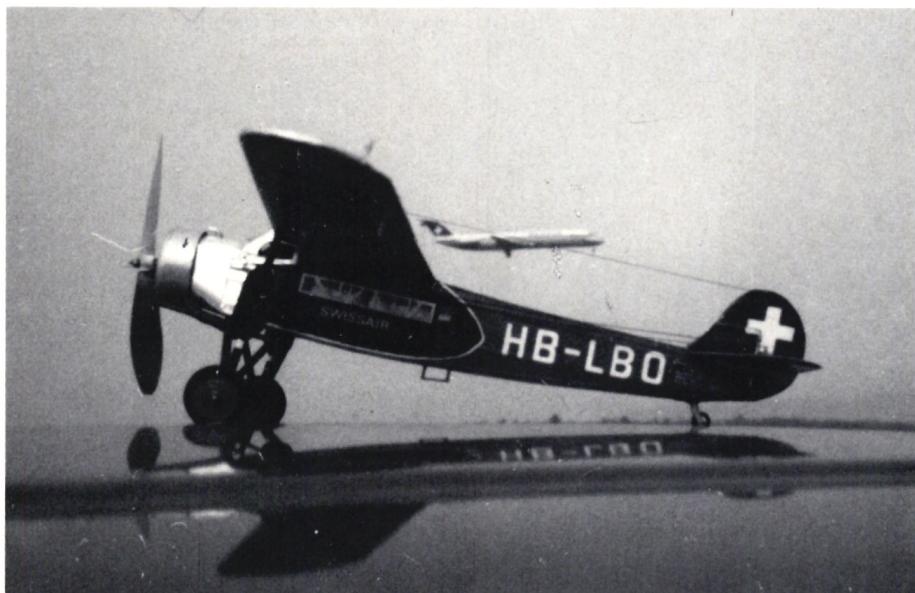
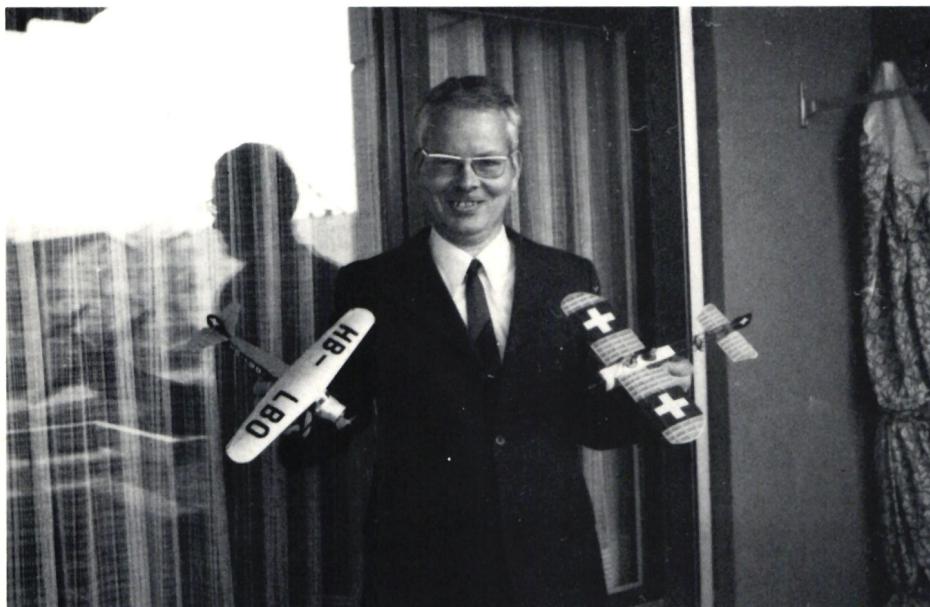
Since there aren't many Peanut competitions, I make a point of participating in at least the ones that are organized. So I sent the Fokker F VIIa model in a small box with spring-loaded padding to protect it from impacts, along with the construction evaluation documents and flight instructions, via airmail to the U.S. for proxy participation. The competition was held in the atrium of a hotel management school, which measured an impressive 60 meters in diameter and 30 meters in height. The usual “Peanut” rules applied: 13-inch wingspan or 9-inch fuselage length. No weight restrictions. The competition was divided into 5 classes—
Class 1: Pioneer: Airplanes from before World War I
Class 2: Warplanes from World War I and II combined
Class 3: Golden Age: Aircraft from the interwar period
Class 4: Modern Era: Aircraft from after World War II
Class 5: Multi-engine, helicopters, and flying boats
Ground launches were required for Classes 1 through 4. The construction evaluation was very well designed and, in some cases, had to be completed by the participants themselves. A combination of the construction score and the flight score then determined the final ranking. In the event of a tie, the higher construction score prevailed. A total of 79 “Peanuts” from 5 countries were entered, with most coming from the U.S. With 29 models evaluated, the “Modern Aircraft” class had the most participants. Of these 29, 10 were Lacey M-10s. The top three places were also taken by Lacey M-10s. This makes this amateur-built aircraft the most popular model in the “Modern” class.
A week and a half after the competition, the box containing the Fokker was back at my home. The model survived both transatlantic flights and five competition flights unscathed. My two U.S. proxy pilots, John Adams and Jack Niederhauser, described each flight to me in great detail in an enclosed report. My model was flown with great care and achieved optimal times (30.6 sec. and 35.8 sec.) in the two scored
flights (out of 9 possible attempts), optimal times (30.6 sec. and 35.8 sec.). With these results, the Fokker (in the “Golden Time” class) achieved 4th place overall, based on 4th place in the model-building category and 12th place in the flight category. I am pleasantly surprised that this proxy system works so well. You can really see the encouraging spirit of international camaraderie behind it. Of course, it would be much nicer to be there in person. That was the case in Flémalle, Belgium. The following report describes the events that took place there.
Following the positive experience at the 4th indoor competition in Flémalle in 1980, I was once again impressed by the excellent organization this year. It is worth commending the fact that, in a small village like Flémalle, a few idealists have the goodwill to host such a significant competition.
Flights took place in the following classes:
Peanut Beginners: 7 models and 1 model without a flight score
Peanut Experts: 32 models and 8 models without a flight score
Sainte-Formel: 2 beginners and 12 experts
F1D Microfilm: 5 participants
F1D Paper: 1 beginner and 8 experts
Penny Plane: 3 participants
EZB: 1 beginner and 11 experts
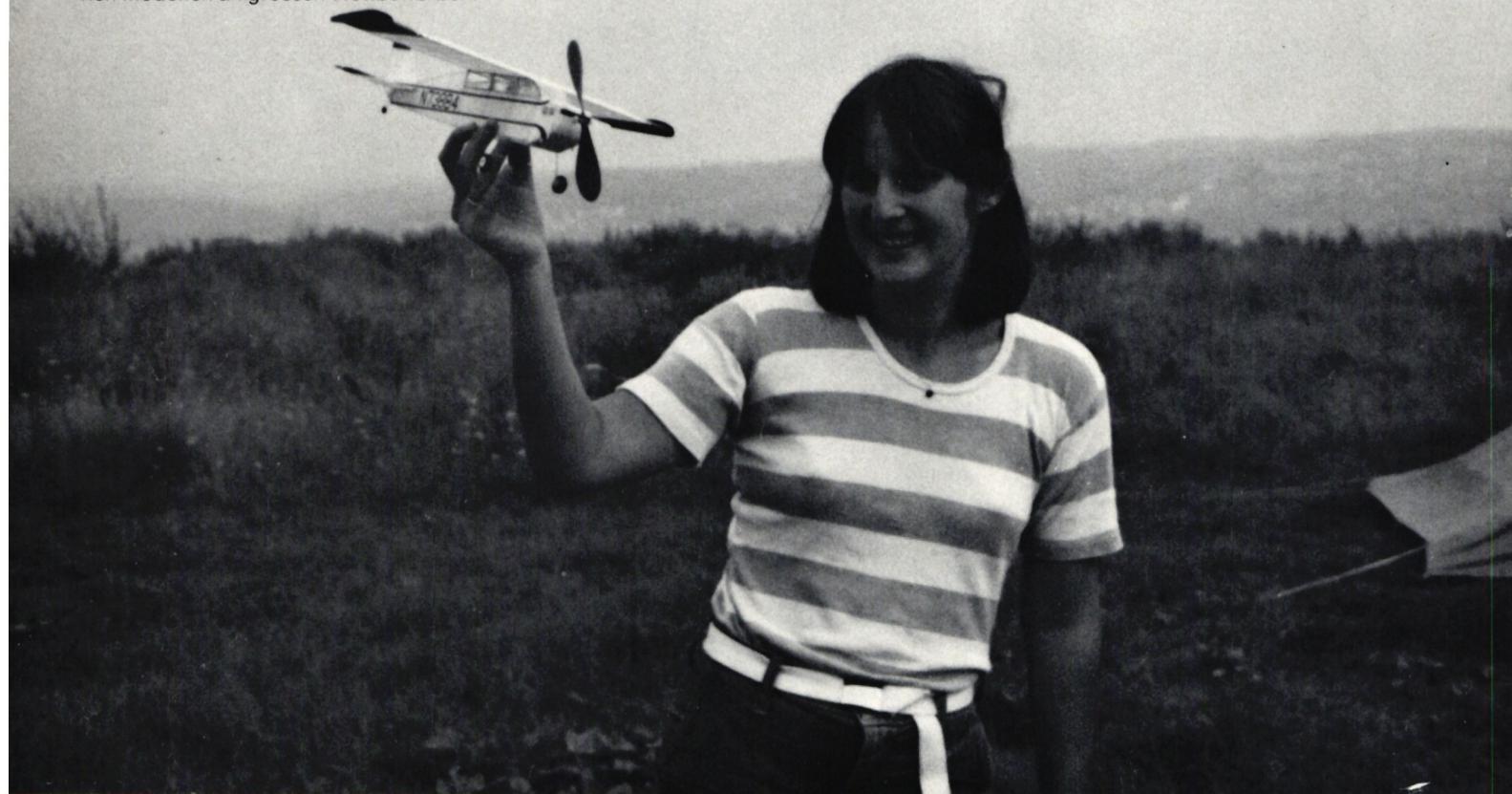
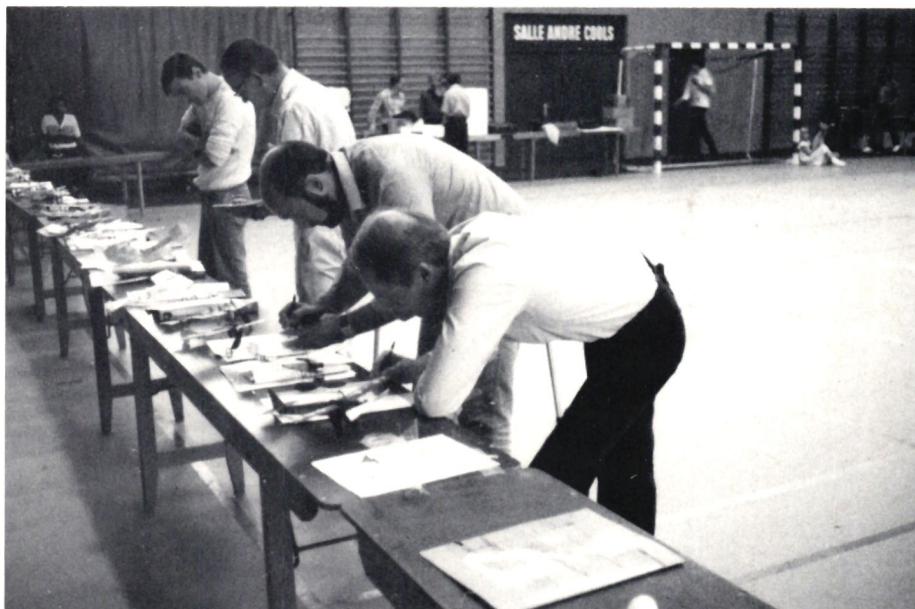
On Saturday, the F1D and EZB classes flew, while the Peanuts underwent their construction evaluation. As a result, the “sky” of the sports hall was densely “populated” with the high-performance models gliding slowly through the air. A truly beautiful sight. On the ground—that is, on tables—the three build judges set to work on the painstaking evaluation of the Peanuts. It was no easy task to evaluate these 48 scale model airplanes. The wingspans were checked using a special measuring device. On Sunday, things got serious: flight day for the Peanuts and Sainte-Formel. The results of the model-building competition were already posted on a board that morning. By then, everyone knew what they were flying. All eyes were on the Englishman Mark Hinton. His biplane “Santos Dumont 14bis” had already placed second in the build evaluation. When the model—weighing about 3 g—flew many beautiful laps in slow motion, everyone knew who the favorite was. It was also gratifying to see a few German “newcomers” to the Peanut class. The Germans J. Weil and H. Heinrath brought several very nice models and competed in the Peanut beginner class. There certainly seem to be prospects for new, capable specialists. The wife of Siegfried Glöckner—who was participating for the second time—had her very neatly built Lacey M-10 registered in the expert class right away. She deserves special praise here: This lovely lady not only builds beautifully, but she’s also very knowledgeable about aerodynamics!
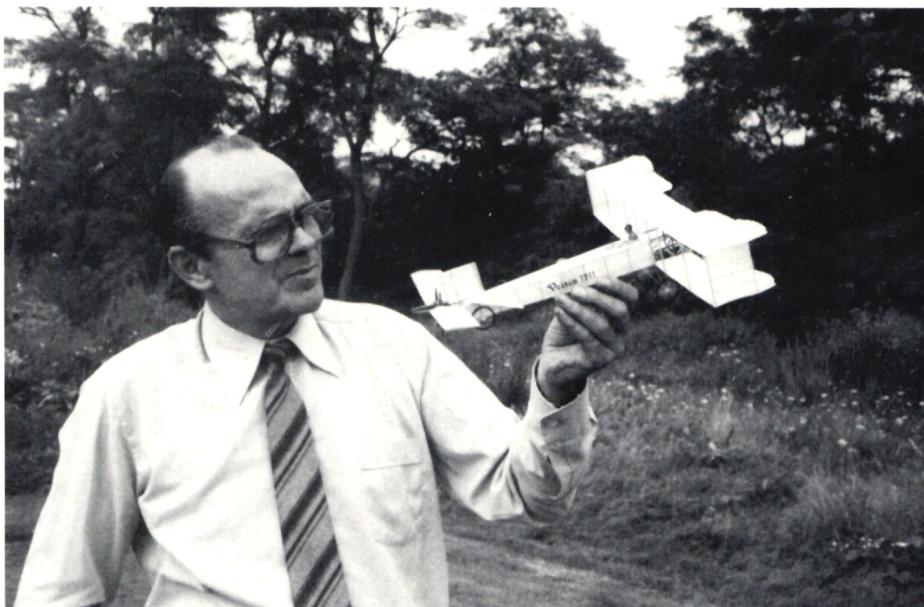
Since the French pilot E. Fillon was not present this year, only one of the “feared” Gossamer muscle-powered aircraft was in action. C. Frugoli of France finished in 3rd place with it. Otherwise, a colorful variety of different aircraft types was on display. A large collection spanning all categories and eras of aviation. Since the hall isn’t very high, the light and slow models have an advantage. Benno Sabel, from West Germany, showed up with a brand-new Voisin 1911 “Duck” biplane. It was superbly built and took 3rd place in the construction evaluation. Unfortunately, this vintage model hadn’t been properly broken in yet. However, there are clear signs of good flight characteristics. It finished in 16th place. I didn’t make it easy for the judges and timekeepers, as I entered seven “Peanuts”: C-3605, two
Pilatus Porters, a Blériot XIb, a Fokker F VIIa, a Bébé Jodel, and a Bucker-Jungmann. The Bucker and the Fokker were too heavy to perform good turning maneuvers in the available space. The C-3605 and the lighter Porter demonstrated serviceable flights. The C-3605 placed 8th and the better-performing Porter placed 10th overall. No qualifying flights under 60 seconds were recorded among the top 7 finishers. Remarkable performances by the Englishman Mark Hinton and several French colleagues. Although I don’t have any top-tier models in terms of flight performance, I am satisfied with the special prize for the highest construction rating, which was awarded to the Blériot XIb.
I’d like to take this opportunity to highlight the appeal of Peanut flying. It’s an interesting way to do something meaningful with little money, but with a lot of patience and skill. Switzerland, as a country known for its watchmaking and precision engineering industries, should really be sending whole groups of Peanut pilots to these competitions. Who’s in?
For information and advice:
Alfred Genther, Gumpisbuelstr. 35,
8600 Dübendorf
, Tel. 01/8210434
Peanut Beginners
| 1. H. Heinath | FRG | Nesmith Coug. |
| 2. H. Heinath | FRG | Currie “Wot” |
| 3. J. Weil | FRG | Piper J3 |
| 4. H. Heinath | West Germany | Luton Minor |
| 5. J. Weil | FRG | D. H. Gipsy M. |
| 6. J. Weil | West Germany | Farman Moust. |
| 7. J. F. André | B | Nesmith Coug. |
Peanut Experts
| 1. M. Hinton | GB | Santos Dum. |
| 2. C. Frugoli | F | Farman Moust. |
| 3. C. Frugoli | F | Gossamer |
| 4. F. Frugoli | F | Hirondelle |
| 5. P. Martin | F | Castaibert |
| 6. M. Hinton | GB | Farman |
| 7. J. Delcroix | F | SK 1 Trempik |
| 8. A. Genther | CH | C 3605 |
| 9. J. Delcroix | F | Pottier 100 T |
| 10. A. Genther | CH | Pilatus Port. |
| 11. A. Genther | CH | Blériot XI b |
| 12. R. Jossien | F | Leningradec |
| 13. A. Genther | CH | Pilatus HB-FF |
| 14. A. Genther | CH | Fokker F VII a |
| 15. J. Delcroix | F | Citabria |
| 16. B. Sabel | D | Voisin 1911 |
| 17. A. Genther | CH | Bébé Jodel |
| 18. J. Delcroix | F | Piper J3 |
| 19. A. Genther | CH | Bücker Jung. |
| 20. R. Lotz | D | Nesmith Coug. |
| 21. S. Glöckner | D | Lacey M 10 |
| 22. S. Glöckner | D | Nesmith Coug. |
| 23. Van Hauwaert | B | Alco-Sport |
| 24. M. Huybrechts | B | Loening M8 |
| 25. Van Hauwaert | B | Renard 31 |
| 26. D. Glöckner | D | Lacey M 10 |
| 27. M. Huybrechts | B | Wibault T 170 |
| 28. J. Kinon | B | L. S. 60 |
| 29. F. Begon | B | Lacey M 10 |
| 30. B. Sabel | D | Piper J3 |
| 31. B. Sabel | D | Waterman Rac. |
| 32. J. Kinon | B | Interstate Ca. |
Beginners
| J. Weil | D | Siemens EI |
Experts
| G. Beaujean | B | DH9 |
| M. Huybrechts | B | Witt's V |
| G. Beaujean | B | Nieuport |
| M. Huybrechts | B | Shoestring |
| M. Huybrechts | B | Inronsides |
| A. Kinon | B | Ganagobie |
| F. Begon | B | Fokker 8 |
| J. Kinon | B | Huntington H |
| 1. J. F. André | B | |
| 2. J. Weil | D | Diabolo |
| 1. M. Frugoli | F | |
| 2. C. Frugoli | F | |
| 3. P. Martin | F | |
| 4. F. Frugoli | F | |
| 5. R. Lotz | D | |
| 6. F. Defourny | B | Black/Green |
| 7. R. Jossien | F | |
| 8. J. Delcroix | F | St. Etique |
| 9. J. Delcroix | F | |
| 10. B. Sabel | D | “Move” |
| 11. F. Defourny | B | Bleu |


TEAM MANAGER "THIS" BOSSHARD
 Rodito Nussbaumer

52. 2026 ALPS CUP
 Emil Giezendanner

ATOM, THE NEW DOUBLE-DECKER FROM CPLR
 Matthias Bosshard

INSIGHTS INTO THE HISTORY OF SEAPLANES

34th HAHNENMOOS ALPINE MODEL AIRPLANE CAMP
Res Dauwalder
CORSAIR F4U – A WARBIRD WITH A MEMORABLE LOOK
Jürgen Rosenberger, Jürgen Prinz
SUMMER FUN 2026 AT MG USTER
Martin Wunderli
SMALL, MODEL-LIKE SAILBOATS
Res Dauwalder
F3A EUROPEAN CHAMPIONSHIPS IN ST-MACAIRE, FRANCE
Matthias Bosshard
What's New at Leomotion.com

HORIZON HOBBY/LEMACO NEWS: MICRO OV-10 BRONCO 645 MM BY E-FLITE

PRIDE AND GOOD IDEAS
 Markus Nussbaumer

News from HEBU

BY YOUTH, FOR YOUTH
Lorena Betschen
YOU KNOW WHAT I MEAN? 125 YEARS OF THE SWISS AERO CLUB
Emil Giezendanner
TRY-OUT DAY AT MFV WETTINGEN
Urs Keller
FREE FLIGHT IN THE MIDDLE OF SUMMER
Urs Muntwyler
THE PC-21 STORY
Emil Giezendanner
TWIN TOWN PARTNERSHIP
Wolfgang Voeller
EURO CONTEST GLIDER ACRO TOUR AUSTRIA 2026

WELCOME, NEW MEMBER!
Andrea Bolliger
COUPE DES ALPES – OBSERVE AND LEARN
Rodito Nussbaumer
NEWS FROM HEBU
 Julia Bucher

FROM 0 TO 100
Markus Nussbaumer
NOS REGION – A HUB FOR ELECTRIC AVIATION
Emil Giezendanner
MEMORIES
Wolfgang Völler
Have you almost forgotten about aircraft that take off and land vertically?
Emil Giezendanner
70 YEARS OF THE NIDWALDEN MODEL AIRPLANE CLUB
Martin Barmettler