
World Championship of Soft Sounds
Fourteen teams are competing in Heraklion: Belgium, China, Germany, France, Greece, Italy, Japan, Canada, Lithuania, Austria, Poland, Russia, the United States, and Switzerland. Unfortunately, well-known teams from Finland, Sweden, and the Netherlands are missing; the trip was too difficult for them.
Heraklion is located in the north of the island of Crete; it’s not easily accessible by car, but it does have a small airport. During the off-season, there are no direct flights from Zurich; you can only get there via Athens. We had decided relatively early on that four people would travel by ferry in two minibuses, while two people would fly.
Joseph Szczur (4th place) and AC Glen (11th place), pilots for the U.S. team, demonstrate that excellent results can be achieved even with balsa models. After the event, however, they conduct a few test flights with Sylvain’s Carbon Wash. They admit to us that the balsa models are very fragile and that they plan to switch to carbon-fiber models as well. Only the coaxial system (counter-rotating propellers) remains to be seen. The system from Lantsov (Russia) is used mainly by Lithuanians, Russians of course, and by pilots who have purchased Lantsov’s “Viktory” model (complete with perfect airbrushing by Donatas). It is slightly louder than the system from Glavak, our sponsor and main equipment supplier. Top pilots now operate both systems using only a battery pack with a capacity of approximately 120 mAh. The large 16- to 18-inch propellers are more efficient, allowing flight times of 7 minutes even with a 1S setup. However, the main purpose of the large propellers is to provide braking during descent. It takes some getting used to that you have to fly “with throttle” even during descents to ensure the braking effect is there and speed can be maintained. Nevertheless—or perhaps even more so—this requires perfect coordination of all control functions: throttle, ailerons, rudder, and elevator, as well as flight mode switches. Gernot has mastered this best. Nicolas Detry (FRA) uses a homemade coaxial system created using 3D printing technology. The Lithuanians tell me that it took them four months to develop servos that operate quickly yet precisely for the 1S setup. They use components from various servos for the gear, motor, and electronics.
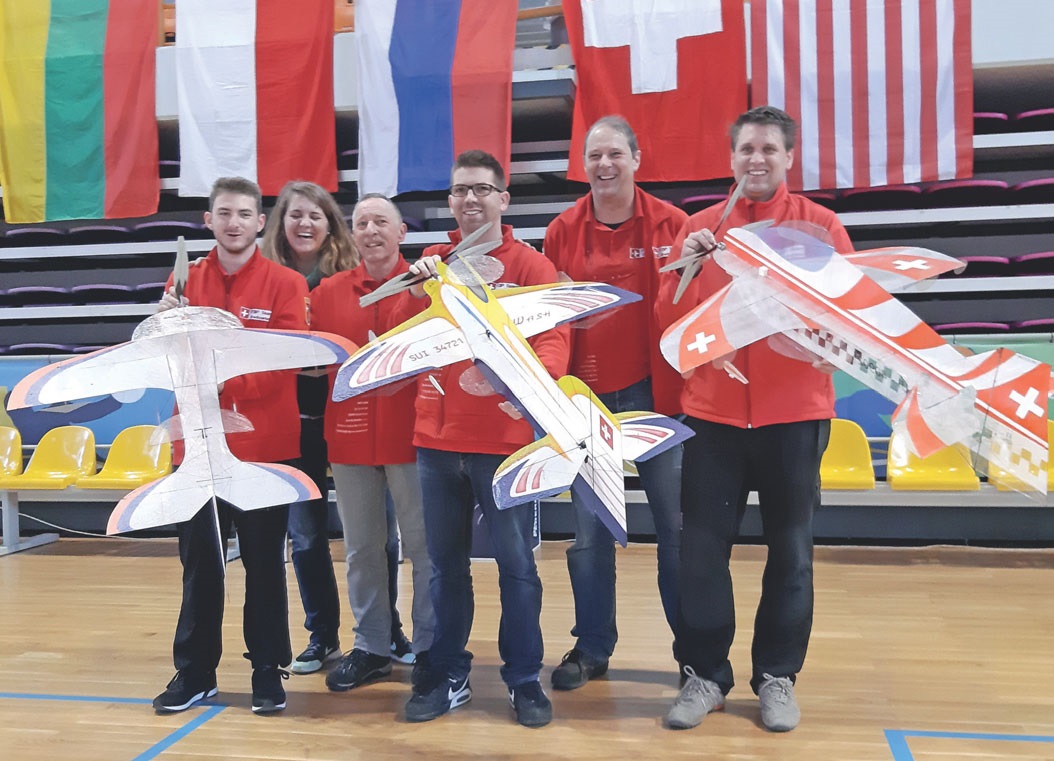
Pilots who make full use of the 5-minute time limit receive higher scores if they manage to fly their models slowly and flawlessly through the maneuvers of the AP-19 preliminary round program. Errors are more easily spotted in this slow-motion style. If the judges see almost none, top scores are awarded. Sylvain Passini masters this better than any of the other Swiss pilots and qualifies for the final with an outstanding 8th-place finish. The U.S. pilots Joseph Szczur and AC Glen also qualify for the final round with their balsa models. We hadn’t expected this improvement from the U.S. pilots compared to the last World Championship. The sensational team performance by the teams from France and Austria prevents us from sending one more pilot to the final. Philipp Schürmann, ranked 16th with 2,912 points, narrowly misses qualifying for the final. Markus Zolitsch (DE) just manages to make it into the top 12 finalists with 2,975 points. Sandro Veronelli delivered consistent flights with few errors, though lacking that slow-motion style, and secured 22nd place out of a total of 40 pilots with 2,777 points. We’re taking it in stride. Gernot Bruckmann—1st place with 3,243 points—and Donats Pauzuolis—2nd place with 3,083 points—once again manage to pull far ahead of the field in the final. Julien Hecht, in 3rd place with 2,974 points, leads the midfield, which also includes Sylvain Pasini with his outstanding 10th-place finish and 2,855 points.
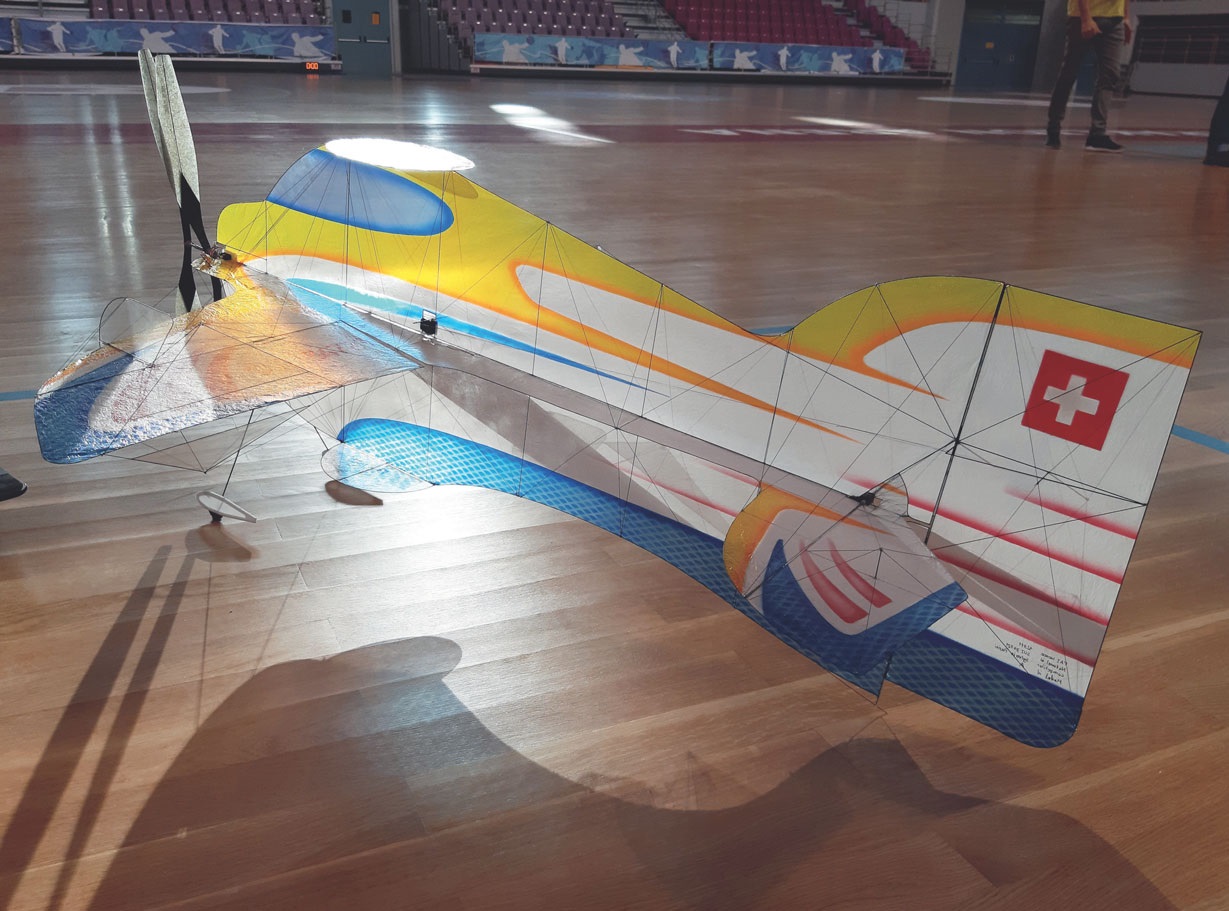
AFM models, too, have become technical marvels. While most models are still built in the conventional milled Depron style, they are otherwise packed with technology. Only Donatas goes to the trouble of building a carbon-fiber model for AFM as well. Variable-pitch propellers, vector control of the motor or propeller, and endless ribbons that trace the model’s flight path—which the model then flies through again—are all part of the technical equipment needed to compete at the top level. Confetti released in time with the music and LEDs that accentuate the music’s rhythm are also part of the mix.
In the AFM preliminary round, a two-minute piece of music must be edited together that includes fast and slow passages, into which the pilots weave their skills with flight maneuvers that are as complex and precise as possible. Even minor errors of just a few hundredths of a second are enough to send the model flying at an angle other than the intended one. This is definitely something for younger pilots, but it’s also a treat for older ones to watch such virtuosity. Which brings us to the topic of spectators: if there were any at all, only a handful ventured into Hall Two Arokia. A few more likely followed the live stream from Friday and Saturday remotely. The atmosphere wasn’t exactly the kind that would have brought out the very best in the pilots.
Unlike in F3P, the points from the preliminary round don’t count toward the AFM final. All finalists start from scratch again. Gernot had to settle for a zero-point round due to a technical failure with the ribbons—they didn’t detach and then got caught in the propeller while he was zapping around. In his second final routine, he performed a special “circle-to-center zapping maneuver” that only he can fly and which ranks among the most difficult maneuvers. All the top pilots performed maneuvers that were executed with precision and blended perfectly with the music. The Italians present programs well-synchronized with the music, though slightly lacking in complexity—which prevents top results but offers a welcome change of pace. Dissatisfied with his rankings in AFM and F3P, Filipo Materazzi is sitting out the final. Sylvain’s yodeling routine also managed to impress the judges. The pilots were intrigued by the LEDs attached to the nose cone, which were perfectly synchronized with the music. Only Sylvain has mastered this technique. Sylvain wasn’t able to refine and practice his second routine enough. Nevertheless, he achieved an excellent 7th-place finish. Szczur, from Team USA, tried using baby powder streamers on the wing tips.
Our goal was to defend our 4th-place finish in the team standings. Austria and France have deep, top-tier teams and are nearly unbeatable. Finland did not compete. Lithuania has only one top pilot, Donatas. We hoped to beat the U.S. Things turned out a little differently.
The ferry schedule allows us to make a few detours on our Monday afternoon trip from Piraeus to Patras. In Corinth, we find nearly deserted beaches where the pebbles glisten in the crystal-clear water. We marvel at how the Greeks managed to build the Corinth Canal in just 12 years, nearly 150 years ago. A few of us dare to look down from the steep cliffs into the turquoise-blue water. In total, we were on the road for more than 16 days—three weeks—from Tuesday, March 12, through Wednesday, March 27. A major investment of both time and money for just a few flights. But these are flights in which only the world’s top pilots can participate—and we are proud to count ourselves among them. It was only thanks to the financial support of the SMV that we were able to participate in this World Championship. Unfortunately, sponsors are also becoming increasingly difficult to find. But that shouldn’t come as a surprise when local specialty retailers are increasingly being left out. This makes our gratitude all the greater to the companies Glavak, Gloor&Amsler, and RB-Voltage, which supported us.
A huge thank you goes to the Swiss team for representing “little” Switzerland on the sporting stage, for the tremendous effort they put in, and for their performance at the World Championships in Greece. Bravo!
We have learned from a reliable source that Romania has submitted a bid to host the 2021 World Championships. The Swiss team would also be able to provide excellent infrastructure.
At present, however, we do not see any possibility of covering the personnel and financial costs. This makes it all the more fitting to extend our heartfelt praise to the team at the “Hellenic Aeronautical and Airsports Federation (ELAO),” led by Antonis Papadopolus, CIAM President, the three jury members—including Peter Uhlig—and the 10 judges deserve great praise for the fantastic event, whose organization left nothing to be desired and which culminated in a banquet with a warm, family-like atmosphere.
Ruedi Gallati


News from HEBU

TEAM MANAGER "THIS" BOSSHARD
 Rodito Nussbaumer

YOU KNOW WHAT I MEAN? 125 YEARS OF THE SWISS AERO CLUB
 Emil Giezendanner

F3A EUROPEAN CHAMPIONSHIPS IN ST-MACAIRE, FRANCE
 Matthias Bosshard

52. 2026 ALPS CUP
Emil Giezendanner
PRIDE AND GOOD IDEAS
 Markus Nussbaumer

ATOM, THE NEW DOUBLE-DECKER FROM CPLR
Matthias Bosshard
CORSAIR F4U – A WARBIRD WITH A MEMORABLE LOOK
Jürgen Rosenberger, Jürgen Prinz
SUMMER FUN 2026 AT MG USTER
Martin Wunderli
TRY-OUT DAY AT MFV WETTINGEN
Urs Keller
TWIN TOWN PARTNERSHIP
Wolfgang Voeller
BY YOUTH, FOR YOUTH
Lorena Betschen
SMALL, MODEL-LIKE SAILBOATS
Res Dauwalder
What's New at Leomotion.com

HORIZON HOBBY/LEMACO NEWS: MICRO OV-10 BRONCO 645 MM BY E-FLITE

COUPE DES ALPES – OBSERVE AND LEARN
Rodito Nussbaumer
EURO CONTEST GLIDER ACRO TOUR AUSTRIA 2026

INSIGHTS INTO THE HISTORY OF SEAPLANES

34th HAHNENMOOS ALPINE MODEL AIRPLANE CAMP
Res Dauwalder
WELCOME, NEW MEMBER!
Andrea Bolliger
FREE FLIGHT IN THE MIDDLE OF SUMMER
Urs Muntwyler
THE PC-21 STORY
Emil Giezendanner
NEWS FROM HEBU
 Julia Bucher

FROM 0 TO 100
Markus Nussbaumer
MEMORIES
Wolfgang Völler
NOS REGION – A HUB FOR ELECTRIC AVIATION
Emil Giezendanner
Have you almost forgotten about aircraft that take off and land vertically?
Emil Giezendanner
DO YOU KNOW WHAT I MEAN IN THE LAND OF SMILES?
Emil Giezendanner