
Special Motor Glider – Flying Experiences with the “Twin Explorer IV” Motor Glider
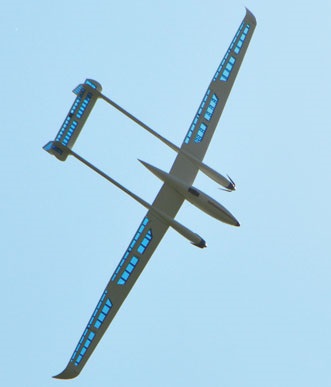
This special motor glider, made of wood and carbon fiber parts, is the improved and optimized version of the “Twin Explorer III,” which was described in detail in the February 2016 issue of *Aufwind*. It is characterized by excellent flight performance and impressive flight characteristics.
The maiden flight of the “Twin Explorer IV” took place in July 2019 at the model airfield in Müswangen. The center of gravity and EWD were adjusted according to the Vortex simulation program. The butterfly settings were as usual (flaps at 60°, ailerons up 10°), along with aileron differential. The launch from the cart went off without a hitch. Hans Baumann, an experienced first-flight pilot, attested that the motor glider exhibited flawless flight behavior.
The model flies as steady as a board and is characterized by high stability and good gliding characteristics. Thanks to its lower wing loading, the “Twin Explorer IV” climbs rapidly in thermal tubes, while still allowing for tight turns. In the event of a stall, the model reacts very forgivingly: during normal straight-and-level flight and with the elevator pulled back, it tips forward. During simulated tight landing approaches at a safe altitude and low speed, the model tilted sideways; after a momentary pull on the elevator, it was quickly back under control. The “Twin Explorer IV” is not a high-performance glider in the modern sense, but rather a magnificent glider with captivating flight characteristics and excellent aerodynamics.
| Wingspan: | 5.33 m |
| Overall length: | 2.36 m |
| Weight (ready for flight): | 12.30 kg |
| Wing loading: | 77.5 g/dm² |
| Wing profiles: | HQW-3012 66% HQA-3010 up to 100% |
| Wing profile for elevator: | NACA-0010 |
| Motors: | 2x E-Flite Outrunner Power 60 400 kV |
| Static thrust: | 2x 3.0 kg at 124 amps and 22 VDC |
| Batteries for propulsion: | 2x LiPo 3,800 mAh/6S in parallel |
| Batteries for the receiver: | 2x LiPo 2400 mAh/2S |
Thanks to the turbulators on the outer wing, the model exhibits very forgiving stall behavior: it remains controllable even if the inner wing stalls. If the turbulators are arranged across the entire wing, the stall speed generally decreases; however, controllability via the ailerons is no longer guaranteed: The model “loses control,” which is fatal near the ground (rest in peace, “Twin Explorer III”). I adopted the arrangement and geometry of the turbulators from examples in civilian sport aviation. I milled out the plastic plates (2 mm Graupner plastic sheet, white) and then secured them with white glue into the holes prepared using a drilling jig.
By using the Vortex simulation program, the desired characteristics of a model aircraft can be determined and optimized in advance. Based on positive practical experience, I decided to use the HQW-3012 airfoil profile for the inner wing throughout up to 66% of the wingspan and to transition from HQW-3012 to HQA-3010 on the outer wing. Additional dihedral on the outer wing set to -1 degree. The tried-and-true symmetrical NACA0010 profile is used for the elevator and rudder. Turbulators cannot be included in this program; however, the stall behavior in terms of controllability is significantly improved by the turbulators described earlier.
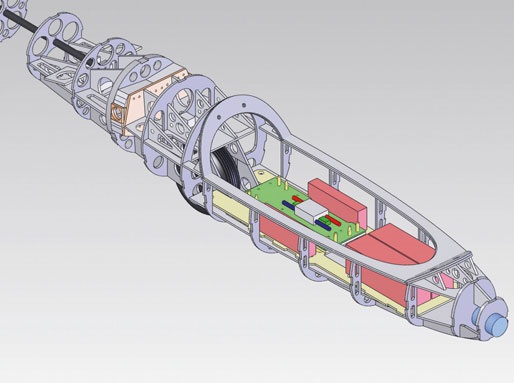
"Twin Explorer IV" is currently being replicated in Sweden, Germany, and Switzerland. All CAD files and a detailed, illustrated technical description serve as the basis for this project. All CAD files can be viewed using a free SolidWorks viewer. The cleaned-up *.dxf files serve as the starting point for a CNC milling machine. This replica project is recommended for experienced model builders.
www.solidworks.com
frankranis@gmx.de
www.ulmer-kunststoffteile.de
www.balsa.ch
www.mgmueswangen.ch
SolidWorks
CAD software, Frank Ranis, Vortex simulation software
, manufacturer of the canopy
, my wood supplier. Under “Customer Projects”: Twin Explorer III
, Müswangen Model Aircraft Club, “Pictures and Videos” from Q3 2019 and Q4 2019


TEAM MANAGER "THIS" BOSSHARD
 Rodito Nussbaumer

F3A EUROPEAN CHAMPIONSHIPS IN ST-MACAIRE, FRANCE
 Matthias Bosshard

News from HEBU

YOU KNOW WHAT I MEAN? 125 YEARS OF THE SWISS AERO CLUB
 Emil Giezendanner

SUMMER FUN 2026 AT MG USTER
Martin Wunderli
TRY-OUT DAY AT MFV WETTINGEN
Urs Keller
52. 2026 ALPS CUP
Emil Giezendanner
BY YOUTH, FOR YOUTH
Lorena Betschen
ATOM, THE NEW DOUBLE-DECKER FROM CPLR
Matthias Bosshard
CORSAIR F4U – A WARBIRD WITH A MEMORABLE LOOK
Jürgen Rosenberger, Jürgen Prinz
SMALL, MODEL-LIKE SAILBOATS
Res Dauwalder
What's New at Leomotion.com

TWIN TOWN PARTNERSHIP
Wolfgang Voeller
EURO CONTEST GLIDER ACRO TOUR AUSTRIA 2026

INSIGHTS INTO THE HISTORY OF SEAPLANES

34th HAHNENMOOS ALPINE MODEL AIRPLANE CAMP
Res Dauwalder
HORIZON HOBBY/LEMACO NEWS: MICRO OV-10 BRONCO 645 MM BY E-FLITE

COUPE DES ALPES – OBSERVE AND LEARN
Rodito Nussbaumer
PRIDE AND GOOD IDEAS
 Markus Nussbaumer

FREE FLIGHT IN THE MIDDLE OF SUMMER
Urs Muntwyler
THE PC-21 STORY
Emil Giezendanner
WELCOME, NEW MEMBER!
Andrea Bolliger
NEWS FROM HEBU
 Julia Bucher

FROM 0 TO 100
Markus Nussbaumer
MEMORIES
Wolfgang Völler
NOS REGION – A HUB FOR ELECTRIC AVIATION
Emil Giezendanner
Have you almost forgotten about aircraft that take off and land vertically?
Emil Giezendanner
70 YEARS OF THE NIDWALDEN MODEL AIRPLANE CLUB
Martin Barmettler