
Overcome a few hurdles
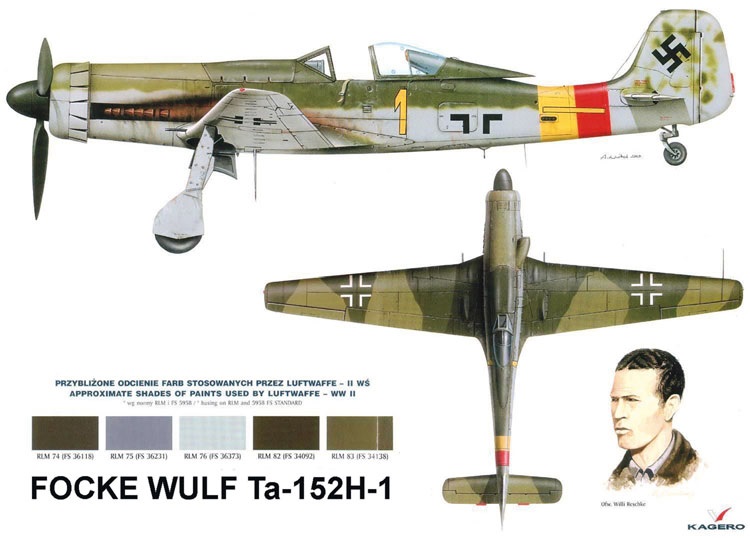
Willi Reschke was born on February 3, 1922. In February 1940, at the age of 18, he volunteered for the Luftwaffe with the goal of becoming a fighter pilot. He flew with Fighter Wing 301 “Wilde Sau” and was one of the few pilots to fly the Focke-Wulf Ta 152 in combat during the final phase of World War II. During his missions, he was shot down eight times, resulting in four crash landings and four parachute jumps. Willi Reschke survived the war and died on July 5, 2017, in Thuringia.
In a previous report, I mentioned that Roger Steiner has a fondness for German World War II aircraft. Now he’s taking on the Focke-Wulf Ta 152 project. Over the course of about two years, Roger has been working on his model on and off, overcoming several hurdles along the way. With a great deal of patience and craftsmanship, Roger once again presents us with a unique model airplane.
The Focke-Wulf is equipped with a truly powerful motor, allowing the model to take off after just a few meters. Roger decides on the spur of the moment to launch it. Although he’s very nervous, he flies his masterpiece calmly and without taking any risks over the MB Buttikon airfield. The model flies very smoothly; the electric motor would have enough power for 160 km/h, though Roger hasn’t tried that yet, of course. It’s time, and Roger begins his approach for landing; the model is still traveling a bit fast, but it touches down gently and rolls to a stop. Roger’s hands are shaking as I’ve rarely seen before,
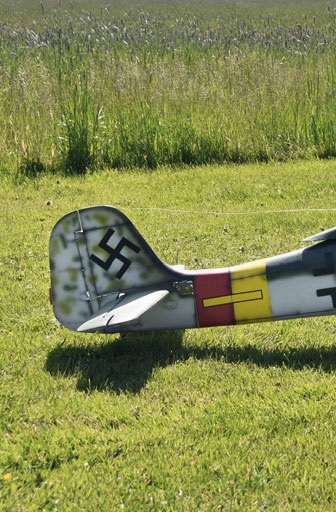
The relief is written all over his face.
On subsequent flights, Roger takes more and more risks as he gets to know his Focke-Wulf better. Caution is advised during landing, however—the model doesn’t like it when it’s going too slow.
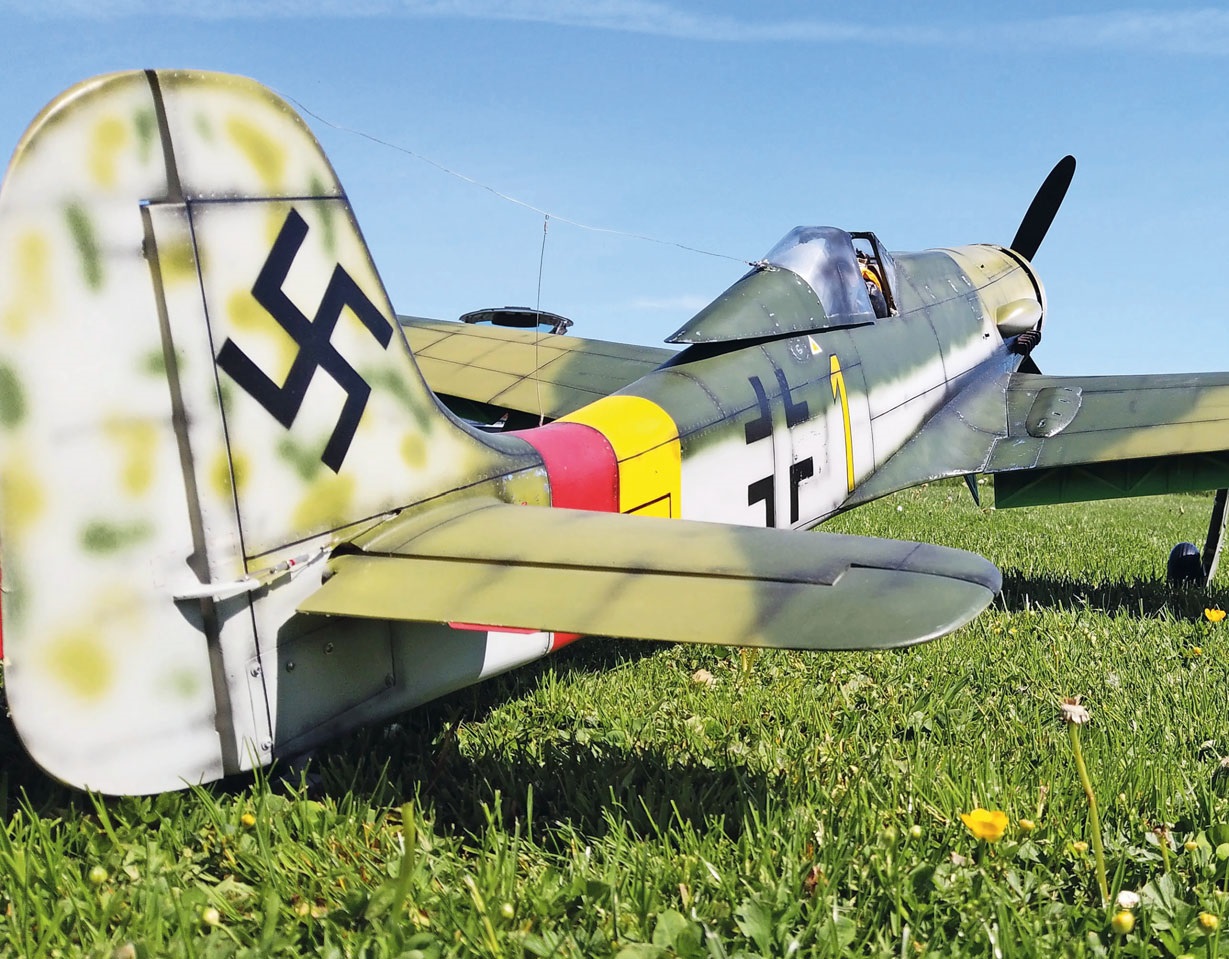
| Wingspan: | 2,380 mm |
| Length: | 1,800 mm |
| Weight: | 8,000 g |
| Motor: | Leopard LC8072 175KV |
| Battery: | Fullymax 10S 5,000 mAh |
| Landing gear mechanism: | Electron ER-40 evo |
| Landing gear struts: | Robart Struts, modified to ensure the correct suspension angle |
| Max. Speed: | 160 km/h |
| Cruising speed: | approx. 90 km/h |
▲
The plans are by David P. Andersen.
http://www.mnbigbirds.com


TEAM MANAGER "THIS" BOSSHARD
 Rodito Nussbaumer

SUMMER FUN 2026 AT MG USTER
Martin Wunderli
52. 2026 ALPS CUP
 Emil Giezendanner

ATOM, THE NEW DOUBLE-DECKER FROM CPLR
 Matthias Bosshard

INSIGHTS INTO THE HISTORY OF SEAPLANES

34th HAHNENMOOS ALPINE MODEL AIRPLANE CAMP
Res Dauwalder
CORSAIR F4U – A WARBIRD WITH A MEMORABLE LOOK
Jürgen Rosenberger, Jürgen Prinz
SMALL, MODEL-LIKE SAILBOATS
Res Dauwalder
F3A EUROPEAN CHAMPIONSHIPS IN ST-MACAIRE, FRANCE
Matthias Bosshard
What's New at Leomotion.com

HORIZON HOBBY/LEMACO NEWS: MICRO OV-10 BRONCO 645 MM BY E-FLITE

PRIDE AND GOOD IDEAS
 Markus Nussbaumer

News from HEBU

BY YOUTH, FOR YOUTH
Lorena Betschen
YOU KNOW WHAT I MEAN? 125 YEARS OF THE SWISS AERO CLUB
Emil Giezendanner
TRY-OUT DAY AT MFV WETTINGEN
Urs Keller
FREE FLIGHT IN THE MIDDLE OF SUMMER
Urs Muntwyler
THE PC-21 STORY
Emil Giezendanner
TWIN TOWN PARTNERSHIP
Wolfgang Voeller
EURO CONTEST GLIDER ACRO TOUR AUSTRIA 2026

WELCOME, NEW MEMBER!
Andrea Bolliger
COUPE DES ALPES – OBSERVE AND LEARN
Rodito Nussbaumer
NEWS FROM HEBU
 Julia Bucher

FROM 0 TO 100
Markus Nussbaumer
NOS REGION – A HUB FOR ELECTRIC AVIATION
Emil Giezendanner
MEMORIES
Wolfgang Völler
Have you almost forgotten about aircraft that take off and land vertically?
Emil Giezendanner
70 YEARS OF THE NIDWALDEN MODEL AIRPLANE CLUB
Martin Barmettler