
Slow Servo Movements
For airbrakes, retractable landing gear, impeller drives, etc., users often want to slow down certain functions. Jeti, Futaba, and Graupner have long offered transmitters with programmable “Servo Speed.” Multiplex / Hitec had, until recently, been pointing to their programmable digital servos (Dieter Wörner, Friedrichshafen Trade Fair 2017), but things seem to be changing here as well: The latest software update, V1.40, for the Multiplex COCKPIT SX Series 7/9/12 now also includes a “Servo Slow up to 12s” feature.
However, slow servo movements are also possible even if only a basic remote control is available: A Servo-Slow module connected between the receiver and the servo performs this function.
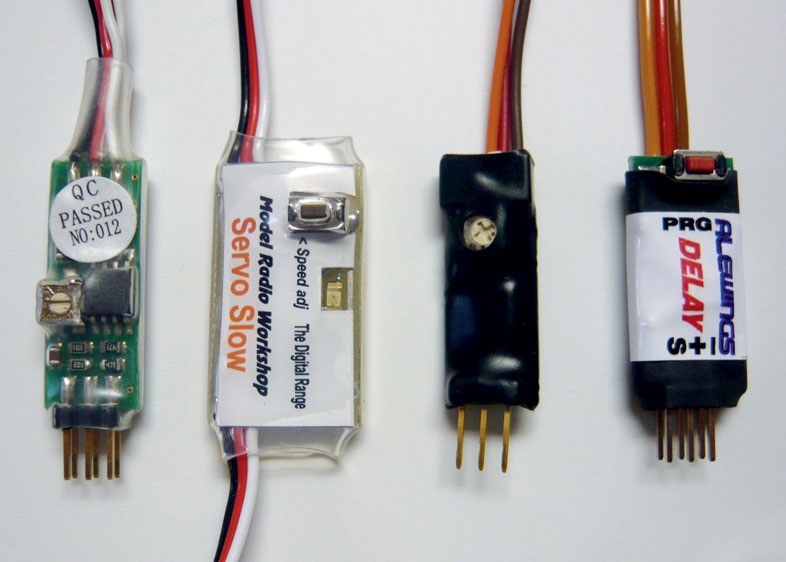
While searching for such a module, I came across the HP Servo-Slow from Hyperion in the old Lindinger catalog. Unfortunately, the two units that arrived from Lindinger shortly afterward did not include an “instruction sheet.” (I hadn’t expected a German instruction manual either.) However, two jack cables and two servo plugs suggested that this might be a dual module. So I had no choice but to take a chance, connect the servo tester and a servo somewhere, and give it a try. But even with a lot of patience and gentle coaxing, I couldn’t get anything more out of the two modules than a servo tremor. When I called Lindinger, a friendly female voice confirmed that there really are no instructions for this product and that I wasn’t the only one whose module wasn’t working properly: “Send the units back to us—we’ll inspect them and either replace them or issue a credit.” I received a credit. During my subsequent online research and inquiries at a specialty store, I came across three additional products, this time from European manufacturers. I still could hardly believe that the product from Hyperion (a well-known manufacturer of electric motors and LiPo batteries) wasn’t working, so I ordered another sample from Brack. The experiences I had with the two HP Servo-Slow units
had prompted me to take a closer look at these four products, though I limited my evaluation to their functionality when used with my Multiplex Cockpit SX (older model, without a touchscreen).
HP-Servo-Slow (Hyperion, China)
Of course, I’m now curious to see how Hyperion’s third prototype will perform: Channel 1 again exhibits only servo
jitter and cuts out after a few seconds. Channel 2 works for a while with jerky movements; after turning the Unitest 2 off and back on, Channel 2 remains in jitter mode with high current draw from the connected servo. As will become clear later (see “Servo Pulse Measurement”), the HP-Servo-Slow generates a very low pulse frequency of only 14 Hz, which my servos obviously can’t handle properly. In any case, Hyperion does not appear to be compatible with Multiplex.
Servo-Slow (Model Radio Workshop, England)
Mike Ridley’s product is built on a single-sided circuit board and, unlike the others, features a connection cable with a plug for a servo on the output side. However, the output amplifier is powerful enough to drive two or more servos using a Y-cable (see load test). The cable cross-section of only 0.14 mm² naturally sets limits here.
The product comes with an easy-to-read and understandable English-language instruction manual. Unfortunately, the technical specifications are missing from the manual; these can only be found on the manufacturer’s website.
Programming is very simple: press the button and count the LED pulses. Drawback: The runtime can only be set in 1-second intervals, meaning the shortest adjustable runtime is 1 second. Here, I would prefer a finer resolution of 0.5 seconds per pulse.
Delay Module (Simprop, Germany)
The Simprop module includes a “servo booster” (which doubles the pulse rate) that can be activated via a slide switch, though I have not tested it. The output amplifier and 0.25-mm² cable are well-sized here, so that two or more servos can be operated in parallel using a Y-cable.
The included bilingual operating instructions describe five different servo modules and are easy to understand; they
It also includes the technical specifications. However, the font could be a bit larger, and you’ll need a magnifying glass to read the text “Manufacturer’s Declaration for Consumers.”
Setting the time using the trimmer potentiometer isn’t quite as easy as one might expect: The rotation angle isn’t proportional to the time adjustment range (center position approx. 0.5 s). The longer the desired runtime, the more difficult it is to set it.
Servo Delay (Alewings, Italy)
The module supplied by Alessandro Torri has a 0.25-mm² cable on the receiver side and features two servo connectors on the output side—Y-cable included! The servo pulses drop only slightly under load; here, too, the product impresses.
Caution: The maximum supply voltage is only 6 V (4 NiMH cells)!
The instruction manual is truly Italian: The font size of the included Italian manual reminds me of the old SBB timetables (glasses and a magnifying glass required). On the Alewings website, you’ll find another set of instructions: the mix of English and Italian leaves you more confused than enlightened. But as my grandmother used to say, “The proof is in the pudding.” After extensive experimentation and repeated readings of the manual, you come to the realization: In programming mode, you can use the button to increase or decrease the runtime in 0.5-second intervals, depending on the servo pulse duration (transmitter stick position).
| Servo Tester: | UniTest 2 (SM Modellbau) with 4×NiMH, MPX uni servo pulses (TP=18 ms) |
| Measuring Instruments: | Oscilloscope and digital multimeter |
| Servo (position tracking): | BMS380MG modified (external electrical potentiometer tap) |
| Servos (function): | Analog: Bluebird BMS380MG; Dymond D200; Hitec HS485MG Digital: Hitec D485 |
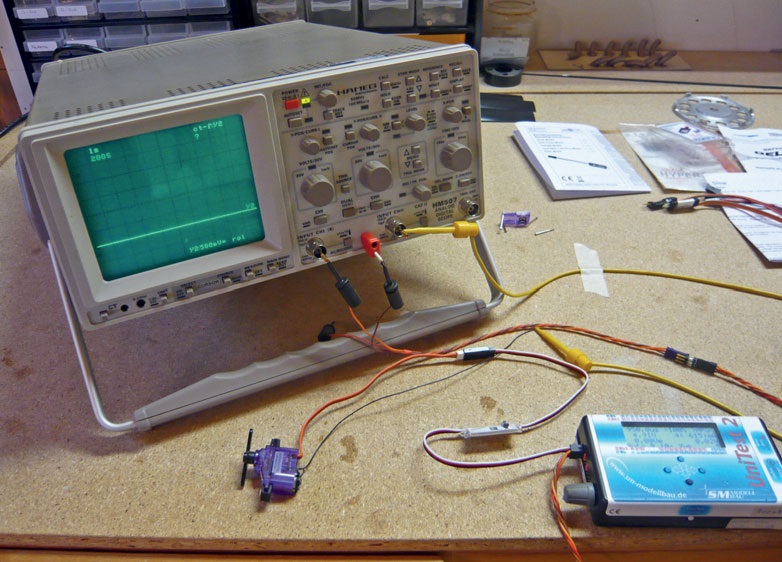
Self-Consumption
The British model is the clear winner here, but the self-consumption is so low for all brands that it is negligible under normal operating conditions.
Servo Travel Recording
For this test, I programmed the modules to have a travel time (from limit switch to limit switch) of approximately 2 s. Using the servo tester, the rotation direction is manually reversed after 4 seconds, and the voltage at the BMS380MG’s potentiometer is recorded as a function of time. The image on the right shows what we expect from a Servo-Slow module: uniform rotation—
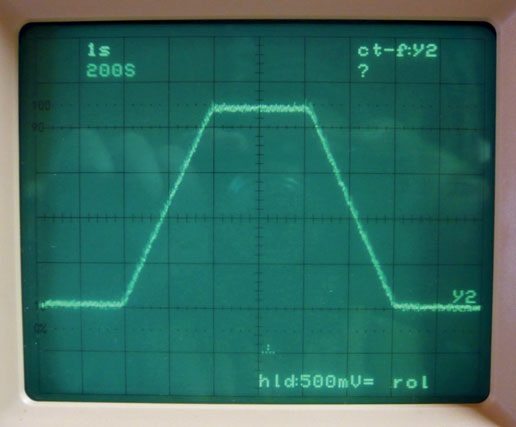
Speed in both directions without overshoot when reaching the end position. The MRW and Alewings brands show hardly any differences from Simprop.
Servo Pulses
Simprop and Alewings demonstrate perfect technical solutions: The output pulse (below) follows the input pulse
(top). MRW reacts slightly slower and with varying delays (4.5 ms), though this is insignificant in practice.
All three European modules feature powerful output drivers, allowing two or more servos to be driven in parallel without any problems.
The servo pulse measurements also highlight Hyperion’s problem: The output—
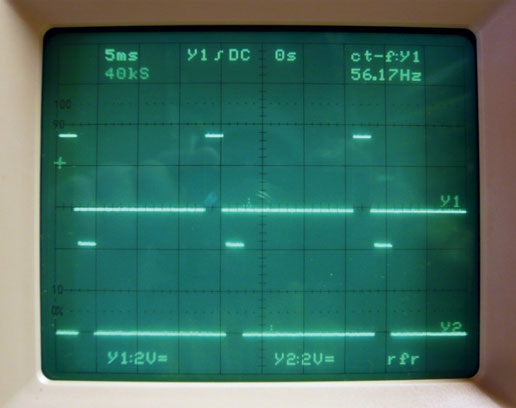
The pulse frequency is only one-quarter that of the servo tester (picture above)! It's no surprise that servos can't do anything useful with it. Also, the pulse amplitude
amplitude under load isn’t exactly reassuring.
All three European products perform their main function
flawlessly and leave a good impression. In addition to design and connection technology, the differences lie primarily in the type of runtime programming. The chinesi,
model, on the other hand, is more suited for bargain hunters and model builders looking for adventure and thrills.
Ruedi Schmid
| Manufacturer | Hyperion (CN) | MRW (GB) | Simprop (D) | Alewings (I) |
| Name, Type | HP Servo-Slow S070011C | Servo-Slow MRW 09 | Delay Module 011 080 9 | Servo Delay E0055A |
| Operating Instructions | None | E | D+E | I,(E) |
| Operating temperature | N/A | N/A | N/A | -10 ... +60 °C |
| Supply voltage | N/A | 4.4–6.3 V (4–5 NiMH) | 4.8–6 V nom. (4–5 NiMH) | 4.8–6 V max.! (5.4 V stable) |
| Current consumption @ 5.03 V* | 5.5 mA | 0.8 mA | 5.3 mA | 2.8 mA |
| Time setting | Trim potentiometer | Button, LED | Trim potentiometer | Button + transmitter control stick |
| Operating time | N/A | 1 ... 10 s | 0 ... 10 s | 0 ... 60 s |
Servo pulses* – Frequency – Delay | 14 Hz! 5 ms | ~56 Hz (jitter) 4 ... 5 ms | 56 Hz 0.5 ms | 56 Hz 0.5 ms |
| Pulse amplitude* without load with load 900 Ω | 4.0 V 2.2 V! | 4.8 V 4.0 V | 4.0 V 3.8 V | 4.1 V 3.7 V |
| Weight, including cable/plug* | 4.7 g | 7.0 g | 3.8 g | 4.9 g |
| Dimensions (without plug) | 31 × 11 × 6 mm | 37 × 18 × 8 mm | 28 × 11 × 6 mm | 27 × 14 × 8 mm |
| Connection cable* | 11 cm/0.14 mm² | 2 × 17 cm/0.14 mm² | 17 cm/0.25 mm² | 17 cm/0.25 mm² |
| Supplier | Lindinger (A) | MRW (UK) | Howald, Thun | Alewings (I) |
| Price | €10.82 | £ 13.30 | CHF 28.50 | €17.00 |
| Shipping to Switzerland | € 9.95 | £ 5.00 | – | € 8.– |
* Our own measurements


News from HEBU

TEAM MANAGER "THIS" BOSSHARD
 Rodito Nussbaumer

YOU KNOW WHAT I MEAN? 125 YEARS OF THE SWISS AERO CLUB
 Emil Giezendanner

HORIZON HOBBY/LEMACO NEWS: MICRO OV-10 BRONCO 645 MM BY E-FLITE

PRIDE AND GOOD IDEAS
 Markus Nussbaumer

34th HAHNENMOOS ALPINE MODEL AIRPLANE CAMP
Res Dauwalder
TRY-OUT DAY AT MFV WETTINGEN
Urs Keller
F3A EUROPEAN CHAMPIONSHIPS IN ST-MACAIRE, FRANCE
 Matthias Bosshard

52. 2026 ALPS CUP
Emil Giezendanner
ATOM, THE NEW DOUBLE-DECKER FROM CPLR
Matthias Bosshard
SUMMER FUN 2026 AT MG USTER
Martin Wunderli
What's New at Leomotion.com

THE PC-21 STORY
Emil Giezendanner
COUPE DES ALPES – OBSERVE AND LEARN
Rodito Nussbaumer
TWIN TOWN PARTNERSHIP
Wolfgang Voeller
EURO CONTEST GLIDER ACRO TOUR AUSTRIA 2026

BY YOUTH, FOR YOUTH
Lorena Betschen
CORSAIR F4U – A WARBIRD WITH A MEMORABLE LOOK
Jürgen Rosenberger, Jürgen Prinz
SMALL, MODEL-LIKE SAILBOATS
Res Dauwalder
WELCOME, NEW MEMBER!
Andrea Bolliger
FREE FLIGHT IN THE MIDDLE OF SUMMER
Urs Muntwyler
INSIGHTS INTO THE HISTORY OF SEAPLANES

NEWS FROM HEBU
 Julia Bucher

FROM 0 TO 100
Markus Nussbaumer
MEMORIES
Wolfgang Völler
NOS REGION – A HUB FOR ELECTRIC AVIATION
Emil Giezendanner
DO YOU KNOW WHAT I MEAN IN THE LAND OF SMILES?
Emil Giezendanner
A SPECTACULAR F3A WORLD CUP IN THE PRINCIPALITY OF LIECHTENSTEIN
Emil Giezendanner