
F3B World Championship in Nardt
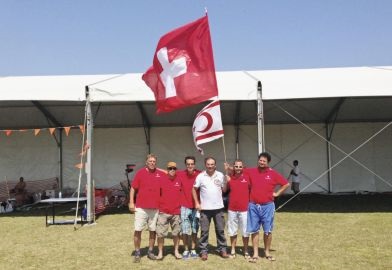
Germany wins, ahead of Austria and the U.S. The Swiss team finishes in the disappointing 4th place.
17 nations and a total of 54 pilots competed in 8 rounds for the world championship title. The competition itself took place at a large-scale glider airfield in Nardt, near Hoyerswerda, east of Dresden, which was closed to other flight operations for the duration of the World Championships.
As was the case in 2009, the scoring program was once again made available to our former Swiss World Championship competitor Christian Müller (see http://f3b-wm-2013.rcsolutions.ch/d/wm2013). This made it possible to evaluate the pilots’ performances against one another based on various criteria. Often, the results were online faster than it took the pilots to get from the airfield to their tents.
The live TV coverage, hosted by Martin Weberschock and Uli Helfrich, was a completely new feature. The livestream can still be viewed today as a recording at http://www.f3b-wm-2013.de/ under the “Livestream” menu item. Around 140,000 visitors were able to cheer on their teams live from their computers at home.
Just as the World Cup was about to begin, there was a brief but heavy downpour, which caused a delay in the start of the competition. On the second night, there was even a violent storm that destroyed the tent for the livestream and part of the TV production equipment. For two days, we had to contend with near-calm conditions, extreme crosswinds, and sweltering heat (37 °C in the shade). It wasn’t until Thursday and Friday that the wind picked up a bit, bringing some relief from the heat. Overall, the weather remained dry throughout the competition (with the exception of early Monday morning). The awards ceremony on the field late Friday evening took place in the rain. The flying conditions were extremely challenging. Choosing the right launch window and the correct side for the cross-country flight were decisive for the competition. In the speed category, the conditions weren’t always balanced, but the fact that the speed round was flown in reverse order of the current standings helped ease the situation somewhat.
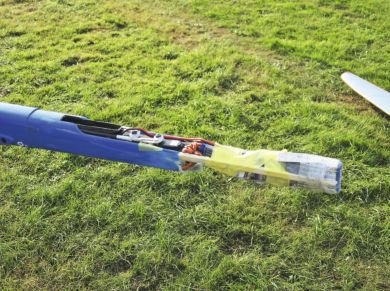
Amid turbulent conditions during the speed event in Round 1, Niklaus Huggler’s model touched the ground as it exited the final B-turn and crashed. Unfortunately, the nose section—containing the battery and receiver—could not be found. Since models cannot be changed during a heat, it was provisionally repaired for the remaining disciplines in Round 1: endurance flight and distance flight. This early setback in the Speed event weighed heavily on Niklaus’s subsequent Speed flights, though he regained his former Speed form as the competition progressed. Roland Hofmann collided during the Distance Flight in Round 1 and damaged the wing. He was able to continue in the World Championships with a replacement model. The crowning finale of our run of bad luck was the penalty incurred by Andreas Böhlen in Round 5, when he landed in the safety zone with one wing during the distance flight.
| Adult Team Standings: | |||
|---|---|---|---|
| 1st place | Germany | 61,135.35 | |
| 2nd place | Austria | 60,056.22 | 1,079.13 |
| 3rd place | USA | 59,747.56 | 308.66 |
| 4th place | Switzerland | 59,633.41 | 114.15 |
| 5th place | CZE | 59,284.10 | 349.31 |
| Adult Individual Standings: | |||
|---|---|---|---|
| 1st place | Andreas Herrig (GER) | 20,752 | |
| 2nd place | Martin Herrig (GER) | 20,717 | 35 |
| 3rd place | Thomas Dylla (GER) | 20566 | 151 |
| 4th place | Jürgen Pölzl (AUT) | 20349 | 217 |
| 5th place | Roland Hofmann (SUI) | 20335 | 14 |
| 6th place | Tom Kiesling (USA) | 20270 | 65 |
| 7th place | Andreas Böhlen (SUI) | 20209 | 61 (300 penalty) |
| 34th place | Niklaus Huggler (SUI) | 19,088 |
After 8 rounds with one score discarded (a maximum of 21,000 points possible), the results were in: For the first time, juniors (ages 18 and under) competed for the Junior World Championship title at a World Championship. Each nation was allowed to bring a maximum of one junior to the World Championship. This junior counted toward the team score (as was the case with Team Austria, featuring world-class pilot and junior champion Berni Flixeder), provided that the junior’s score was better than that of the team’s lowest-scoring adult pilot. In the end, the Swiss pilots were just a little short on luck to move even further up the rankings.
Looking back, it was a very well-organized World Championship. As in 2003 and 2011, more than seven rounds were flown. The next host, the Netherlands in 2015, will be judged by this standard.
We would like to extend our special thanks to the Swiss Model Flying Association (SMV), which, as always, supported us with a substantial contribution, and to our sponsors, without whom participating in the World Championships would hardly be possible.
Thomas Schorb


News from HEBU

TEAM MANAGER "THIS" BOSSHARD
 Rodito Nussbaumer

YOU KNOW WHAT I MEAN? 125 YEARS OF THE SWISS AERO CLUB
 Emil Giezendanner

SUMMER FUN 2026 AT MG USTER
Martin Wunderli
52. 2026 ALPS CUP
Emil Giezendanner
BY YOUTH, FOR YOUTH
Lorena Betschen
CORSAIR F4U – A WARBIRD WITH A MEMORABLE LOOK
Jürgen Rosenberger, Jürgen Prinz
SMALL, MODEL-LIKE SAILBOATS
Res Dauwalder
TRY-OUT DAY AT MFV WETTINGEN
Urs Keller
What's New at Leomotion.com

ATOM, THE NEW DOUBLE-DECKER FROM CPLR
 Matthias Bosshard

INSIGHTS INTO THE HISTORY OF SEAPLANES

34th HAHNENMOOS ALPINE MODEL AIRPLANE CAMP
Res Dauwalder
F3A EUROPEAN CHAMPIONSHIPS IN ST-MACAIRE, FRANCE
Matthias Bosshard
HORIZON HOBBY/LEMACO NEWS: MICRO OV-10 BRONCO 645 MM BY E-FLITE

COUPE DES ALPES – OBSERVE AND LEARN
Rodito Nussbaumer
PRIDE AND GOOD IDEAS
 Markus Nussbaumer

EURO CONTEST GLIDER ACRO TOUR AUSTRIA 2026

FREE FLIGHT IN THE MIDDLE OF SUMMER
Urs Muntwyler
THE PC-21 STORY
Emil Giezendanner
TWIN TOWN PARTNERSHIP
Wolfgang Voeller
WELCOME, NEW MEMBER!
Andrea Bolliger
NEWS FROM HEBU
 Julia Bucher

FROM 0 TO 100
Markus Nussbaumer
MEMORIES
Wolfgang Völler
NOS REGION – A HUB FOR ELECTRIC AVIATION
Emil Giezendanner
Have you almost forgotten about aircraft that take off and land vertically?
Emil Giezendanner
70 YEARS OF THE NIDWALDEN MODEL AIRPLANE CLUB
Martin Barmettler