
GETTING STARTED IN SAILING ACROBATICS
Silent, precise, harmonious—that’s sailplane aerobatics
Sailplane aerobatics is a fascinating and challenging form of model flying that is captivating more and more model pilots.

Would you be interested in mastering a glider model and flying precise aerobatic maneuvers? Swissakro Connection is here to help. They’re hosting open house days again this year. Whether you’re a beginner, an intermediate pilot, or a seasoned competitor, everyone is welcome. In the following article by Andreas Schaerer, you can read about how to best set up your model.
Sailplane aerobatics is considered the pinnacle of aerobatics. When performed by an expert, it appears calm, elegant, and seemingly effortless. However, for this silent art form to look truly precise and be enjoyable, it takes more than just practice and a suitable model—the correct model setup is crucial. I’d like to share a few tips with you on this. I’m assuming that the model you’ve chosen is fundamentally suitable for aerobatics: sufficiently sturdy, with a slight V-shape, sufficiently large control surfaces, and decent inverted flight characteristics. If that’s the case, you can certainly adjust it so that the maneuvers can be flown cleanly and under control. We’ll base our adjustments on the basic maneuvers of glider aerobatics; we’ll deliberately leave out expert maneuvers like inverted rolls for now.
Important: The settings for aerobatics are not the same as those for towing or landing. That’s why I’ve always programmed two flight modes for my aerobatic gliders:
- Takeoff and landing: Easy to handle, stress-free, and willing to turn. And enough elevator trim so that the model flies well above the motorized aircraft during towing.
- Acro: Exclusively for aerobatics
I’ve assigned these flight modes to a separate switch, which I set to the “Acro” position before starting the aerobatics program and back to the “Takeoff & Landing” position before landing. Other pilots have combined these switches with the tow hook release. The following settings all refer to the “Acro” position.
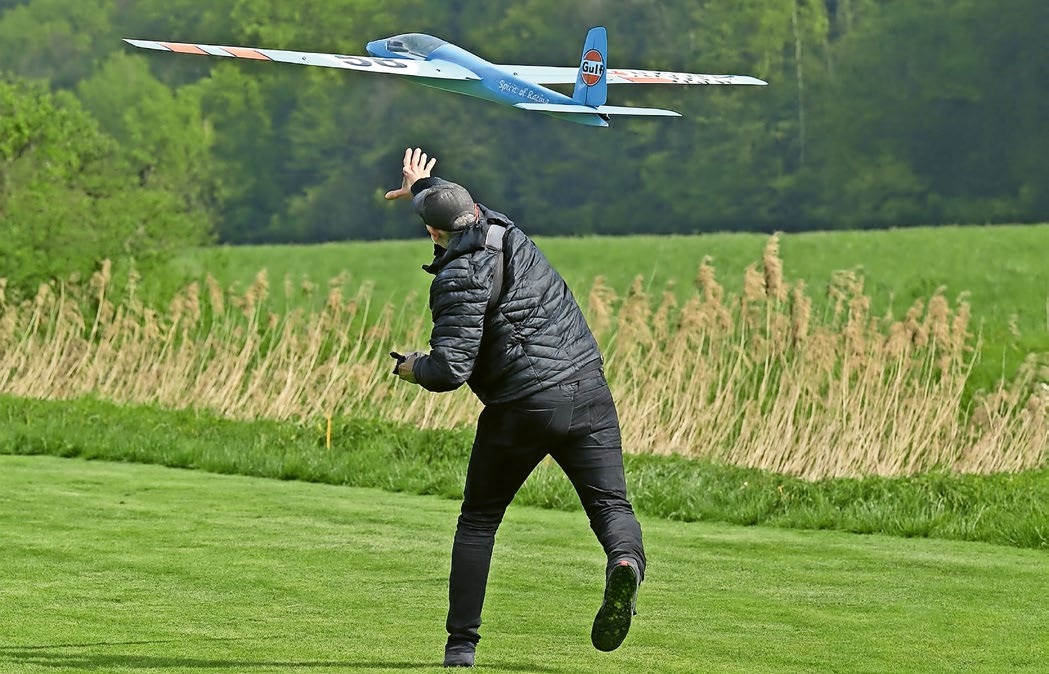
What sounds simple is actually quite challenging in practice—but absolutely essential. Straight lines must be as straight as a string. Any wobbles or curves are immediately spotted by the judges and mercilessly penalized. The model must therefore be able to fly precise straight lines: horizontally, at 45° up and down, and vertically up and down. In acro mode, I trim the elevator enough so that the model neither recovers nor becomes steeper during a 45° dive. It should maintain the set angle exactly—even in a vertical dive. I test this setting in all directions. It forms the basis for clean transitions between maneuvers.
For turns and radii—such as loops and humpties—I adjust the elevator deflection so that tight radii are possible at high speeds without stalling, and so that smooth, even maneuvers are still achieved at low speeds. Both positive and negative. Especially for negative maneuvers, it can help to let the ailerons move slightly upward along with the elevator deflection. On my 5.80-meter Swift, that’s about 5–10 mm of negative aileron deflection at full elevator—with a huge effect.
Rolls must be one thing above all else: straight. No deviation upward, downward, or sideways. The key here is correctly adjusted aileron differential—ideally close to zero. Here’s how I adjust it: fly away from me at high speed (so that I see the model directly from behind), then pull into a 45° climb and perform a half roll upward at that angle. From behind, you can easily spot any lateral deviations. If they occur, one aileron is applying more brake than the other. Adjust the aileron differential until no deviation is visible during both left- and right-handed rolls.
...the rudder is the key. You want as much rudder deflection as possible—about 45° is ideal. Once the deflection is right, the only thing left to do in flight is to time the full application of the rudder correctly.
In Acro flight mode, Expo is very useful for stabilizing the model at high speeds—especially on the elevator and ailerons. On my competition Swift, I fly with about 40% Expo in the Acro position.
Well, I hope you have a lot of fun setting it up—and performing your first clean aerobatic maneuvers!
This year, Swissakro Connection is offering two introductory courses in glider aerobatics. Interested model pilots are invited to explore the world of aerobatics—whether with their own glider or in a two-seat glider. Everyone is welcome. ■
The location and date are listed on the Swissakro website: www.swissakro.ch.
Register on the website of the Swiss Model Flying Association.
For the Swissakro Connection
, Hans Gratwohl; photos by Kusi Brönnimann


TEAM MANAGER "THIS" BOSSHARD
 Rodito Nussbaumer

52. 2026 ALPS CUP
 Emil Giezendanner

ATOM, THE NEW DOUBLE-DECKER FROM CPLR
 Matthias Bosshard

INSIGHTS INTO THE HISTORY OF SEAPLANES

34th HAHNENMOOS ALPINE MODEL AIRPLANE CAMP
Res Dauwalder
CORSAIR F4U – A WARBIRD WITH A MEMORABLE LOOK
Jürgen Rosenberger, Jürgen Prinz
SUMMER FUN 2026 AT MG USTER
Martin Wunderli
F3A EUROPEAN CHAMPIONSHIPS IN ST-MACAIRE, FRANCE
Matthias Bosshard
What's New at Leomotion.com

HORIZON HOBBY/LEMACO NEWS: MICRO OV-10 BRONCO 645 MM BY E-FLITE

PRIDE AND GOOD IDEAS
 Markus Nussbaumer

News from HEBU

BY YOUTH, FOR YOUTH
Lorena Betschen
YOU KNOW WHAT I MEAN? 125 YEARS OF THE SWISS AERO CLUB
Emil Giezendanner
SMALL, MODEL-LIKE SAILBOATS
Res Dauwalder
TRY-OUT DAY AT MFV WETTINGEN
Urs Keller
FREE FLIGHT IN THE MIDDLE OF SUMMER
Urs Muntwyler
THE PC-21 STORY
Emil Giezendanner
TWIN TOWN PARTNERSHIP
Wolfgang Voeller
EURO CONTEST GLIDER ACRO TOUR AUSTRIA 2026

WELCOME, NEW MEMBER!
Andrea Bolliger
COUPE DES ALPES – OBSERVE AND LEARN
Rodito Nussbaumer
NEWS FROM HEBU
 Julia Bucher

FROM 0 TO 100
Markus Nussbaumer
NOS REGION – A HUB FOR ELECTRIC AVIATION
Emil Giezendanner
MEMORIES
Wolfgang Völler
Have you almost forgotten about aircraft that take off and land vertically?
Emil Giezendanner
70 YEARS OF THE NIDWALDEN MODEL AIRPLANE CLUB
Martin Barmettler