
An FAI World Cup Lives Up to Its Name
Gürbe Cup: An FAI World Cup Successfully Concluded in Mühlethurnen. For two days, the Gürbe Valley was the focal point of the global free flight community.
From October 27–29, 2023, the MV Bern organized an FAI World Cup in the F1ABC and F1Q categories in Mühlethurnen in the Gürbetal valley, south of Bern. Originally, 118 competitors had registered. The well-known Andrist family of free-flight enthusiasts and members of the MV Bern were responsible for organizing the event. The competition director was the renowned F1E pilot Andreas Tschanz from Burgdorf, a member of the MV Bern. Dominik Andrist himself lives in the municipality of Mühlethurnen. In order to use the site, Dominik Andrist had to approach 15 different farmers to obtain their consent. Additionally, approval from the municipality of Mühlethurnen is required for the event.
The competition site is used for helicopter training flights involving low-altitude passes and off-field landings. A “Danger Zone” for this airspace was therefore registered with the Federal Office of Civil Aviation (FOCA) for the duration of the event. This eliminated the risk of model airplanes being sucked into the helicopter rotor from above, which could have led to an accident. The two major helicopter operators, including the Swiss Air Rescue Service (Rega), were also contacted directly.
The Gürbe Cup ultimately drew 95 competitors across the four FAI categories. The participants came from 15 countries. Unfortunately, the Israeli participants were unable to attend. The largest group of participants came from France, followed by Germany, the Netherlands, and Ukraine. Eight participants were registered from Switzerland. One participant, Walt Ghio, came from the United States.
The weather had been warmer and nicer than average right up until the previous week. From October 24 to 27, there was widespread precipitation. In addition, southerly foehn winds and westerly winds were active. This leads to interesting local weather conditions in the Gürbetal valley that are difficult to predict. Either the foehn or the westerly winds may dominate. The first participants arrived as early as Thursday and took advantage of the weather window to train. Registration also opened on Thursday afternoon. Participants were given a bag containing local products such as Emmental cheese, cabbage, apples, and local information. This was made possible by the support of various sponsors from the Bern–Thun economic region. It also fosters local suppliers’ interest in the event.
For sponsors from outside the region, however, free flight likely needs greater visibility—probably more spectators and media coverage. Sponsorship is very competitive these days and does not typically include “niche sports” like model free flight in sponsorship plans.
Friday, October 27, was canceled due to strong westerly winds. Otherwise, the models would have been blown eastward into a forest in the north-south-oriented Gürbetal valley. This meant that the plan to split the launches—with the motorized categories FF1B/C and Q on Friday and F1A on Saturday, each with roughly the same number of participants—had to be scrapped. Many participants used the day off for excursions in the surrounding area to Thun, taking the mountain railway up to the Niesen, and shopping for model aircraft components. The catering, on the other hand, was rather slow on Friday.
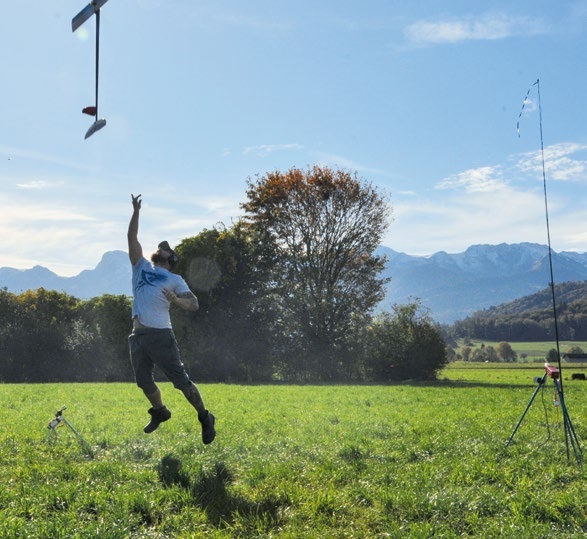
On Saturday, all four categories had to start at the same time. This required two separate starting areas for the two groups. The timekeepers, who had originally been scheduled over two days, all had to be on duty on Saturday. The organizing committee had their hands full getting all the arrangements ready for Saturday. The disciplined and cooperative behavior of the participants made the organizing committee’s job easier.
In return, the flying conditions on Saturday were ideal, allowing for five rounds in all four categories. During Föhn conditions, visibility into the Alps is excellent. At the competition site, the wind was rather light, with a Föhn tendency toward the north—that is, out of the valley toward Bern.
The maximum score was awarded to those who met the specified times of 4 minutes (1st and 2nd runs) and 3 minutes (3rd through 5th runs) in all five runs.
Saturday’s results:
- F1A (gliders with high launch): 14 perfect scores out of 47 entrants
- F1B (gliders with rubber-powered engines): 12 perfect scores out of 24 entrants
- F1C (gliders with internal combustion engines): 3 perfect scores out of 8 competitors
- F1Q (gliders with electric motors): 8 perfect scores out of 16 entrants
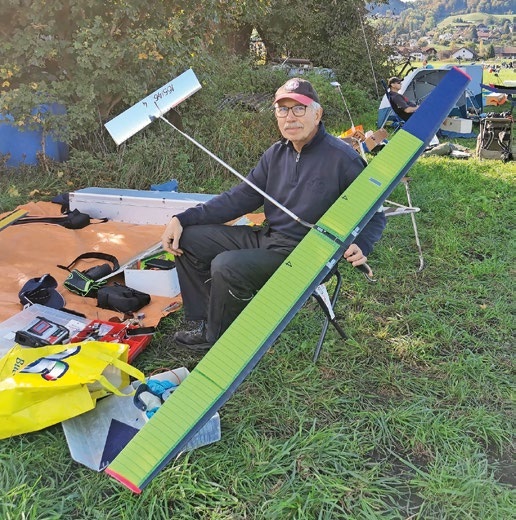
Since the evening in late October began early and the wind was picking up, the fly-off was scheduled for early Sunday morning. The fly-offs to determine the winners early Sunday morning had a maximum flight time of 10 minutes. Under stable conditions, the F1B/C and Q motorized glider categories took off first.
Finally, the high-launch gliders took to the air. They combine athleticism and high-tech in one. The fly-off was highly selective, with flights lasting up to about 10 minutes.
The winners:
F1A gliders with high launch:
- Dusan Fric (CZE): 568 seconds
- Dominik Andrist (CH): 538 seconds
- Lauri Malila (CH): 534 seconds
Juniors:
- Oscar Thevenon (F): 320 seconds
- Capucin Ragot (F): 25 seconds
- Madeline Ragot (F) – no fly-off
F1B gliders with rubber-powered engines:
- Stepan Stefanchuk (UKR): 488 seconds
- Michael Seifert (D): 486 seconds
- Hubert Pietzko (D): 436 seconds
Juniors – no one in the fly-off:
- Oleksii Kosylo (UKR)
- Dali Jacquemin (F)
- Louison Jacquemin (F)
F1C gliders with internal combustion engines:
- Dittmar Meissnest (D): 410 seconds
- Claus-Peter Wächtler (D): 369 seconds
- Tonu Luman (EE) – no tiebreaker
F1Q gliders with electric motors:
- Franco Gradi (I): 462 seconds
- Mihaly Varadi (HU): 450 seconds
- Imola Varadine Fodor (HU): 439 seconds
Juniors – no one in the fly-off:
- Lorant Buzas (HU)
- András Csaba Buzas (HU)
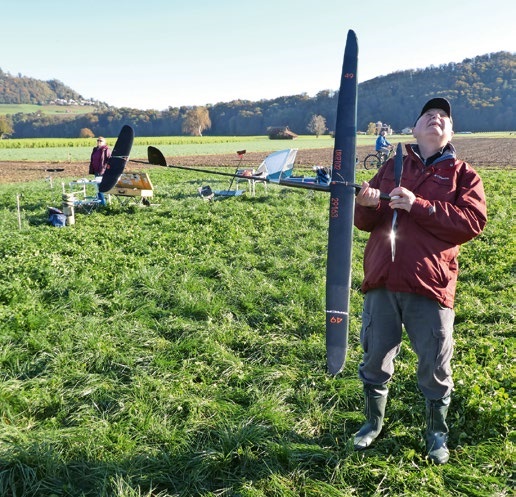
Flying conditions on Saturday were ideal. The wind was light and shifting. The wind conditions in the Gürbetal valley are quite unique. There was a very strong westerly wind at 1,000 meters above sea level all weekend. It’s always difficult to predict whether that wind will actually blow in the Gürbetal valley. We were certainly very lucky this weekend. Despite the excellent conditions, there were still a few bad flights here and there. As a result, the field of competitors in the fly-off was still wide open. Conditions were also superb on Sunday morning during the fly-off. They allowed for flights lasting up to about 10 minutes. It was perfect for F1A in particular. In all classes, the winners were the favorites—the same pilots who are leading the pack in this year’s overall World Cup standings.
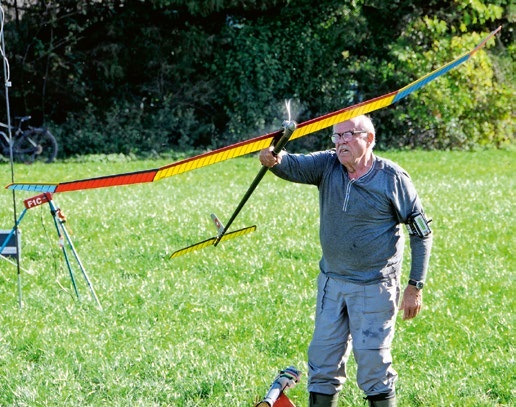
It became clear that the level of competition is very high in all classes. The models are built using the latest materials (carbon fiber). This results in high strength and allows the models to be cleared for flight with the maximum possible load. In all classes, the models are launched to an initial altitude of over 100 meters.
The technical level is very high due to the use of electronic timers. Without precise calibration of the individual flight phases, such launches would not be possible in any class. Appropriate training is essential to optimize the models’ settings. The models are primarily built from carbon fiber. Without this material, it is impossible to withstand the forces generated during launch. Building such models is therefore extremely labor-intensive.
In the F1C and F1B classes, the trend toward a standardized model continues. In F1C, “conventional” models—including flappers—no longer stand a chance against the folders, most of which are made by Babenko. In the F1B fly-off, all participants used the same 6-panel full-carbon model from Stefanchuk. The models were distinguishable to the timekeepers only by the LEDs flashing in different colors. Without these LEDs, the models would not have been visible at all against the dark backdrop of the forest. In F1A, the top spots were all won with full-carbon flappers. The F1Q models offer the most individuality; homemade models are still used in this class.
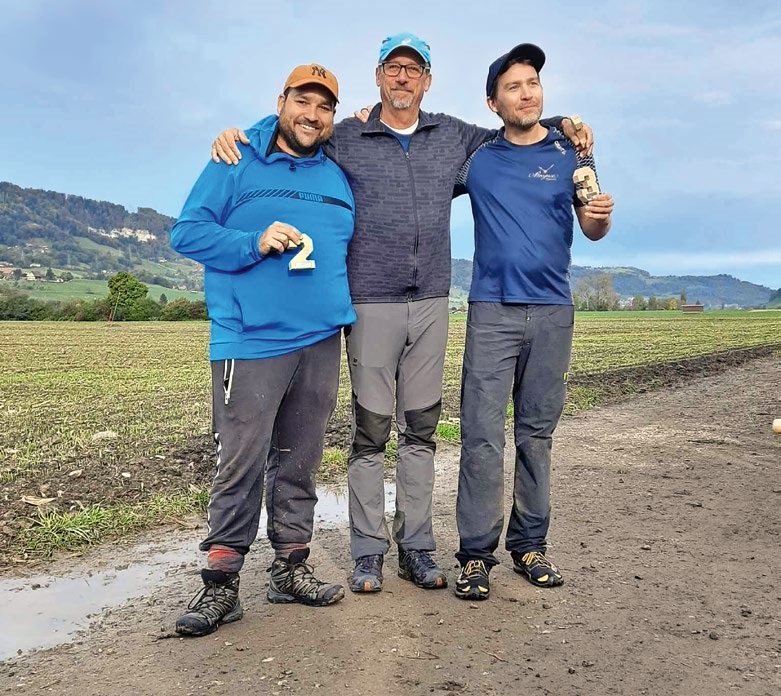
For the organizers, this was the first competition of this scale. Almost all participants provided positive feedback—despite the change in the launch site for the second round, which went off without a hitch. Many thanks to the participants. F1Q was flown at 2 joules. This was perfect and is the right solution for this class. The results were posted online promptly throughout the day. The fly-offs on Sunday morning proceeded in an organized manner and according to plan. It was a great show for everyone in attendance. Participants were required to bring their own reading devices for the altimeter check. This saved us a lot of time, and the results were finalized promptly. In Fly-offs A and B, almost exclusively full-carbon models were flown. The performance of these models is truly breathtaking—and almost too fast for the timekeeper.
Despite the need to focus on a single day, the competition proceeded smoothly and harmoniously thanks to the understanding and cooperative participants, who accepted and supported the competition organizers’ decisions—which were not always easy. Even an unexpected, immediate change in starting positions for the F1B/C/Q categories—due to a misunderstanding with a farmer that necessitated a lengthy interruption of the competition—was carried out swiftly and without protest. We benefited from the fact that the conditions after the interruption remained the same as at the start of the round, so those who started later were not at a disadvantage.
As a result of combining all categories into a single day, we naturally had to set up far more launch sites than originally planned. Among the numerous timekeepers, however, some were participating in a free-flight competition for the first time. Instead of being able to share a launch site with an experienced person as planned, they were thrown in at the deep end and had to fend for themselves. They performed their duties to everyone’s satisfaction. We would like to take this opportunity to thank them once again.
For the fly-off, pilots had to indicate in advance whether they also wanted an altimeter evaluation of their flight. Only F1A pilots took advantage of this option. In fact, the altimeter analysis of the eventual winner, Dusan Fric, showed a longer flight time than that recorded by the timekeepers, even though they were able to track the flight the entire time. This resulted in Dominik Andrist, who opted not to have an altimeter evaluation, being relegated to second place. In my view, the altimeter evaluation devalues the timekeepers’ work and ultimately renders them superfluous:
The participants were very impressed by the competition’s organization, the airfield, and the stunning view of the Alps on a Föhn day, and they hope the event will be held annually. The organizing committee has already spoken with the farmers who own the airfield. The feedback from the farmers and the local community has been positive, and they are in favor of holding another Gürbe Cup. The farmers and their approval to use the site are essential for the Gürbe World Cup. The support from sponsors in the Bern region and the many volunteers from the model aviation community was also gratifying.


News from HEBU

TEAM MANAGER "THIS" BOSSHARD
 Rodito Nussbaumer

SUMMER FUN 2026 AT MG USTER
Martin Wunderli
BY YOUTH, FOR YOUTH
Lorena Betschen
SMALL, MODEL-LIKE SAILBOATS
Res Dauwalder
TRY-OUT DAY AT MFV WETTINGEN
Urs Keller
What's New at Leomotion.com

52. 2026 ALPS CUP
 Emil Giezendanner

ATOM, THE NEW DOUBLE-DECKER FROM CPLR
 Matthias Bosshard

INSIGHTS INTO THE HISTORY OF SEAPLANES

YOU KNOW WHAT I MEAN? 125 YEARS OF THE SWISS AERO CLUB
Emil Giezendanner
34th HAHNENMOOS ALPINE MODEL AIRPLANE CAMP
Res Dauwalder
CORSAIR F4U – A WARBIRD WITH A MEMORABLE LOOK
Jürgen Rosenberger, Jürgen Prinz
F3A EUROPEAN CHAMPIONSHIPS IN ST-MACAIRE, FRANCE
Matthias Bosshard
HORIZON HOBBY/LEMACO NEWS: MICRO OV-10 BRONCO 645 MM BY E-FLITE

PRIDE AND GOOD IDEAS
 Markus Nussbaumer

EURO CONTEST GLIDER ACRO TOUR AUSTRIA 2026

FREE FLIGHT IN THE MIDDLE OF SUMMER
Urs Muntwyler
THE PC-21 STORY
Emil Giezendanner
TWIN TOWN PARTNERSHIP
Wolfgang Voeller
WELCOME, NEW MEMBER!
Andrea Bolliger
COUPE DES ALPES – OBSERVE AND LEARN
Rodito Nussbaumer
NEWS FROM HEBU
 Julia Bucher

FROM 0 TO 100
Markus Nussbaumer
MEMORIES
Wolfgang Völler
NOS REGION – A HUB FOR ELECTRIC AVIATION
Emil Giezendanner
Have you almost forgotten about aircraft that take off and land vertically?
Emil Giezendanner
70 YEARS OF THE NIDWALDEN MODEL AIRPLANE CLUB
Martin Barmettler