
The Man with the Flying Boxes
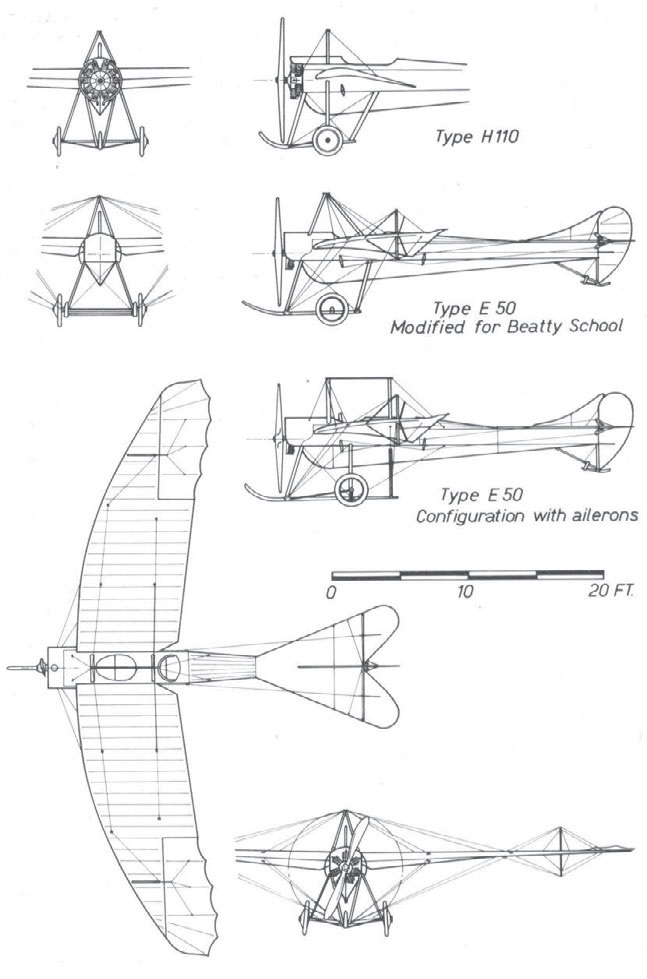
So there I am, completely unaware, at the MG Buttikon model airfield, and there’s Rainer Mattle assembling a brand-new vintage model with a historical background. “It’s a Handley Page Type E 1911,” Rainer explains to me.
Markus: Where did you get the plans for the Handley Page? How did you go about this project?
Rainer: You can find lots of authentic details and drawings of these old planes online. (e.g., www.flying.machines.ru)
Markus: How did you decide on this 1:3.5 scale for the Handley Page?
Rainer: I prefer large models because the flight characteristics and appearance simply stand out better compared to the original. Of course, the engine was also a deciding factor in the size.
Markus: The model is powered by a Valach 60-cc 4-stroke engine. Why did you choose this engine?
Rainer: It comes very close to the original in terms of sound and performance.
Markus: What materials did you use? Is there anything in particular worth mentioning?
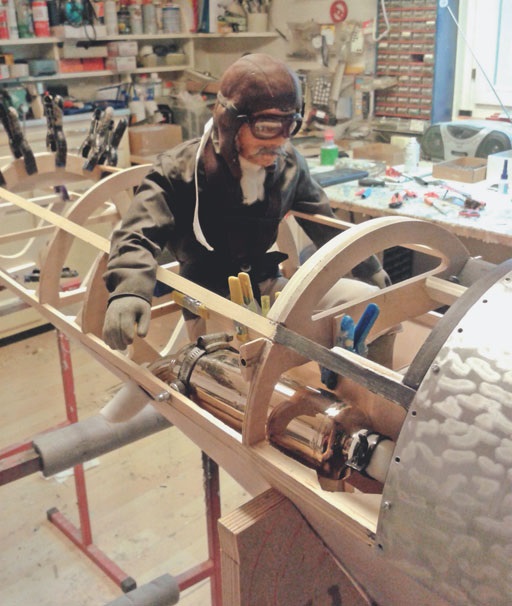
Rainer: Balsa, spruce, plywood, aluminum, and Solar Tex covering; the elevator and wings are removable. The pilot figure is movable and has two functions. The goal is always to build as lightly as possible.
Markus: How many servos are installed? What are their functions?
Rainer: A total of nine Hitec HV 7.4-volt servos with 10 kg of thrust.
Markus: Is there anything special to say about the landing gear?
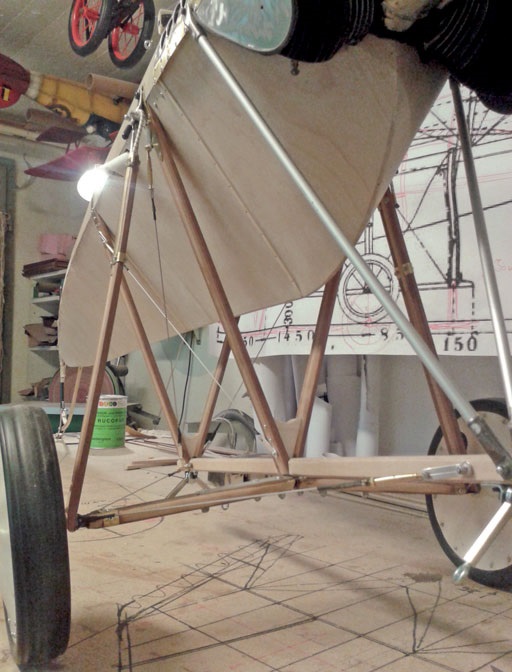
Rainer: The landing gear was precisely replicated based on original photos. In practice, however, it didn’t work well because it caused a building sway during taxiing. Consequently, just like on the original, it was replaced with a two-skid landing gear after the first few flights.
Markus: What were the biggest challenges with this model? How would you describe this vintage plane’s flight characteristics? Is it generally easy to fly, or does it act up?
Rainer: The model flies very smoothly, with absolutely no problems—it even handles simple aerobatics. By the way, back then, the aviation pioneers (pilots) also performed simple aerobatic maneuvers with planes like this. They were real “daredevils” back then, admired by the general public.
Markus: You sell your model airplanes when someone is interested in them. Don’t you have a problem parting with such a unique model?
Rainer: Basically, I have no problem giving away model airplanes like this. I’m actually happy when someone is delighted to take one of my model airplanes off my hands. To—
I’d quickly run out of space, since I build relatively large and complex models. What appeals to me most is planning and building these kinds of projects. Once they’re flying, I’m soon on the lookout for a new project.
Markus: So, do you always finish one project before moving on to a new one?
Rainer: No, no, I always work on several projects at the same time. Sometimes I get a commission in between to restore a model airplane or even build a new one from scratch, so I put my own plans on hold for a bit.
Markus: So that means there will be new airplanes of yours to admire again this spring?
Rainer: Exactly—it’ll be exciting to see what’s in store!
Markus Nussbaumer
(according to Wikipedia)
Handley Page Limited was the first publicly traded aircraft manufacturer in Great Britain. The company, headquartered in Radlett, Hertfordshire, was founded in 1909 and dissolved in 1970 due to insolvency. It became known as a manufacturer of bombers and commercial aircraft.
Headquarters: Radlett, United Kingdom
Founder: Frederick Handley Page
Founded: June 17, 1909
Successor: Scottish Aviation
Dissolution: March 1970. The
Handley Page Type D or H.P.4 was a single-seat, single-engine tractor monoplane, the first Handley Page design to fly for more than a few short flights.
Only one was built.


News from HEBU

TEAM MANAGER "THIS" BOSSHARD
 Rodito Nussbaumer

YOU KNOW WHAT I MEAN? 125 YEARS OF THE SWISS AERO CLUB
 Emil Giezendanner

F3A EUROPEAN CHAMPIONSHIPS IN ST-MACAIRE, FRANCE
 Matthias Bosshard

PRIDE AND GOOD IDEAS
 Markus Nussbaumer

ATOM, THE NEW DOUBLE-DECKER FROM CPLR
Matthias Bosshard
SUMMER FUN 2026 AT MG USTER
Martin Wunderli
52. 2026 ALPS CUP
Emil Giezendanner
HORIZON HOBBY/LEMACO NEWS: MICRO OV-10 BRONCO 645 MM BY E-FLITE

TWIN TOWN PARTNERSHIP
Wolfgang Voeller
CORSAIR F4U – A WARBIRD WITH A MEMORABLE LOOK
Jürgen Rosenberger, Jürgen Prinz
SMALL, MODEL-LIKE SAILBOATS
Res Dauwalder
TRY-OUT DAY AT MFV WETTINGEN
Urs Keller
WELCOME, NEW MEMBER!
Andrea Bolliger
COUPE DES ALPES – OBSERVE AND LEARN
Rodito Nussbaumer
EURO CONTEST GLIDER ACRO TOUR AUSTRIA 2026

BY YOUTH, FOR YOUTH
Lorena Betschen
INSIGHTS INTO THE HISTORY OF SEAPLANES

34th HAHNENMOOS ALPINE MODEL AIRPLANE CAMP
Res Dauwalder
What's New at Leomotion.com

FREE FLIGHT IN THE MIDDLE OF SUMMER
Urs Muntwyler
THE PC-21 STORY
Emil Giezendanner
NEWS FROM HEBU
 Julia Bucher

FROM 0 TO 100
Markus Nussbaumer
MEMORIES
Wolfgang Völler
NOS REGION – A HUB FOR ELECTRIC AVIATION
Emil Giezendanner
DO YOU KNOW WHAT I MEAN IN THE LAND OF SMILES?
Emil Giezendanner
Have you almost forgotten about aircraft that take off and land vertically?
Emil Giezendanner