
Innovation: Helicopter prototype with counter-rotating rotors / Robbe autopilot / Four-stroke gasoline engines
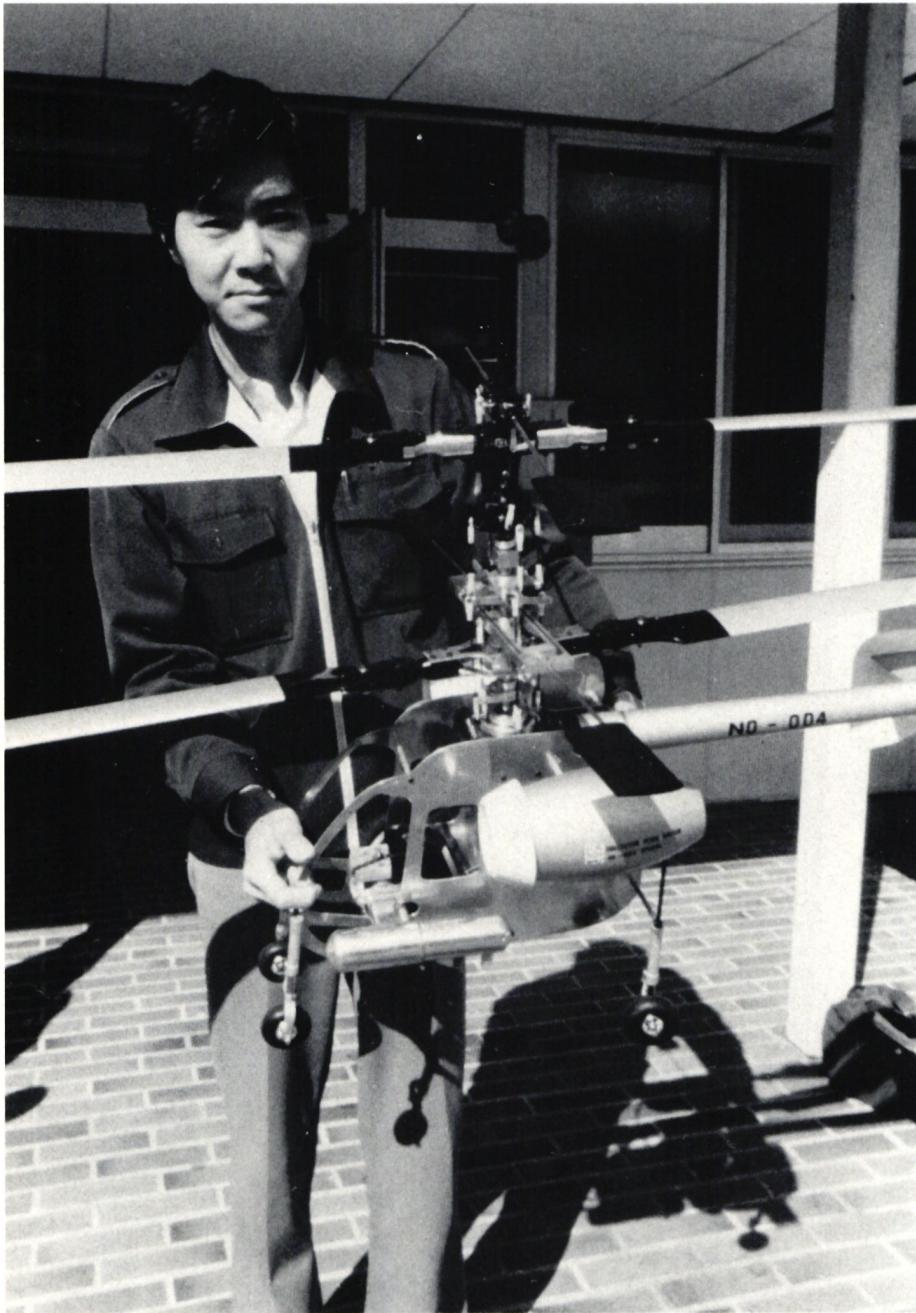
Takashi Hirata, technical director of the company “Kalt,” proudly presents his latest design: a model helicopter with two counter-rotating rotors. According to him, the prototype exhibits excellent flight characteristics; its stability is almost sensational, and no other model helicopter is as easy to control, since there are no torque-related issues. It is still unclear when the model will be released, as there is still a considerable amount of development work to be done before it is ready for mass production.
Above: “Kalt”—prototype of a model helicopter with counter-rotating rotors.
An autopilot from Robbe has been available for about half a year. Its core component is a gyroscope powered by a small electric motor. The movements are “sensed” without physical contact, which explains how it works so precisely. I’ve been a competitive pilot for several years and initially thought it should work just as well without a gyroscope. At a competition in Belgium, Paul Ingold and I were almost the only ones without an autopilot. There’s almost always strong wind in Belgium, and we had a hard time flying clean nose and tail circles. So I decided to buy one of these gyros. After reading the instructions, I installed the gyro in the Star-Ranger. I set the efficiency to 70%, switchable to 30%.
Even the first flight was amazing. The tail was absolutely steady. Now I had to get used to the new control scheme. There’s no more counter-steering or, for example, blocking off during a pirouette. During a turn, I simply tapped the control slightly as usual at the top of the turn; the helicopter now descended sideways and turned only slowly into the direction of flight. Now, for this maneuver, I have to control the tail rotor until the model’s nose is pointing down, then let go, and the autopilot maintains the new flight path.
For flight maneuvers, I set the sensitivity to 30%; for hovering maneuvers, to 70%. It’s best to assign this switch to a separate control channel. If the helicopter responds too weakly to tail rotor deflections, you can slightly increase the tail rotor deflection.
The Robbe gyro comes with a good instruction manual that explains everything about installation, operation, and setup. At first, I recommend setting the sensitivity to no more than 50%; this provides a good balance between automatic stabilization and controllability. Once you’ve gained a bit more practice, you can experiment with varying levels of gyro sensitivity. I’ve already used the Robbe gyro at the Swiss Championship and during several friendly fly-ins, and I’m very satisfied with it. I power it using the Emplänger 1200 mA battery. Anyone who flies more than about five flights without recharging would be wise to ensure the gyro is powered by the auxiliary battery. If that battery runs out, you won’t crash—the gyro will simply stop working.
I’m happy to answer any questions from those interested. Here’s my address:
Rudolf Linder
Eyfeldweg 1, 3400 Burgdorf
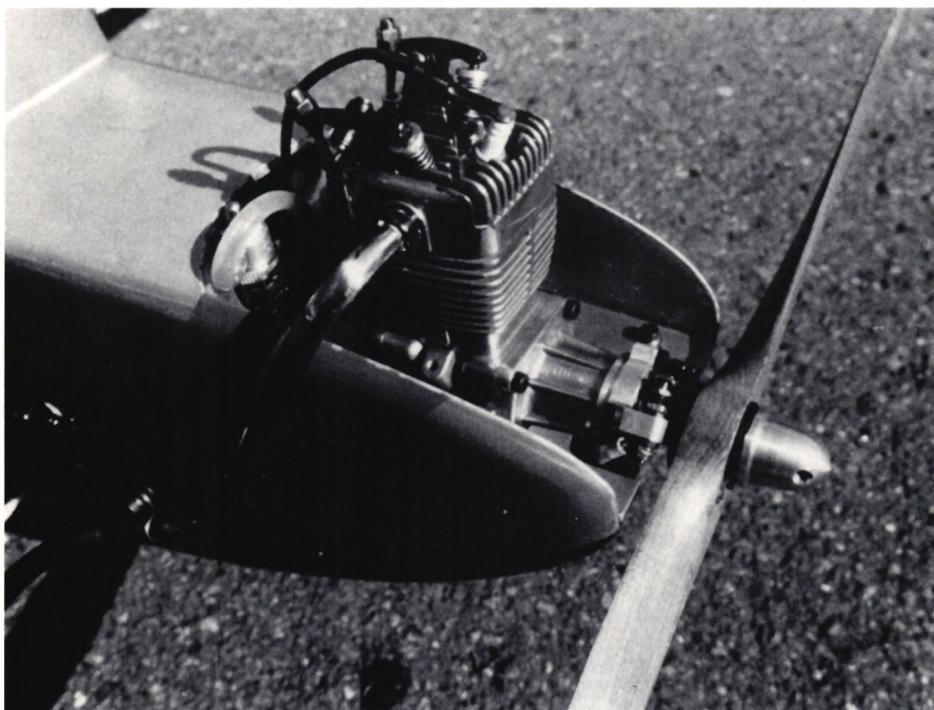
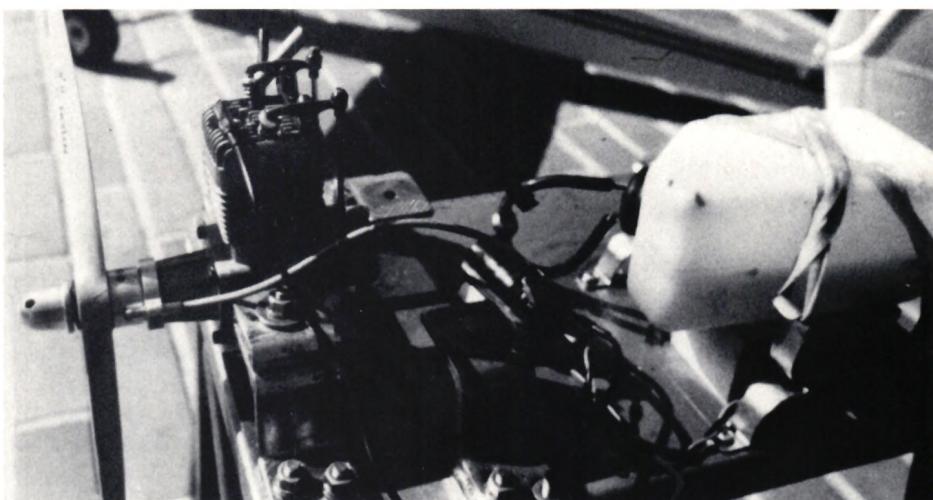
sll. The Japanese company “Kalt” sees the future of model internal combustion engines in four-stroke gasoline-powered engines. Our photos from the “Kalt” development workshop in Gotenba, at the foot of Mount Fuji, show an “OS-Gemini” boxer engine converted to gasoline operation, a modified “Kalt FC-1” (7.5 cc) with a mechanical ignition contact (behind the propeller), and—on the test stand—the same engine with a contactless ignition system. Tests with the latest version show that its performance is roughly the same as that of the glow plug version, but it can fly about three times as long on the same amount of fuel. Now that very good mini spark plugs have been developed in collaboration with NRC, nothing stands in the way of mass production of this small four-stroke gasoline engine. The engine is expected to hit the market in mid-1982.


TEAM MANAGER "THIS" BOSSHARD
 Rodito Nussbaumer

YOU KNOW WHAT I MEAN? 125 YEARS OF THE SWISS AERO CLUB
 Emil Giezendanner

F3A EUROPEAN CHAMPIONSHIPS IN ST-MACAIRE, FRANCE
 Matthias Bosshard

News from HEBU

SUMMER FUN 2026 AT MG USTER
Martin Wunderli
TRY-OUT DAY AT MFV WETTINGEN
Urs Keller
52. 2026 ALPS CUP
Emil Giezendanner
BY YOUTH, FOR YOUTH
Lorena Betschen
ATOM, THE NEW DOUBLE-DECKER FROM CPLR
Matthias Bosshard
CORSAIR F4U – A WARBIRD WITH A MEMORABLE LOOK
Jürgen Rosenberger, Jürgen Prinz
SMALL, MODEL-LIKE SAILBOATS
Res Dauwalder
What's New at Leomotion.com

TWIN TOWN PARTNERSHIP
Wolfgang Voeller
EURO CONTEST GLIDER ACRO TOUR AUSTRIA 2026

INSIGHTS INTO THE HISTORY OF SEAPLANES

34th HAHNENMOOS ALPINE MODEL AIRPLANE CAMP
Res Dauwalder
HORIZON HOBBY/LEMACO NEWS: MICRO OV-10 BRONCO 645 MM BY E-FLITE

COUPE DES ALPES – OBSERVE AND LEARN
Rodito Nussbaumer
PRIDE AND GOOD IDEAS
 Markus Nussbaumer

FREE FLIGHT IN THE MIDDLE OF SUMMER
Urs Muntwyler
THE PC-21 STORY
Emil Giezendanner
WELCOME, NEW MEMBER!
Andrea Bolliger
NEWS FROM HEBU
 Julia Bucher

FROM 0 TO 100
Markus Nussbaumer
MEMORIES
Wolfgang Völler
NOS REGION – A HUB FOR ELECTRIC AVIATION
Emil Giezendanner
Have you almost forgotten about aircraft that take off and land vertically?
Emil Giezendanner
70 YEARS OF THE NIDWALDEN MODEL AIRPLANE CLUB
Martin Barmettler