
All the way back to ancient times
Hardly anyone gives it a second thought these days when launching a model airplane and steering it through the air—mostly by remote control. Countless model airplanes are available today, some of which are ready to fly right out of the box. Unfortunately, the fun of building them is usually put on the back burner. The motto is often: buy it today, fly it today or tomorrow.
Model aircraft actually form the basis of aeronautical engineering. Yet model aircraft are by no means a modern invention. The first—unsuccessful—attempts are said to have taken place as early as antiquity, as well as in the late Middle Ages. Leonardo da Vinci (1452–1519) conducted studies on flight, drawing inspiration from the flight of birds. But it was not until the 19th century that systematic aerodynamic research yielded the first successes.
Sir George Cayley (1773–1857) of England, after numerous experiments, established the basic structure of an aircraft (fuselage, wings, tail, landing gear). He also recognized the relationship between airflow and the curvature of surfaces, which is essential for lift. The discovery of the stability moments on the elevator and rudder is also attributed to him. As early as about 1804, he built a glider to study the center of gravity.
Based on Cayley’s scientific findings, the Englishmen William S. Henson and John F. Stringfellow built a steam-powered model in 1842, but it was not successful. Stringfellow (1799–1883), however, consistently pursued the concept and achieved success around 1848 with a flying model with a wingspan of three meters. Propulsion was provided by a steam engine with two propellers. It flew a distance of about 30 meters.
In 1891, L. Hargrave (1850–1915) successfully flew a steam-powered model in Australia, covering a distance of approximately 73 meters. In the United States, Samuel P. Langley (1834–1906) experimented with steam-powered models, but also, as early as the beginning of the 20th century, successfully tested a 5-cylinder gasoline radial engine for the first time.
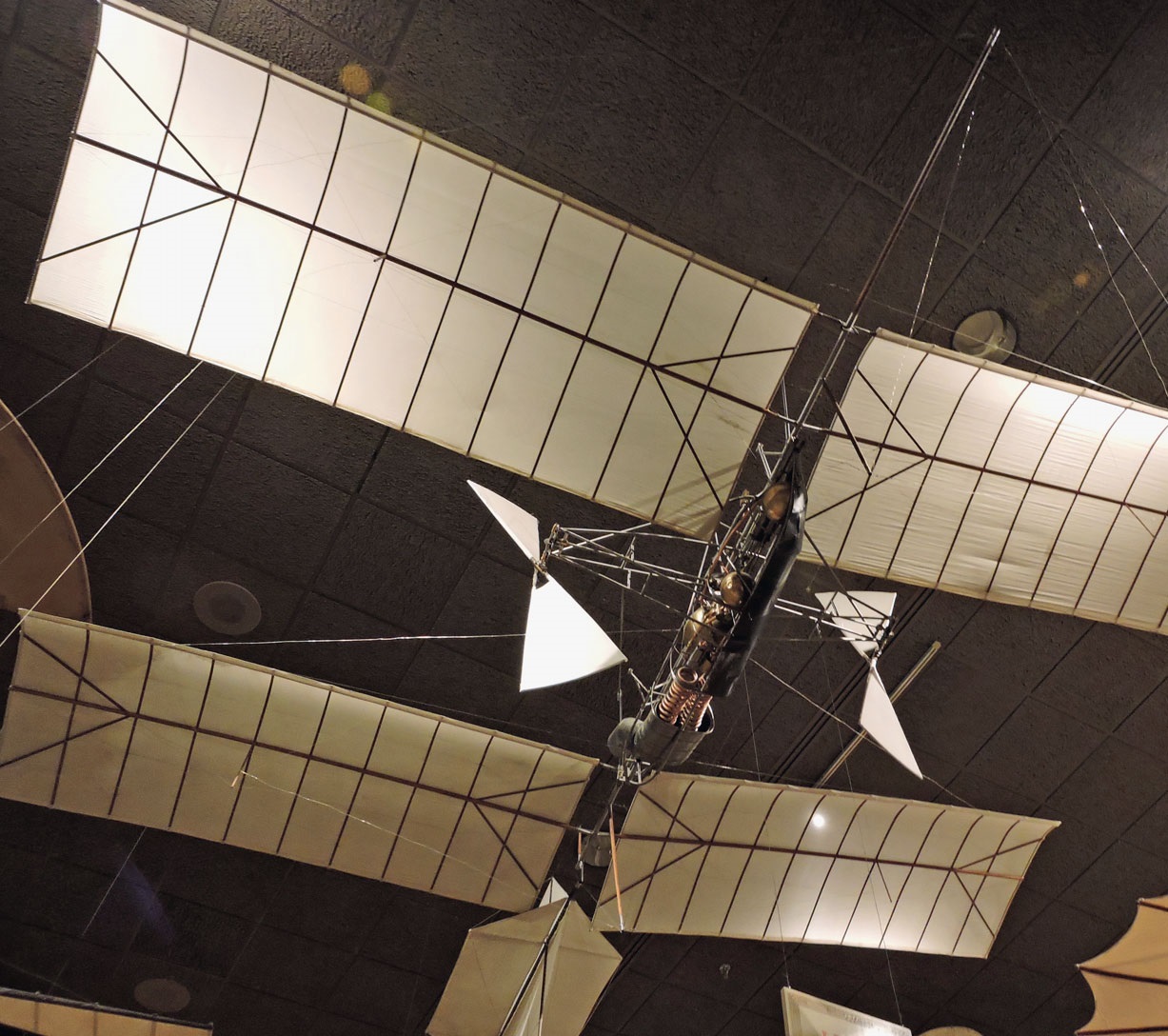
A new propulsion concept was also developed in France: the twisted rubber motor. Alphonse Pénaud (1850–1880) of France built not only free-flight models but also, in 1871, the “Planophore,” powered by twisted rubber cords and a pusher propeller. For the first time, the model featured a stabilizing tail unit and a defined angle of attack. The wings were curved and slightly bent upward at the tips for stabilization purposes. Pénaud’s research had a significant impact on model aircraft design and laid the foundation for further developments. Also in France, Felix du Temple (1823–1890) worked on spring-driven and steam-powered propulsion systems and successfully flew his designs as well. He even filed a patent application for his model. →
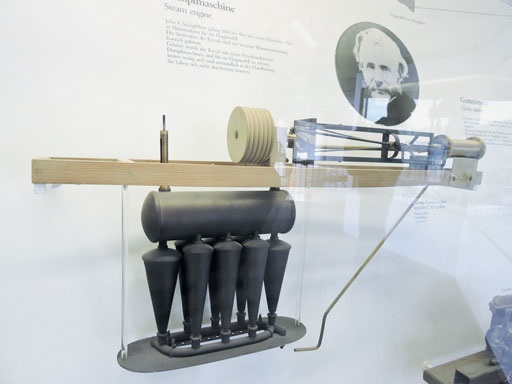
Other types of propulsion were added, namely compressed-air and carbon dioxide propulsion. In addition to Hargrave, M. V. Tatin (1843–1913) also worked on compressed-air engines. The fuselage served as a pressure vessel. Carbon dioxide (CO₂) propulsion systems were successfully used by the German Josef Hofmann beginning in 1897. In Austria, too, the development of model airplanes was significantly influenced by Wilhelm Kress (1846–1913). His collaboration with Alphonse Pénaud had a positive impact on his designs. His free-flying models were very successful, in contrast to his manned motorized aircraft on floats. After the turn of the century, model aviation developed rapidly, particularly following the Wright brothers’ first powered successes. Aircraft designers such as Hans Grade (1879–1946), Alexander Lippisch (1894–1976), and Igo Etrich (1879–1967) designed model airplanes in order to apply the knowledge gained from them to the construction of full-scale aircraft.
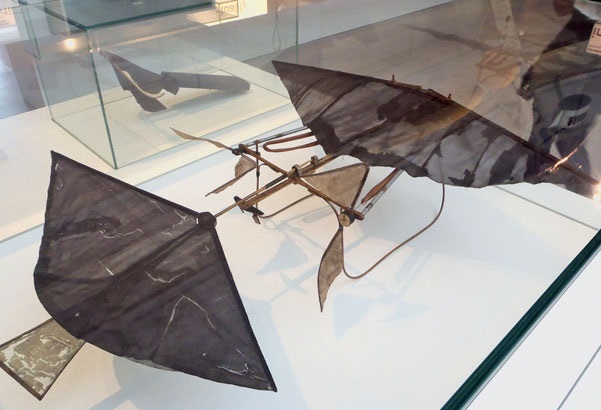
World War I certainly hindered further developments in model aviation for several years. During the interwar period and the Nazi era, model aviation regained its prominence. Systematic, state-directed model building was intended to produce aircraft builders and pilots. After World War II, flying was banned; however, following initial relaxations of the restrictions and starting in 1955, model aviation could once again be practiced without restrictions in Austria. Pioneers such as Oscar Czepa, Gerd Kirchert, Josef Sperl, Rudolf Salzmann, Johann Niederwimmer, and Fred Militky at Graupner shaped model aviation with their designs and dedication. It should also be noted that rubber-powered Wakefield models and CO2-powered models are still used today in free flight in the corresponding international classes. For about three years now, the Austrian Aviation Museum in Graz-Thalerhof (*www.luftfahrtmuseum.at*) has featured a vivid exhibition of model aircraft from the disciplines of free flight, RC flight, and tethered flight, as well as model engines dating from around 1940 and radio control systems from around 1960. It is certainly worth delving into the world of model aviation, as model aircraft laid the foundation for the large manned aircraft, examples of which can be viewed at the Austrian Aviation Museum.
This report is an attempt to provide a—certainly not exhaustive—overview of the early days of model aviation up through the post-World War II era.


TEAM MANAGER "THIS" BOSSHARD
 Rodito Nussbaumer

SUMMER FUN 2026 AT MG USTER
Martin Wunderli
52. 2026 ALPS CUP
 Emil Giezendanner

ATOM, THE NEW DOUBLE-DECKER FROM CPLR
 Matthias Bosshard

INSIGHTS INTO THE HISTORY OF SEAPLANES

34th HAHNENMOOS ALPINE MODEL AIRPLANE CAMP
Res Dauwalder
CORSAIR F4U – A WARBIRD WITH A MEMORABLE LOOK
Jürgen Rosenberger, Jürgen Prinz
SMALL, MODEL-LIKE SAILBOATS
Res Dauwalder
F3A EUROPEAN CHAMPIONSHIPS IN ST-MACAIRE, FRANCE
Matthias Bosshard
What's New at Leomotion.com

HORIZON HOBBY/LEMACO NEWS: MICRO OV-10 BRONCO 645 MM BY E-FLITE

PRIDE AND GOOD IDEAS
 Markus Nussbaumer

News from HEBU

BY YOUTH, FOR YOUTH
Lorena Betschen
YOU KNOW WHAT I MEAN? 125 YEARS OF THE SWISS AERO CLUB
Emil Giezendanner
TRY-OUT DAY AT MFV WETTINGEN
Urs Keller
FREE FLIGHT IN THE MIDDLE OF SUMMER
Urs Muntwyler
THE PC-21 STORY
Emil Giezendanner
TWIN TOWN PARTNERSHIP
Wolfgang Voeller
EURO CONTEST GLIDER ACRO TOUR AUSTRIA 2026

WELCOME, NEW MEMBER!
Andrea Bolliger
COUPE DES ALPES – OBSERVE AND LEARN
Rodito Nussbaumer
NEWS FROM HEBU
 Julia Bucher

FROM 0 TO 100
Markus Nussbaumer
NOS REGION – A HUB FOR ELECTRIC AVIATION
Emil Giezendanner
MEMORIES
Wolfgang Völler
Have you almost forgotten about aircraft that take off and land vertically?
Emil Giezendanner
70 YEARS OF THE NIDWALDEN MODEL AIRPLANE CLUB
Martin Barmettler