
A minor incident—a major impact
How a Model Airplane Crash Led to a Criminal Case That Lasted Nearly Seven Years
Philip Bärtschi
The author of this article served as the defense attorney for the model airplane pilot involved and provides a brief account of the events surrounding these interminably long criminal proceedings.
On December 1, 2018, at 1:00 p.m., a model airplane crashed into the median barrier of an expressway. Despite all the necessary pre-flight checks, the aircraft became uncontrollable after takeoff, strayed out of the model airfield’s airspace, and fell uncontrollably to the ground—without posing any danger to others. No vehicle was struck. No vehicle had to swerve out of the way. No vehicle had to brake. In fact, no vehicle was even near the crash site at the time of the crash. The cause of the crash was a technical malfunction that the pilot was unable to detect. One would think that
the incident could therefore be closed. However, after the police arrived on the scene and helped recover the model airplane from the median of the expressway, an almost seven-year legal odyssey began.
Six months after the incident, the public prosecutor’s office surprised the model airplane pilot with a penalty order for negligent disruption of public traffic under Article 237 of the Penal Code—without ever having heard his side of the story first. He filed an objection to the penalty order. He had a calculated hope of being able to convince the public prosecutor’s office that he had done nothing wrong. Seven months later, he was summoned by the public prosecutor’s office. The result came a month later: an amended penalty order, which was forwarded directly to the criminal court. The fact that public transportation had not been disrupted
in any way and that the pilot had fulfilled his duty of care did little to impress the public prosecutor’s office.
After another five years of waiting, the court hearing finally took place. A key issue in the trial was the following allegation by the prosecution: “As a pilot,
you are personally responsible for the safe operation of your aircraft. Technical malfunctions must be anticipated at all times; therefore, to avoid any potential legal violations, you must not fly over settlements, people, or roads.”
This rather stubborn view of the prosecution naturally proved untenable in court as well, as did the allegation that other road users had allegedly been endangered. After six and a half years, the pilot was finally acquitted.
The following points are important:
- As soon as the police become involved in a model aircraft accident, they will report it to the public prosecutor’s office. The risk of criminal proceedings is therefore significant. If people have been injured or killed, criminal proceedings are even inevitable.
- The offense of “disruption of public transportation,” which is typically applied to such incidents, is a misdemeanor and not merely a minor offense. Such offenses are entered into the criminal record. The same applies, of course, to negligent bodily injury and negligent homicide.
- Statements made to the police can be used against the pilot in such criminal proceedings. It may therefore be advisable to consult with an attorney before
- with a lawyer. In most cases, those being questioned hope to de-escalate the situation and foster understanding through self-critical assessments and admissions. Unfortunately, however, this is usually not the case.
- Legal protection insurance can cover the costs of a defense attorney in the event of criminal proceedings and is therefore recommended, as is, of course, the mandatory liability insurance for model aircraft pilots. The Swiss Model Aircraft Association (SMV) offers appropriate legal protection insurance products for model aircraft pilots. It is therefore advisable to contact the SMV.
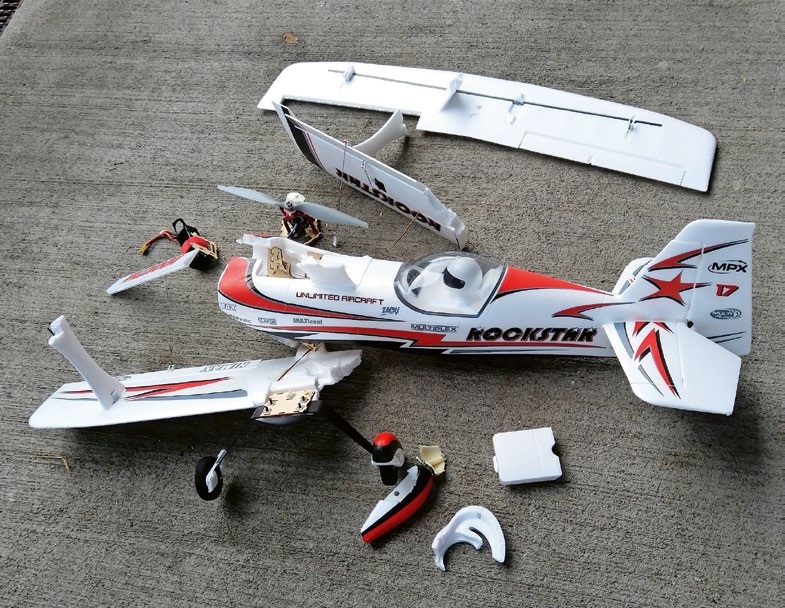
Fortunately, serious accidents involving model airplanes are relatively rare. However, the case described here shows that an incident—especially one involving third parties—can result in lengthy legal proceedings. Thorough
pre-flight checks can reduce this risk to manageable levels, but cannot eliminate it entirely.
Philip Bärtschi is an
attorney specializing in aviation law, a member of the board of directors, and the volunteer head of the Legal Department of the Swiss Aero Club. As the holder of a private pilot’s license, he has been handling cases—including aviation accidents involving both manned and unmanned aircraft—at his Lucerne law firm for 18 years
. ■


News from HEBU

TEAM MANAGER "THIS" BOSSHARD
 Rodito Nussbaumer

SUMMER FUN 2026 AT MG USTER
Martin Wunderli
BY YOUTH, FOR YOUTH
Lorena Betschen
SMALL, MODEL-LIKE SAILBOATS
Res Dauwalder
TRY-OUT DAY AT MFV WETTINGEN
Urs Keller
What's New at Leomotion.com

52. 2026 ALPS CUP
 Emil Giezendanner

ATOM, THE NEW DOUBLE-DECKER FROM CPLR
 Matthias Bosshard

INSIGHTS INTO THE HISTORY OF SEAPLANES

YOU KNOW WHAT I MEAN? 125 YEARS OF THE SWISS AERO CLUB
Emil Giezendanner
34th HAHNENMOOS ALPINE MODEL AIRPLANE CAMP
Res Dauwalder
CORSAIR F4U – A WARBIRD WITH A MEMORABLE LOOK
Jürgen Rosenberger, Jürgen Prinz
F3A EUROPEAN CHAMPIONSHIPS IN ST-MACAIRE, FRANCE
Matthias Bosshard
HORIZON HOBBY/LEMACO NEWS: MICRO OV-10 BRONCO 645 MM BY E-FLITE

PRIDE AND GOOD IDEAS
 Markus Nussbaumer

EURO CONTEST GLIDER ACRO TOUR AUSTRIA 2026

FREE FLIGHT IN THE MIDDLE OF SUMMER
Urs Muntwyler
THE PC-21 STORY
Emil Giezendanner
TWIN TOWN PARTNERSHIP
Wolfgang Voeller
WELCOME, NEW MEMBER!
Andrea Bolliger
COUPE DES ALPES – OBSERVE AND LEARN
Rodito Nussbaumer
NEWS FROM HEBU
 Julia Bucher

FROM 0 TO 100
Markus Nussbaumer
MEMORIES
Wolfgang Völler
NOS REGION – A HUB FOR ELECTRIC AVIATION
Emil Giezendanner
Have you almost forgotten about aircraft that take off and land vertically?
Emil Giezendanner
70 YEARS OF THE NIDWALDEN MODEL AIRPLANE CLUB
Martin Barmettler