
Safety at IG Warbird
IG Warbird is a club dedicated to building and flying historic military aircraft. Safety must be a top priority—not just at the annual meetings.
Building and flying scale models—which are often large—is a thrilling challenge. This makes it all the more important that these models be operated safely—whether at public events, the traditional IG Warbird meetings, air shows, or at one’s own model airfield—and that they pose no danger to themselves or bystanders. The Swiss Model Aviation Association’s “Safety First” safety compendium is, of course, a key pillar and the foundation of the briefings at IG Warbird meetings!
Even smaller models can cause serious injuries if operated improperly. This is all the more true for large Warbirds, whose engines drive propellers with diameters ranging from 60 cm to one meter. There’s no point in deluding oneself about what happens if a finger or an entire hand comes into contact with a fiberglass propeller that’s in operation—or even running at full throttle.
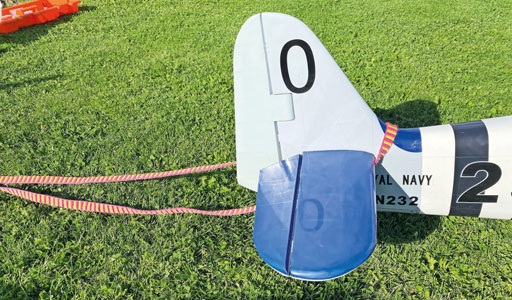
Therefore, whether at club events or at a meeting, the following rule applies: The model must always be secured when starting up! The best way to do this is with a sturdy rope that is firmly anchored to the ground. At a meeting
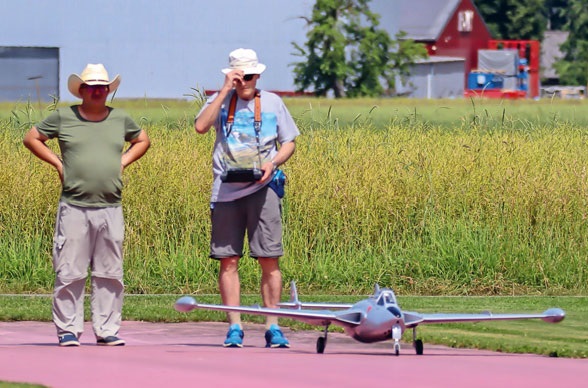
It’s often a fellow pilot who secures the model until the pilot gives the go-ahead. By the way, we also recommend that electric models have at least a basic safety feature for self-protection—such as a motor emergency shut-off switch.
At a flying event, pilots are never left alone at the front of the runway! This always works perfectly with our long-standing guest club, the Kulm Model Flying Club, which consistently provides proven flight directors for our “Sun and Fun” event in Kulm. At other events,
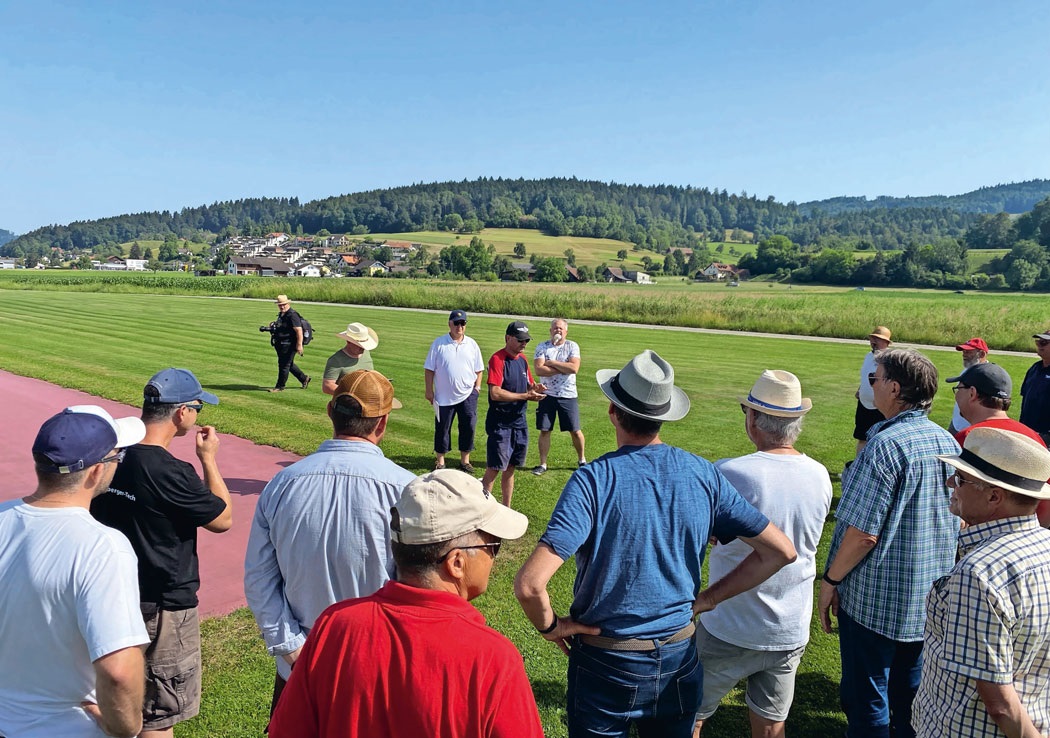
For example, in Schänis, this role is also filled by experienced members of the IG Warbird. The flight directors assist the pilot throughout the entire flight, alert him to critical airspace, inform him whether there are people near the runway, and confirm that the runway is safe and clear for the landing approach. At our meetings, the models are always lined up in a queue, and the engines are not started until shortly before takeoff clearance is given. This prevents a model from suddenly taxing out onto the runway while another model is on final approach.
It is also very important that the runway be either sufficiently far away from spectators and participants—as is the case, for example, at the fall meeting in Schänis—or, if not, that the runway edge be equipped with a safety net. Such nets are provided by the model flying regions.
One of the fascinations of flying warbirds is certainly “formation flying.” However, things can quickly get out of control here. I remember a meeting many years ago when suddenly six or seven medium-sized models were in the air at the same time, because every pilot wanted to quickly join in “spontaneously.” In the end, you had to concentrate very hard just to find your own model in that wild flock! While such spontaneous
While formation flying with lightweight foam models poses an acceptable risk, even medium-sized motorized models weighing between five and eight kilograms can pose a danger to bystanders. Formation flying should always be discussed in advance and agreed upon during a pre-flight briefing.
In principle, even two or three large models flown by experienced pilots can fly together spontaneously without issue. What’s important here is having an experienced flight director who keeps an eye on the overall situation at all times, as well as some basic knowledge of formation flying. For example, the models should never appear to overlap visually when turning, since it is impossible to judge from a distance how close the models are coming to each other. In addition, one pilot should always clearly call out which maneuvers are being flown.
The IG Warbird is a diverse group consisting of old, seasoned veterans as well as new pilots who haven’t yet gained much ex-
have experience with aircraft that aren’t always easy to take off or land. That makes it all the more important to sense when someone is feeling a little unsure and to support that pilot. Sometimes, however, a certain firmness is also needed. For example, there have been situations where someone seriously wanted to fly a new, large model for the first time right in the middle of a meeting—which, of course, we had to forbid. And sometimes even an experienced pilot needs to be made aware of risky behavior, which isn’t always easy. Ultimately, the goal is for us to be able to go home feeling good after a meeting or a flying day. ■
The SMV’s Safety Compendium can be found on the modellflug.ch website.
Report in French: https://www.modellflug.ch/FR/cont/19
Report in Italian: https://www.modellflug.ch/IT/cont/19


News from HEBU

TEAM MANAGER "THIS" BOSSHARD
 Rodito Nussbaumer

YOU KNOW WHAT I MEAN? 125 YEARS OF THE SWISS AERO CLUB
 Emil Giezendanner

F3A EUROPEAN CHAMPIONSHIPS IN ST-MACAIRE, FRANCE
 Matthias Bosshard

SUMMER FUN 2026 AT MG USTER
Martin Wunderli
TRY-OUT DAY AT MFV WETTINGEN
Urs Keller
52. 2026 ALPS CUP
Emil Giezendanner
BY YOUTH, FOR YOUTH
Lorena Betschen
ATOM, THE NEW DOUBLE-DECKER FROM CPLR
Matthias Bosshard
CORSAIR F4U – A WARBIRD WITH A MEMORABLE LOOK
Jürgen Rosenberger, Jürgen Prinz
SMALL, MODEL-LIKE SAILBOATS
Res Dauwalder
What's New at Leomotion.com

TWIN TOWN PARTNERSHIP
Wolfgang Voeller
EURO CONTEST GLIDER ACRO TOUR AUSTRIA 2026

INSIGHTS INTO THE HISTORY OF SEAPLANES

34th HAHNENMOOS ALPINE MODEL AIRPLANE CAMP
Res Dauwalder
WELCOME, NEW MEMBER!
Andrea Bolliger
HORIZON HOBBY/LEMACO NEWS: MICRO OV-10 BRONCO 645 MM BY E-FLITE

FREE FLIGHT IN THE MIDDLE OF SUMMER
Urs Muntwyler
COUPE DES ALPES – OBSERVE AND LEARN
Rodito Nussbaumer
PRIDE AND GOOD IDEAS
 Markus Nussbaumer

THE PC-21 STORY
Emil Giezendanner
NEWS FROM HEBU
 Julia Bucher

FROM 0 TO 100
Markus Nussbaumer
MEMORIES
Wolfgang Völler
NOS REGION – A HUB FOR ELECTRIC AVIATION
Emil Giezendanner
Have you almost forgotten about aircraft that take off and land vertically?
Emil Giezendanner
DO YOU KNOW WHAT I MEAN IN THE LAND OF SMILES?
Emil Giezendanner